Editor-reviewed
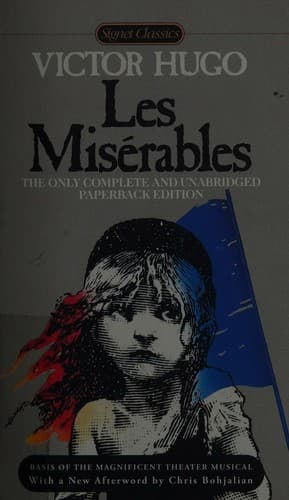
Les Misérables
Victor Hugo·1862·A. Lacroix, Verboeckhoven & Cie·Literature
Reading level: Ages 14+ (adult) · 55-hour read · Advanced difficulty.
- Reading time
- 55h
- Difficulty
- Advanced
- Recommended age
- Ages 14+
- Guide read
- 5min
- Editor's rating
- 4.8 / 5
- victor-hugo
- french-literature
- 19th-century
- justice
- poverty
- revolution
- long-reads
- adaptation
— In one sentence —
Hugo spent seventeen years on this novel. It is a political argument, a religious argument, a love story, and a chase across Paris. It is also one of the best plots ever constructed.
§ 01 · WHY READ
Why read
Victor Hugo began Les Misérables in 1845 and published it in 1862 — seventeen years during which he was also exiled from France for opposing Napoleon III, living first in Belgium, then Jersey, then Guernsey. He finished the novel in Guernsey in 1861, in a glass-enclosed writing room at the top of his house, standing at a high desk, looking at the sea. When the book was published, the first telegram from his publisher arrived with a single question mark: ? He replied with a single exclamation: !
The novel sold out immediately across Europe. The initial print run was gone in hours.
The premise everyone knows: Jean Valjean, a man imprisoned nineteen years for stealing bread, is paroled and cannot find work because of his criminal record. He steals from a bishop who then protects him from arrest and transforms his life. Inspector Javert, who believes that law and morality are identical, pursues him for decades. Valjean becomes a factory owner, then a mayor, takes in the orphan Cosette, and eventually finds himself on the barricades of the 1832 Paris student uprising.
What is less known: the digressions. Hugo interrupts his narrative for eighty pages on the Battle of Waterloo, thirty pages on the Paris sewer system, forty pages on the history of the Paris barricades. These are not mistakes or self-indulgences. Hugo was writing a comprehensive novel about France — about poverty, law, religion, revolution, and what it means for a society to be just — and the digressions are where he makes his explicit arguments. The plot, magnificent as it is, is the vehicle.
§ 02 · CHARACTERS
Characters
Jean Valjean — the novel's center. He begins as a man deformed by suffering and emerges, through the bishop's act of mercy, into a different kind of person. His trajectory is the novel's thesis about what grace does to a human being: it doesn't remove difficulty, it changes what the difficulty is for.
Javert — the antagonist, and one of literature's most interesting: a man of absolute integrity who is absolutely wrong about the relationship between law and justice. He is not cruel; he is principled in a way that produces cruelty. His crisis — when Valjean spares his life and his categories collapse — is the novel's most psychologically precise moment.
Fantine — Cosette's mother, who dies in the first third of the novel. Her arc — from factory worker to prostitute, destroyed by the indifference of the society around her — is Hugo's most direct argument about what poverty does, and what those with power are responsible for.
Cosette — Fantine's daughter, whom Valjean rescues from the Thénardiers. She grows up loved and somewhat sheltered, falls in love with Marius, and is the novel's image of what a person protected from suffering can become.
Marius Pontmercy — the idealistic young student who falls in love with Cosette and fights on the barricades. He is less interesting than Valjean or Javert; he is the novel's future, its promise that the next generation will carry something forward.
The Thénardiers — innkeepers who exploit and abuse everyone in their orbit. They are Hugo's comic-grotesque element: opportunistic, amoral, endlessly adaptable.
Éponine — the Thénardiers' daughter, who loves Marius and helps him find Cosette knowing she is helping him away from herself. She dies on the barricade in his arms. Her arc is the novel's most heartbreaking.
§ 03 · HIGHLIGHTS
Three highlights
No. 1 · The bishop's candlesticks. Valjean steals the bishop's silver; the police catch him and bring him back. The bishop tells the police that he gave Valjean the silver — and adds the candlesticks, which Valjean had not taken. He says Valjean is no longer a thief; he has bought Valjean's soul for God. The scene is the novel's origin point: every act of Valjean's subsequent life is a consequence of this one act of radical mercy.
No. 2 · Javert's crisis. Valjean spares Javert's life on the barricade. Javert, who has dedicated his existence to the pursuit of Valjean as the embodiment of lawless criminality, cannot integrate what has happened. The man he has defined as evil has shown him mercy. His categories — law equals morality, Valjean equals evil — do not accommodate this. The chapter describing Javert's attempt to reconcile the irreconcilable is one of the most precise psychological passages in 19th-century fiction.
No. 3 · The sewers. Valjean carries the wounded Marius through the Paris sewer system to safety. The sewer sections are also where Hugo makes his argument that the wealth of Paris is built on what it discards — that the city's glory and the city's waste are the same thing, recirculated. The digressions on the sewer system that preceded this scene are not irrelevant; they prepare the reader to understand what Valjean is moving through.
§ 04 · EDITIONS
Recommended editions
Translation is the central question.
| Translation | Why pick it |
|---|---|
| Julie Rose (Modern Library, 2008) | The most recent scholarly translation; contemporary prose without anachronism. Recommended for first-time readers. |
| Norman Denny (Penguin, 1976) | For decades the standard English translation; readable and authoritative. |
| Charles Wilbour (1862) | The first English translation, authorized by Hugo; Victorian prose. Read by millions but now dated. |
| Abridged editions | Avoid for a first reading; the digressions are part of Hugo's argument. |
| Audiobook (various) | The Recorded Books production (read by George Guidall) is the best-known; 60+ hours. |
The musical adaptation (Claude-Michel Schönberg, 1980; the 1987 Broadway production) is one of the great musical theatre achievements of the 20th century. See it after reading.
§ 05 · FIT
Who it's for / not for
Read this if you are…
- Willing to give a long novel the time it deserves: the digressions slow the plot but enrich the argument. Read one digression at a time if needed.
- Anyone interested in 19th-century French history, poverty, and the relationship between law and justice.
- Readers who know the musical and want to discover what Hugo actually wrote: the novel is darker, longer, funnier, and more politically explicit than the adaptation.
Skip it if you are…
- Not prepared for the digressions. Hugo will stop the Valjean narrative for sixty pages to describe Waterloo. If you cannot tolerate this, read an abridged version rather than skipping — but know you're reading a different book.
§ 06 · TIPS
Reading tips
- Don't skip the digressions. The Waterloo section, the sewer history, the Parisian slang chapter: they are Hugo's explicit arguments. The Waterloo section argues that history's outcomes are determined by accident. The sewer history is the political economy argument. Read them.
- Javert is not the villain. He is a man of absolute principle. The novel treats him with complete seriousness; his collapse is only comprehensible if you understand that he was right about everything except the thing that mattered.
- Éponine matters more than Cosette. Cosette is necessary for the plot; Éponine is necessary for the heart. Track her.
- The novel's Christianity is real. Hugo was not a conventional Christian, but his argument — that mercy, not law, is the foundation of justice — is a theological one. Valjean's transformation by the bishop is not metaphor; it is Hugo's statement about what grace means.
§ 07 · COMPARE
Read alongside
- Leo Tolstoy — War and Peace (1869). The Russian companion: another massive 19th-century novel that combines plot, history, and explicit philosophical argument. Published seven years after Les Misérables.
- Charles Dickens — Bleak House (1853). Dickens's parallel project: the English Victorian novel that argues against the legal system's distance from justice. More satirical, less epic; the comparison is productive.
- Dostoevsky — Crime and Punishment (1866). The Russian contemporary: a novel about law, guilt, punishment, and the possibility of regeneration. Published four years after Les Misérables; Dostoevsky read Hugo.
§ 08 · DISCUSSION
Discussion questions
- The bishop gives Valjean the candlesticks and tells him his soul has been bought for God. Is this credible as the origin of a life transformation? What makes it work in the novel?
- Javert believes law and morality are identical. When Valjean spares his life, this belief collapses. Is Javert's crisis tragic? Does the novel have sympathy for him?
- Fantine is destroyed by poverty and society's indifference. Hugo makes her destruction specific and procedural. What is he arguing about collective responsibility?
- Hugo interrupts the narrative for the Waterloo section. His argument is that Napoleon's defeat was determined by a single lucky break for the allies. How does this fit the novel's larger argument about history and contingency?
- The novel ends with Valjean dying alone, reconciled with Marius and Cosette. Is this a happy ending? Does Valjean get what he deserved? What did he deserve?
- The musical adaptation ends with "To love another person is to see the face of God." This is a synthesis of Hugo's themes rather than a direct quotation. Does it capture the novel's argument?
- Hugo was writing in 1862 about events of 1815–1832. How does the historical distance shape the novel? Is it a historical novel, or is it using historical events to make arguments about Hugo's present?
One line to remember
“To love another person is to see the face of God.”— Finale — Les Misérables (musical adaptation, from Hugo's text)
Appears in collections
Reading lists featuring this book
6 books
The Best Books About War and Its Cost
Six novels about what war actually does — not to nations, but to people.
Open list →
7 books
The Best Books for a Long Flight
Seven books substantial enough to disappear into for ten hours in a metal tube.
Open list →
6 books
Best Books Set in France
Six novels that use France as a country, not a postcard.
Open list →
10 books
Books That Earn Every Hour: Ten Essential Long Reads
Not long because they couldn't be shorter. Long because the size is the point.
Open list →
6 books
Most Immersive Books
Six books that require full surrender — and pay for it.
Open list →
You might also like
Read next
William Faulkner · 1936
Absalom, Absalom!
Four narrators reconstruct a man who destroyed his family. The story keeps changing. That is the point.
Read · 7 min
Toni Morrison · 1987
Beloved
Toni Morrison said she wrote this novel to give voice to the sixty million. It won the Pulitzer, the Nobel, and is the greatest American novel of the second half of the twentieth century.
Read · 6 min
Leo Tolstoy · 1878
Anna Karenina
Not just a love story. Two parallel lives — Anna's destruction, Levin's salvation — ask the same question: how should a person live?
Read · 6 min