Book list · Editor's pick·Fiction
Best Books Set in France
Six novels that use France as a country, not a postcard.
- Books
- 6
- france
- french-literature
- classic-fiction
- 19th-century
- social-novel
Updated 2026-05-24
— Why read this list —
The France of these books is not a destination. It is a society — provincial and metropolitan, clerical and revolutionary, mining-town and boulevard — and its texture is the substance of the books, not their setting.
What this list refuses
There is a kind of book set in France that is mainly about cheese, light, and the narrator's psychological recovery. We have nothing against those books and they are not on this list. The France of the books here is the country as the French actually wrote it — provincial, clerical, industrial, revolutionary, imperial — and the texture is in the social arrangements, not the scenery. You will not find descriptions of the lavender or the cafés where one might sip a coffee. You will find Verrières and Yonville, the Hôtel de la Mole and the boulevard theatres, the barricades of 1832 and the mining village of Montsou.
The other thing the list refuses is the consolation of treating France as exotic. These books were written by French novelists for French readers and they treat their country with the same critical attention an honest American novelist would bring to America. Stendhal is merciless about the post-Napoleonic establishment. Flaubert is merciless about the provincial bourgeoisie. Zola is merciless about both the Second Empire and the industrial system that paid for it. Voltaire is merciless about everyone. Hugo is the warmest of the group and the most outraged. The country that emerges across the six books is not a brand. It is a place.
How to read in order
The chronology is roughly the order above, and reading it in order gives a small course in the development of the French novel from the eighteenth-century philosophical tale through Stendhal's psychological realism, Flaubert's stylistic perfection, Hugo's encyclopedic romanticism, and Zola's naturalism. If you want one book that contains the most France, take Les Misérables. If you want one short book that gives you the sensibility, take Candide. If you want the book that has had the most influence on the modern novel as a form, take Madame Bovary. If you want to see what the country was actually built of, take Germinal.
The texture of place in these novels is mostly in the social detail — what people wear, what they eat, who they marry, what their work pays, what their priest expects — rather than in the landscape. That is the French novelistic tradition. It is also why these books still feel current. The arrangements have changed, but the kind of attention the novels pay to those arrangements is the kind of attention that does not date.
The 6 books
In publication order

Book 1·France as sensibility
Candide
Voltaire·1759
Start in the eighteenth century with the shortest and most acidic book on the list. Voltaire's France is the France of the Enlightenment as it actually felt to one of the Enlightenment's authors — an Enlightenment surrounded by war, earthquake, inquisition, and the absurdities of provincial nobility. The book moves through several countries, but the sensibility is entirely French, the prose is the model of the French satirical style, and the closing line about cultivating one's garden is the most quoted French sentence in world literature for a reason.

Book 2·France as social ladder
The Red and the Black
Stendhal·1830
Stendhal's Julien Sorel climbs from a provincial sawmill in Franche-Comté to the salons of Paris by reading the social system around him with the cold attention a chess player gives a board. The novel is the great record of post-Napoleonic France as a society in which the old aristocracy and the new clerical reaction were trying to absorb a generation of young men who had grown up believing that talent should decide everything. The texture of place is in the calculations: what one wears in Verrières versus what one wears in the Hôtel de la Mole.

Book 3·France as provincial weight
Madame Bovary
Gustave Flaubert·1857
Flaubert's Normandy is the inside of provincial France in the middle of the nineteenth century — small towns, second-rate doctors, debt, ennui, and the romantic fiction that the actual lives of the inhabitants cannot live up to. The book made Flaubert famous for the precision of its sentences and famous in court for what those sentences described. Read it for the texture of Yonville: the pharmacy, the priest, the bored wife, the rain on the windows, the slow accumulation of small purchases that add up to ruin.
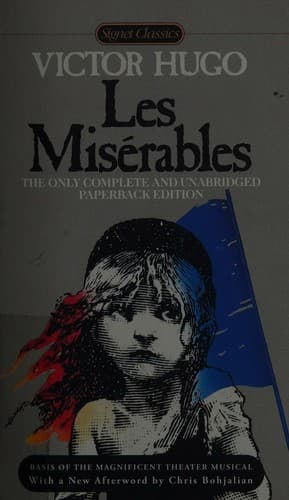
Book 4·France at full scale
Les Misérables
Victor Hugo·1862
The longest book on this list and the one that contains the most France — from the bishop's house in Digne to the Paris sewers, from the convent walls to the barricades of the 1832 June Rebellion. Hugo's commitment is to the country at full scale: he digresses for chapters on the battle of Waterloo, on the argot of the Paris underworld, on the construction of the sewers, because he believes a novel about France has to contain France. The texture is encyclopedic. The novel is also one of the great moral arguments of the century, but it is the texture that makes the argument carry.

Book 5·France as imperial spectacle
Nana
Émile Zola·1880
Zola's Paris during the Second Empire — the theatre on the boulevard, the racetrack at Longchamp, the supper rooms, the apartments paid for by bankers and ruined by them. Nana is a courtesan and the novel uses her career to anatomize the financial and sexual machinery that powered the city's surface glamour. The texture is the texture of imperial Paris at its most decadent moment, observed by a novelist who refused to be charmed by what he was describing.

Book 6·France underground
Germinal
Émile Zola·1885
Close the list with the France no tourist sees. Zola descends into the coal mines of the Nord and writes the conditions — the cages, the seams, the firedamp, the company store, the strike that begins in hunger and ends in dynamite — with the documentary patience of someone who went and looked. The novel is the great nineteenth-century account of industrial labor in any language, and its France is the one the boulevards and salons of the other books were built on top of. Read it last because it shows you what the country was actually made of.