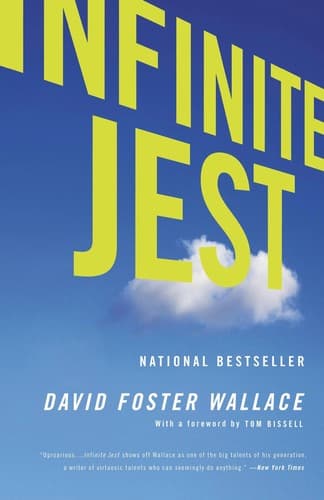
Editor-reviewed
Infinite Jest
David Foster Wallace·1996·Little, Brown·Literature
Reading level: Ages 18+ (adult) · 50-hour read · Advanced difficulty.
- Reading time
- 50h
- Difficulty
- Advanced
- Recommended age
- Ages 18+
- Guide read
- 6min
- Editor's rating
- 4.6 / 5
- david-foster-wallace
- american-literature
- postmodern
- addiction
- tennis
- entertainment
- endnotes
- long-reads
— In one sentence —
1,079 pages. 388 endnotes, some with their own footnotes. Set in a near-future North America where entertainment has become genuinely fatal. The most demanding novel in contemporary American literature, and one of the most rewarding.
§ 01 · WHY READ
Why read
David Foster Wallace finished Infinite Jest in 1994 and published it in 1996. He was thirty-four years old. The manuscript was enormous — the published book runs to 1,079 pages, with 388 endnotes, some of which have their own footnotes, and an endnote that runs to several pages and includes diagrams. His editor Michael Pietsch spent over a year working with Wallace on a manuscript he described as a mountain of pages. The book was published to mixed immediate reviews and has since become one of the most discussed, most assigned, and most often abandoned novels in contemporary American literature.
The setting: a near-future North America (ONAN — the Organization of North American Nations — a political satire operating in the background) where time has been sold to corporations: each year is named after a sponsor (Year of the Depend Adult Undergarment, Year of the Whopper). Entertainment has become so sophisticated that the government's Office of Unspecified Services is investigating an entertainment — a film called Infinite Jest — so pleasurable that anyone who views it loses all desire for anything else. They watch until they die.
The three narrative strands: (1) Enfield Tennis Academy, a competitive tennis school in Boston, and specifically Hal Incandenza and his family; (2) Ennet House Drug and Alcohol Recovery House, near the Academy, and its residents; (3) Quebecois separatists trying to obtain and deploy the fatally pleasurable film.
What the novel is actually about: addiction, entertainment, loneliness, and the paradoxes of self-consciousness. Wallace was interested in the specific way that certain forms of pleasure — entertainment, drugs, ironic detachment — become self-defeating when they become the organizing principle of a life. The film Infinite Jest is an extreme version of what he saw happening to American culture in the 1990s: the substitution of entertainment for meaning, pleasure for connection, irony for genuine feeling.
§ 02 · CHARACTERS
Characters
Hal Incandenza — a tennis prodigy and intellectual polymath who can remember everything he has ever read. The novel begins with Hal in a strange state — unable to communicate normally, his face doing things his face doesn't usually do — at a college admissions interview. The novel is partly the story of how he got there.
Don Gately — a former burglar and Demerol addict who is now a resident counselor at Ennet House, trying to stay clean one day at a time. He is the novel's emotional center: enormous, honest, good without being simple. His story is the clearest and the most affecting.
Joelle van Dyne (Madame Psychosis) — connected to the Incandenza family and to the film; her veil, her voice, her beauty: all are part of the novel's investigation of entertainment and self-effacement.
James O. Incandenza — Hal's father, a filmmaker and optical scientist who created Infinite Jest the film. He died by putting his head in a microwave before the novel begins; his films, his ghost, and the question of why he made the film run through the entire novel.
§ 03 · HIGHLIGHTS
Three highlights
No. 1 · The endnotes. The endnotes are not optional or supplementary. Some of them contain essential plot information; some contain the novel's most technically precise writing (Hal's recollection of his father's filmography is one of the funniest and most inventive passages in the book); some are rabbit holes. Wallace uses them structurally: they require the reader to move between pages physically, to hold multiple threads, to do work. This is deliberate. The endnote structure embodies the novel's argument about attention.
No. 2 · Don Gately at AA. Gately's relationship to the Alcoholics Anonymous program — to its clichés, its group dynamics, its insistence on action over understanding — is Wallace's most direct engagement with his actual subject: how to live in a way that isn't self-defeating. Gately doesn't understand why AA works. He does it anyway. Wallace's argument through Gately is that sincerity, even in the form of cliché, is available as a response to irony's failure — that "it works if you work it" is true even when it sounds ridiculous.
No. 3 · The Eschaton game. Part of the way through the novel, the Enfield Tennis Academy students play Eschaton — a sophisticated geopolitical war simulation using tennis balls as nuclear weapons. The game collapses when players start targeting other players directly (violating the simulation's internal rules) rather than the geopolitical entities they represent. It is one of the funniest sequences in the novel and also one of the most precise: a demonstration of what happens when a system's participants start treating the map as the territory.
§ 04 · EDITIONS
Recommended editions
| Edition | Why pick it |
|---|---|
| Little, Brown (standard hardcover / paperback) | The canonical US edition; all printings contain the same text. |
| Audiobook (Sean Pratt) | Pratt reads the entire 55-hour audiobook; highly recommended. Many readers who find the print version too demanding have completed it on audio. |
Reading aid: The Infinite Jest Wiki (infinitejest.org) and the subreddit r/davidfosterwallace have compiled chapter-by-chapter notes. Many readers use them; some prefer to read without. The novel does not require them, but they accelerate the second read.
§ 05 · FIT
Who it's for / not for
Read this if you are…
- A reader who has been circling this novel and wants to commit: it rewards the commitment.
- Anyone interested in American culture, entertainment, addiction, and what happens when pleasure becomes an end rather than a means.
- Readers interested in what the novel form can do at its most formally ambitious.
Skip it if you are…
- Not ready for 50+ hours of sustained attention. The novel cannot be read in fragments; it accumulates meaning across its full length. Reading 100 pages and stopping is not reading Infinite Jest.
- Looking for plot resolution. The novel is not conventionally plotted; the three narrative strands are not resolved in a conventional sense. The ending requires the reader to reconstruct what it means.
§ 06 · TIPS
Reading tips
- Read the endnotes. Not all of them are essential; all of them are part of the book. Read them at the point indicated, not at the end.
- Don Gately is the emotional center. When the novel loses you, Gately will bring you back.
- The chronology is scrambled. The novel does not proceed chronologically; events from different times in the narrative are interleaved. The scrambling is intentional; the chronology eventually becomes clear.
- The Year of the Depend Adult Undergarment is the present. Most of the novel takes place in a single year; the names are part of the satire.
- Don't try to understand everything on first read. The novel rewards rereading; on first pass, follow Gately and trust that the rest will accumulate.
§ 07 · COMPARE
Read alongside
- Thomas Pynchon — Gravity's Rainbow (1973). The American predecessor in scope and formal ambition: another maximalist novel that requires sustained attention and repays it. Where Pynchon is paranoid, Wallace is anxious.
- Don DeLillo — White Noise (1985). The cultural diagnosis companion: DeLillo's analysis of American media saturation, ten years earlier and half the length. Reading both together traces how the diagnosis developed.
- David Foster Wallace — Consider the Lobster (2005). Essays that make his argument in essay form; particularly "E Unibus Pluram" (on irony and television) and the McCain essay. Essential context.
- William T. Vollmann — Europe Central (2005). The other great American maximalist of the same era; completely different in subject (WWII Europe) but comparable in ambition and density.
§ 08 · DISCUSSION
Discussion questions
- The fatal entertainment — a film so pleasurable that viewers lose all desire for anything else — is an extreme metaphor for what Wallace saw happening in American culture. What is the film a metaphor for specifically? What 1990s or contemporary cultural phenomenon does it represent?
- Don Gately does not understand why AA works; he does it anyway, and it works. Wallace is making an argument about sincerity and action vs. understanding and irony. What is the argument?
- The endnotes require physical movement between pages, split attention, and sustained tracking. Is this a formal gimmick or a structural argument? What does it require of the reader that linear prose doesn't?
- Hal is introduced in a state where he cannot communicate normally, then the novel moves back in time. By the end, is it clear how he got there? Does the novel want you to be able to reconstruct this?
- The Eschaton game collapses when players treat the map as the territory. What is Wallace demonstrating through this scene?
- The novel is 1,079 pages and contains everything. Does it need to be this long? What would be lost by cutting a quarter of it?
- Wallace struggled with depression throughout his life and died by suicide in 2008. Does knowing this change how you read the novel's themes of addiction, self-consciousness, and the difficulty of genuine connection?
One line to remember
“The truth will set you free. But not until it is finished with you.”— David Foster Wallace — Infinite Jest
Appears in collections
Reading lists featuring this book
5 books
Books About Addiction and Recovery
Five books that name what compulsion actually feels like from inside it.
Open list →
7 books
The Best Books for a Long Flight
Seven books substantial enough to disappear into for ten hours in a metal tube.
Open list →
10 books
Books That Earn Every Hour: Ten Essential Long Reads
Not long because they couldn't be shorter. Long because the size is the point.
Open list →
6 books
Most Immersive Books
Six books that require full surrender — and pay for it.
Open list →
You might also like
Read next
William Faulkner · 1936
Absalom, Absalom!
Four narrators reconstruct a man who destroyed his family. The story keeps changing. That is the point.
Read · 7 min
Toni Morrison · 1987
Beloved
Toni Morrison said she wrote this novel to give voice to the sixty million. It won the Pulitzer, the Nobel, and is the greatest American novel of the second half of the twentieth century.
Read · 6 min
Leo Tolstoy · 1878
Anna Karenina
Not just a love story. Two parallel lives — Anna's destruction, Levin's salvation — ask the same question: how should a person live?
Read · 6 min