Editor-reviewed
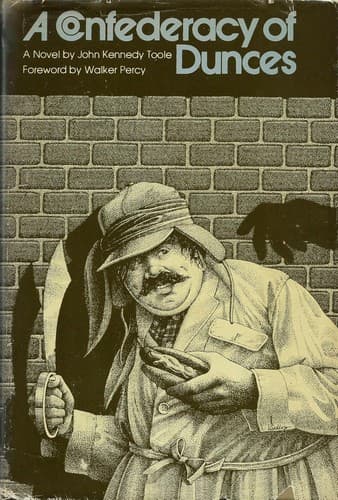
A Confederacy of Dunces
John Kennedy Toole·1980·Louisiana State University Press·Literature
Reading level: Ages 16+ (adult) · 12-hour read · Beginner difficulty.
- Reading time
- 12h
- Difficulty
- Beginner
- Recommended age
- Ages 16+
- Guide read
- 4min
- Editor's rating
- 4.6 / 5
- john-kennedy-toole
- comedy
- new-orleans
- american-literature
- satire
- classic
- posthumous
— In one sentence —
A monument of comic fiction, published eleven years after its author's death. Ignatius J. Reilly — enormous, flatulent, indolent, and convinced of his own genius — is one of the great characters in American literature.
§ 01 · WHY READ
Why read
John Kennedy Toole wrote A Confederacy of Dunces in the early 1960s. He was unable to find a publisher, fell into depression, and died by suicide in 1969 at the age of thirty-one. His mother, Thelma Toole, spent the next decade trying to get the novel published, eventually convincing Louisiana State University Press to take it in 1980. It won the Pulitzer Prize for Fiction in 1981. The novel has since sold millions of copies and is widely regarded as one of the funniest American novels ever written.
The premise: Ignatius J. Reilly, a large, flatulent, thirty-year-old medievalist who lives with his mother in New Orleans and has never held a job, is forced by circumstances to find employment. The novel follows his catastrophic tenure at the Levy Pants company and then as a hot dog vendor, his correspondence with his imprisoned intellectual companion Myrna Minkoff in New York, and his mother's romantic and social entanglements. Everything Ignatius touches becomes a disaster; he attributes every disaster to Fortune's Wheel turning against him.
What makes it great: Ignatius is one of literature's great comic inventions — an impossible figure of vanity, sloth, and genuine learning, so convinced of his own superiority that he cannot function in the world. Toole's satirical targets are wide: the genteel poverty of the New Orleans middle class, corporate management culture, the American entertainment industry, progressive politics, and medieval philosophy (Ignatius's preferred intellectual framework for condemning everything modern). The novel is also, underneath the comedy, a portrait of a man so defended against real feeling that he has become unable to live.
The setting: New Orleans in the early 1960s is rendered with exceptional specificity — the accents, the streets, the social hierarchies, the food. The city is as much a character as Ignatius.
§ 02 · CHARACTERS
Characters
Ignatius J. Reilly — the novel's center of gravity: enormous in body and ego, devoted to Boethius and the medieval concept of Fortuna, contemptuous of everything modern from jazz to underwear elastic. His journal entries (written in Big Chief tablets) provide interior access to a mind so self-aggrandizing it is almost sublime.
Irene Reilly — Ignatius's long-suffering mother, a New Orleans working-class woman trying to manage both Ignatius and her own late-life social aspirations, including a romance with the disreputable Claude Robichaux.
Myrna Minkoff — Ignatius's pen pal and intellectual sparring partner from New York, a progressive activist whom Ignatius considers a barbarian but cannot stop writing to. She is his closest approximation of a friend.
Burma Jones — an African American man forced to work at a strip club to avoid vagrancy charges; his subplot runs parallel to Ignatius's misadventures and contains the novel's sharpest social commentary on race in the early-1960s South.
Mr. Levy — the owner of Levy Pants, a man who has entirely abdicated responsibility for his business and his life; his wife, Mrs. Levy, fills the vacuum with aggressive psychological manipulation.
§ 03 · HIGHLIGHTS
Three highlights
No. 1 · The Levy Pants crusade. Ignatius, convinced he is going to improve industrial relations at Levy Pants through the application of medieval philosophy, organizes the Black factory workers into a protest movement. The protest goes spectacularly wrong in ways that implicate everyone, resolve nothing, and leave Ignatius more convinced of his own brilliance than ever. The sequence is Toole's sharpest satire of 1960s progressive politics and corporate management simultaneously.
No. 2 · The hot dog cart. After his dismissal from Levy Pants, Ignatius takes a job as a hot dog vendor, consuming most of his product, dispensing the rest to unresponsible buyers, and eventually becoming involved in a scheme to reform the American political system through the organized political power of gay men. The scheme culminates in a catastrophe at a masquerade party that must be read to be believed.
No. 3 · The journal entries. Scattered throughout the novel are excerpts from Ignatius's journals, written in a voice of deranged grandeur. "I am at the moment writing a lengthy indictment against our century" is typical. The journals reveal Ignatius's genuine learning alongside his spectacular self-delusion; the comedy comes from the gap between the scale of his self-regard and the modest chaos of his actual life.
§ 04 · EDITIONS
Recommended editions
| Edition | Why pick it |
|---|---|
| LSU Press (original, any printing) | The canonical edition; Walker Percy's foreword is essential context — his account of reading the manuscript and recognizing it immediately is one of the great publishing stories. |
| Penguin Modern Classics (UK) | The standard international paperback; same text. |
| Audiobook (Barrett Whitener) | Whitener's reading captures the New Orleans voices accurately; the novel works exceptionally well in audio. |
§ 05 · FIT
Who it's for / not for
Read this if you are…
- Anyone who enjoys comic fiction and hasn't read this: it is one of the genre's landmarks.
- Readers interested in New Orleans and the American South in the 1960s — the novel's sense of place is as strong as its comedy.
- Anyone interested in the category of "impossible characters" in fiction: Ignatius belongs with Falstaff, Don Quixote, and Oblomov.
Skip it if you are…
- Looking for plot-driven narrative. The novel is character-driven; the plot is a series of disasters orbiting Ignatius rather than a developing arc.
- Sensitive to racial language: the novel depicts early-1960s New Orleans with period accuracy, including language.
§ 06 · TIPS
Reading tips
- Read Walker Percy's foreword. His account of how the manuscript came to him and his first encounter with Ignatius sets the context for both the comedy and the tragedy of Toole's life.
- Read the journal entries slowly. They are the densest and funniest passages; the comedy rewards attention to the grandiosity of the diction.
- Burma Jones is not comic relief. His subplot is the novel's sharpest engagement with race; he is its most clear-eyed and competent character.
§ 07 · COMPARE
Read alongside
- Flannery O'Connor — Wise Blood (1952). The Southern Gothic companion: another grotesque protagonist convinced of his own spiritual authority, navigating a world that won't cooperate. O'Connor and Toole are very different writers with a shared Southern absurdism.
- Kingsley Amis — Lucky Jim (1954). The British comic-novel companion: another man convinced he is surrounded by fools, in much worse trouble than he acknowledges. Less baroque than Toole, more controlled.
- Miguel de Cervantes — Don Quixote (1605/1615). The structural ancestor: a man with a medieval worldview attempting to function in a modern world that finds him absurd. Toole knew the connection.
§ 08 · DISCUSSION
Discussion questions
- Ignatius is convinced that Fortune's Wheel is responsible for his disasters. Is he wrong? To what extent are his misfortunes caused by external bad luck versus his own behavior?
- The novel's comedy depends partly on the gap between Ignatius's self-assessment and his actual effect on the world. At what point (if any) does the comedy shade into something sadder?
- Burma Jones is the novel's most competent character, systematically exploited by almost everyone around him. What is Toole doing by placing this character at the moral center of the novel?
- Ignatius cannot live in the world but also cannot leave it. What does the ending suggest about his prospects? Is it a hopeful ending?
- The novel is set in the early 1960s but written about them. What is Toole satirizing, specifically? Does the satire age well?
- Walker Percy's foreword describes reading the manuscript and recognizing it immediately as a masterpiece. What makes the novel immediately recognizable as extraordinary — what is the quality Percy identified?
One line to remember
“I am at the moment writing a lengthy indictment against our century. When my brain begins to reel from my literary labors, I make an occasional cheese dip.”— Ignatius J. Reilly — A Confederacy of Dunces
Appears in collections
Reading lists featuring this book
6 books
Books About Being an Outsider
Six novels about people who cannot find a world that will accept them whole.
Open list →
10 books
Books About the American South
Ten books, ten Souths — some in direct contradiction.
Open list →
10 books
Ten Novels to Understand the American South
A literature that carries the full weight of American history — grace and violence together.
Open list →
7 books
Overlooked Masterpieces
Seven novels that belong in the first tier but rarely get there — and why.
Open list →
You might also like
Read next
William Faulkner · 1936
Absalom, Absalom!
Four narrators reconstruct a man who destroyed his family. The story keeps changing. That is the point.
Read · 7 min
Toni Morrison · 1987
Beloved
Toni Morrison said she wrote this novel to give voice to the sixty million. It won the Pulitzer, the Nobel, and is the greatest American novel of the second half of the twentieth century.
Read · 6 min
Leo Tolstoy · 1878
Anna Karenina
Not just a love story. Two parallel lives — Anna's destruction, Levin's salvation — ask the same question: how should a person live?
Read · 6 min