Editor-reviewed
The Brothers Karamazov
Fyodor Dostoevsky·1880·Various (public domain)·Literature
Reading level: Ages 16+ (adult) · 38-hour read · Intermediate difficulty.
- Reading time
- 38h
- Difficulty
- Intermediate
- Recommended age
- Ages 16+
- Guide read
- 7min
- Editor's rating
- 4.9 / 5
- dostoevsky
- russian-literature
- classic
- 19th-century
- canonical
- philosophy
- religion
— In one sentence —
Dostoevsky's final novel and his fullest argument. Three brothers, a murdered father, and every question about God, freedom, and what human beings owe each other.
§ 01 · WHY READ
Why read
Dostoevsky wrote The Brothers Karamazov in his sixties, dying as he finished it, and it contains everything he had been working toward for a lifetime. It is a murder mystery, a philosophical debate, a family tragedy, a novel of ideas, and a religious argument — simultaneously, without any of these elements feeling like it is carrying extra freight. That integration is the achievement.
Fyodor Karamazov is a dissolute, licentious, faintly comic Russian landowner with three sons by two marriages and a natural son he doesn't acknowledge. He is murdered. The question of who killed him — legally, morally, metaphysically — organizes everything. The three legitimate sons are the novel's philosophical positions: Dmitri (passion, honor, excess), Ivan (reason, atheism, rebellion against God's world), and Alyosha (faith, love, active goodness). Each position is given its best argument. No position wins.
The novel's center is Ivan's argument in "The Grand Inquisitor" — perhaps the most powerful statement of the problem of evil ever put in fictional form. Ivan does not deny God's existence; he returns the ticket. Even if God exists and has a plan, he refuses to accept a world in which children suffer as the price of anyone's harmony. The chapter is self-contained enough to read alone, but the rest of the novel is Dostoevsky's answer — not a refutation but a lived counterargument, embodied in Alyosha and Father Zosima.
This is the novel that Freud called the greatest ever written. It is also the most entertaining of Dostoevsky's novels: funny, propulsive, full of grotesque comedy alongside the philosophy.
§ 02 · CHARACTERS
Characters
Dmitri Karamazov — the eldest son: violent, generous, passionate, fundamentally honest. He is accused of his father's murder and, in a profound sense, is guilty of wanting it — even though he didn't do it. His trial and its aftermath are the novel's moral and legal climax.
Ivan Karamazov — the intellectual son: brilliant, cold, the author of the Grand Inquisitor parable. His rebellion against God is the most articulate statement of that position in fiction. But Dostoevsky gives him a shadow — Smerdyakov, who acts on Ivan's ideas more literally than Ivan intended — and the consequences destroy him.
Alyosha Karamazov — the youngest son and Dostoevsky's intended hero: a novice monk, genuinely good without being naive, capable of being present with people in their suffering. He is the novel's answer to Ivan, not through argument but through existence.
Father Zosima — Alyosha's elder, the monastery's spiritual center, whose teachings on active love and universal responsibility are Dostoevsky's positive theology. His biography, told after his death, is the novel's spiritual core.
Smerdyakov — the fourth son, the bastard, Ivan's shadow: he listens to Ivan's arguments about moral freedom and absence of God, concludes that if God doesn't exist everything is permitted, and acts accordingly. He is the novel's most chilling character.
§ 03 · HIGHLIGHTS
Three highlights
No. 1 · The Grand Inquisitor. Ivan tells Alyosha a story: Christ returns to 16th-century Seville, is arrested by the Cardinal Inquisitor, and is told that humanity doesn't want freedom — it wants bread, miracle, and authority. The Inquisitor is not simply a villain; he is a man who has thought this through and concluded that love requires taking freedom away. Ivan's point: even if God exists, the world he made — where children suffer — is one Ivan refuses to endorse. This is the novel's most important chapter. Read it twice.
No. 2 · Dmitri's interrogation. After the murder, Dmitri is interrogated over many hours in a grinding, legally meticulous scene that is also a portrait of a man simultaneously guilty of everything his character implies and innocent of the specific act he's accused of. The confusion of legal and moral guilt is precise and devastating.
No. 3 · Ilyusha's funeral. In the final section, Alyosha speaks to a group of boys at the funeral of their friend, a child who has died. The speech — on memory, on love, on what it means to have been kind to someone — is Dostoevsky's simplest and most direct statement of his answer to Ivan's Grand Inquisitor. Not philosophy. A specific child. A specific memory. Twelve boys who were kind to him.
§ 04 · EDITIONS
Recommended editions
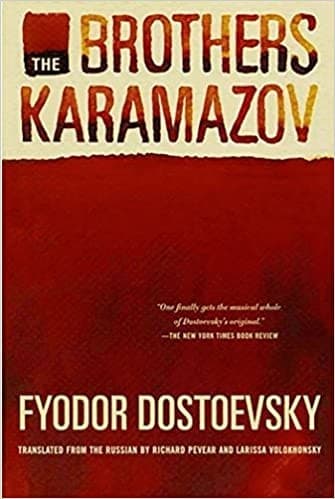
Richard Pevear and Larissa Volokhonsky (Farrar, Straus and Giroux, 1990) is the definitive translation. Their Karamazov — which won the PEN/Book-of-the-Month Club Translation Prize — preserves Dostoevsky's polyphony, his syntax, his grotesque comedy, and his theological precision. This is the one.
Constance Garnett is the historical translation and remains widely read; but her Dostoevsky is smoothed and slightly dignified compared to the original. If you have a Garnett, it will do — but P&V is the better experience.
David McDuff (Penguin, 1993) is a competent alternative but does not surpass P&V.
§ 05 · FIT
Who it's for / not for
Read this if you are…
- Anyone serious about fiction at the level of its ultimate ambitions.
- Readers interested in the problem of evil, free will, and what faith looks like when it is honest about what it costs.
- Anyone who enjoyed Crime and Punishment and wants the larger, more complex version of the same arguments.
Skip it if you are…
- Deterred by length (800+ pages). This is a commitment. But Dostoevsky is never slow — even the long digressive sections have energy.
- Looking for a tidy resolution: the novel withholds moral resolution deliberately.
§ 06 · TIPS
How to read it
The Russian name system is at its most complex here. The three brothers are Dmitri (Mitya), Ivan (Vanya), and Alexei (Alyosha). Most editions include a character list; use it for the first 100 pages.
Read "The Grand Inquisitor" chapter knowing that everything around it is Dostoevsky's response. The novel is not structured as a philosophical treatise but as a lived counterargument: Ivan is right in theory; Alyosha's existence and Zosima's teachings are the answer that doesn't fit into Ivan's theory.
The "Book Six" — Father Zosima's biography — is sometimes skipped by readers impatient for plot. Don't skip it. It is the positive theology that gives Ivan's position its full weight.
§ 07 · COMPARE
Read alongside
- Fyodor Dostoevsky — Crime and Punishment (1866). The controlled precursor: one protagonist, one murder, one philosophical argument. Read it first.
- Albert Camus — The Plague (1947). Camus explicitly wrestled with Ivan Karamazov's argument — the refusal to accept a world where children suffer. The Plague is his response.
- Fyodor Dostoevsky — The Idiot (1869). Dostoevsky's earlier attempt at a "positively good man" — Prince Myshkin. Read Karamazov first; the contrast illuminates both.
§ 08 · DISCUSSION
Discussion questions
- Ivan's Grand Inquisitor argument is that humanity doesn't want freedom — it wants certainty and bread. Is this true? Has history validated Ivan's pessimism?
- Ivan is innocent of the murder in legal terms. Is he morally innocent? What is the nature of his guilt?
- Alyosha is Dostoevsky's answer to Ivan. Is he a convincing answer? What does he actually say or do that responds to Ivan's argument?
- Smerdyakov takes Ivan's ideas literally. Does this discredit Ivan's philosophy, or merely show that ideas can be misapplied?
- The novel ends with a speech at a child's grave. Why does Dostoevsky end with children?
- Freud called this the greatest novel ever written. What do you think he saw in it? Do you agree with the assessment?
One line to remember
“Love in action is a harsh and dreadful thing compared to love in dreams.”— Fyodor Dostoevsky — The Brothers Karamazov
Appears in collections
Reading lists featuring this book
You might also like
Read next
Fyodor Dostoevsky · 1866
Crime and Punishment
The most gripping novel about guilt ever written. A student murders a pawnbroker to prove he's above morality — and spends 600 pages finding out he isn't.
Read · 6 min
Fyodor Dostoevsky · 1864
Notes from Underground
The founding document of modern alienation. An unnamed civil servant argues himself into a corner for 130 pages — and means every word.
Read · 5 min
Fyodor Dostoevsky · 1869
The Idiot
What happens when a genuinely good person enters Russian society? It destroys him. And everyone around him.
Read · 6 min