Editor-reviewed
Notes from Underground
Fyodor Dostoevsky·1864·Various (public domain)·Literature
Reading level: Ages 16+ (adult) · 5-hour read · Intermediate difficulty.
- Reading time
- 5h
- Difficulty
- Intermediate
- Recommended age
- Ages 16+
- Guide read
- 5min
- Editor's rating
- 4.7 / 5
- dostoevsky
- russian-literature
- classic
- 19th-century
- canonical
- existentialism
- alienation
— In one sentence —
The founding document of modern alienation. An unnamed civil servant argues himself into a corner for 130 pages — and means every word.
§ 01 · WHY READ
Why read
Notes from Underground is 130 pages long and it contains the prototype of every alienated, self-aware, self-defeating narrator in modern fiction. The Underground Man — unnamed, retired, living in a corner of St. Petersburg — delivers a sustained monologue that is simultaneously a philosophical argument, a social self-indictment, and a confession that denies it is confessing anything. He is the ancestor of Camus's Meursault, Salinger's Holden Caulfield, Ellison's Invisible Man, and dozens of other figures who speak from a position of wounded, furious self-awareness.
Dostoevsky wrote it in 1864 as a direct polemic against Nikolai Chernyshevsky's novel What Is to Be Done? — which argued that human beings, if educated and given rational self-interest as their guide, would naturally choose right behavior and build a utopia. The Underground Man's answer, spanning the entire first section ("Underground"), is that this is wrong: human beings are not rational calculators; they are perverse, self-contradictory creatures who will choose against their own interest specifically to assert that they are free. "Shower upon him every earthly blessing... and even then, out of sheer ingratitude, sheer spite, man would play you such a trick."
The second section ("Apropos of the Wet Snow") illustrates the argument with experience: three episodes from the Underground Man's past — a confrontation with an officer, a dinner with former schoolmates, an encounter with a prostitute named Liza — that demonstrate, in lived action, everything he has argued in theory. The demonstration is even more devastating than the argument.
The book is short enough to read in an evening and important enough to require several readings. Start here if you want to understand what Dostoevsky was arguing against, and what he built everything else to answer.
§ 02 · CHARACTERS
Characters
The Underground Man — the narrator and only sustained presence: middle-aged, retired on a small inheritance, brilliant, deeply self-aware, and completely unable to act on any of his self-awareness. He can see himself clearly and cannot stop. He argues that self-consciousness at this degree is itself a disease, a paralysis. He may be right.
Liza — the young prostitute who appears in Part Two and who, in a single encounter, listens to the Underground Man's extended speech about the degradation of her life and begins to believe it. She is the novel's moral center, precisely because she appears so briefly: her trust in the Underground Man, and what he does with it, is the demonstration of everything his theory predicts about himself.
The Officer — appears in a brief episode: a large man who physically moves the Underground Man out of the way in a tavern without noticing he exists. The Underground Man spends years planning revenge. The eventual revenge is both petty and, in its own terms, satisfying. The episode is the novel's funniest and most precise portrait of wounded pride.
§ 03 · HIGHLIGHTS
Three highlights
No. 1 · "Twice two makes four." The Underground Man's attack on rationalism culminates in the argument that even mathematical certainty — "twice two makes four" — is intolerable if it leaves no room for the will. "Twice two makes five is sometimes a very charming thing too." This is not irrationalism; it is the argument that freedom, even freedom to be wrong, is more essentially human than correctness. It is one of the most important philosophical passages in 19th-century fiction.
No. 2 · The dinner with the schoolmates. The Underground Man, after years of isolation, forces himself into a farewell dinner for an old acquaintance he despises. The evening is a sustained social catastrophe — he is ignored, condescended to, left behind — and his response is to follow the party to a brothel in a fever of wounded pride. The scene is agonizing and hilarious simultaneously.
No. 3 · Liza's visit. Having delivered a long speech to Liza about how prostitution will destroy her, the Underground Man gives her his address. She comes. He is, at this moment, genuinely moved by her trust. And then — because his theory predicts he will, because he cannot accept genuine connection — he destroys it. The scene is the novel's most precise account of what self-consciousness without self-command produces.
§ 04 · EDITIONS
Recommended editions
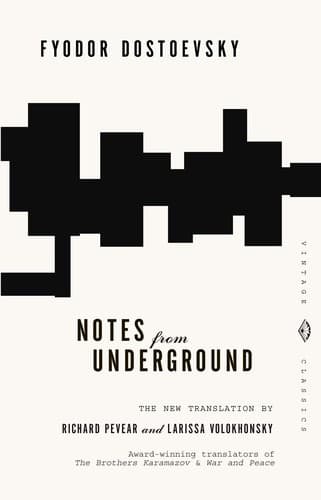
Richard Pevear and Larissa Volokhonsky (Vintage, 1994) — translated as part of their Notes from Underground / The Double volume. The P&V translation captures the Underground Man's manic, circling prose rhythm, which is essential: the style is the psychology.
Michael Katz (Norton Critical Edition, 2001) is the recommended alternative for anyone who wants extensive annotation and critical essays — the Norton edition includes Chernyshevsky's What Is to Be Done? excerpts that are the polemical target, which clarifies the argument enormously.
Constance Garnett's translation exists and functions, but the Underground Man's voice is one of the most distinctive in fiction and the newer translations serve it better.
§ 05 · FIT
Who it's for / not for
Read this if you are…
- Anyone starting Dostoevsky who wants an entry point that isn't 600 pages. This is 130 pages and contains the core argument.
- Readers interested in the origins of existentialism, alienation literature, and the unreliable narrator.
- Anyone who has ever watched themselves do something against their own interest and been unable to stop.
Skip it if you are…
- Looking for a conventional narrative: Notes is not a novel in the usual sense. Part One is a philosophical monologue; Part Two is illustrative episodes.
- Expecting resolution: the Underground Man's last line is "enough — I don't want to write any more from underground." He stops. He doesn't change.
§ 06 · TIPS
How to read it
Read Part One as argument, Part Two as proof. The Underground Man tells you in Part One exactly how he will behave; Part Two shows him doing it. The structure is deliberate and precise.
Knowing the polemic target helps. Dostoevsky was arguing against the rationalist utopians — Chernyshevsky in particular — who believed that human beings, given the right information and incentives, would choose rationally and well. The Underground Man is Dostoevsky's demonstration that this is not what human beings are like.
§ 07 · COMPARE
Read alongside
- Fyodor Dostoevsky — Crime and Punishment (1866). Raskolnikov acts on the Underground Man's philosophical position — the idea of the exceptional individual above ordinary morality. Reading Notes first provides the theoretical scaffold.
- Jean-Paul Sartre — Nausea (1938). Roquentin, alone in a provincial city, unable to find meaning or connection: the direct existentialist descendant of the Underground Man.
- Ralph Ellison — Invisible Man (1952). Ellison's narrator, in a literal underground room surrounded by light bulbs, channeling the same monologue tradition. The connection is explicit.
§ 08 · DISCUSSION
Discussion questions
- The Underground Man argues that human beings will choose against their own interest just to prove they are free. Do you believe this? Can you think of examples?
- Is the Underground Man right about himself? Are his predictions about his own behavior accurate?
- What happens with Liza? Why does the Underground Man do what he does when she comes to him?
- The Underground Man is highly intelligent and completely self-aware. Does this self-awareness help him? What does Dostoevsky think self-consciousness does to a person?
- The book was written as a polemic against rationalism. Does it refute rationalism, or simply describe a particular kind of person who can't benefit from it?
- "I am a sick man... I am a wicked man." The first sentence. By the end, do you agree with either or both of these self-descriptions?
One line to remember
“I am a sick man... I am a wicked man. An unattractive man. I think my liver is diseased.”— Fyodor Dostoevsky — Notes from Underground
You might also like
Read next
Fyodor Dostoevsky · 1866
Crime and Punishment
The most gripping novel about guilt ever written. A student murders a pawnbroker to prove he's above morality — and spends 600 pages finding out he isn't.
Read · 6 min
Fyodor Dostoevsky · 1880
The Brothers Karamazov
Dostoevsky's final novel and his fullest argument. Three brothers, a murdered father, and every question about God, freedom, and what human beings owe each other.
Read · 7 min
Fyodor Dostoevsky · 1869
The Idiot
What happens when a genuinely good person enters Russian society? It destroys him. And everyone around him.
Read · 6 min