Editor-reviewed
The Idiot
Fyodor Dostoevsky·1869·Various (public domain)·Literature
Reading level: Ages 16+ (adult) · 24-hour read · Intermediate difficulty.
- Reading time
- 24h
- Difficulty
- Intermediate
- Recommended age
- Ages 16+
- Guide read
- 6min
- Editor's rating
- 4.6 / 5
- dostoevsky
- russian-literature
- classic
- 19th-century
- canonical
- goodness
- tragedy
— In one sentence —
What happens when a genuinely good person enters Russian society? It destroys him. And everyone around him.
§ 01 · WHY READ
Why read
Dostoevsky set himself the most ambitious task in fiction: to portray a positively beautiful, genuinely good human being. He knew this was nearly impossible. He wrote in his notebook: "The main idea of the novel is to portray a positively beautiful man." Then he created Prince Myshkin — and showed, with relentless honesty, what goodness actually costs in the world as it is.
Prince Lev Nikolaevich Myshkin arrives in St. Petersburg from a Swiss sanatorium where he has been treated for epilepsy. He is naive, transparent, incapable of guile, genuinely compassionate, and constitutionally unable to participate in the social performances that Russian society runs on. He is also, in the novel's own terms, profoundly sane about things that the "sane" characters are blind to. The title is ironic: the "idiot" sees more clearly than anyone around him.
What happens when such a person arrives in a society organized around money, status, sexual competition, and performative emotion? He becomes a catalyst for everyone else's destruction. Not through malice — through goodness. Myshkin cannot lie, cannot protect himself by pretending, cannot choose one woman over another without causing devastation. His complete honesty and complete incapacity for cruelty are, in the specific social world Dostoevsky creates, more dangerous than villainy.
The Idiot is Dostoevsky's most tragic novel and, arguably, his most personal. The epilepsy scenes draw directly on his own experience. The question — whether genuine goodness can survive contact with actual social reality — gets answered here more honestly than anywhere else in his work.
§ 02 · CHARACTERS
Characters
Prince Myshkin — the protagonist: epileptic, gentle, astonishingly perceptive, and utterly without the social armor that makes ordinary life navigable. He loves Nastasya Filippovna and Aglaya simultaneously and genuinely — not through weakness but through a complete inability to hierarchy his own compassion. This incapacity is both his defining virtue and the mechanism of the tragedy.
Nastasya Filippovna — the most complex female character Dostoevsky created: beautiful, proud, self-destructive, simultaneously attracted to Myshkin's goodness and certain she is unworthy of it. She was kept and then abandoned by Totsky from childhood; she knows her own degradation and cannot escape it. Her arc from degradation to destruction is the novel's central tragedy.
Rogozhin — the merchant's son who is passionately, destructively in love with Nastasya: brutal, possessive, capable of violence, and yet in a strange way the most honest of the male characters about what he feels and what he intends. His relationship with Myshkin — they become something like brothers — is one of Dostoevsky's most disturbing and interesting inventions.
Aglaya Epanchina — the general's daughter who loves Myshkin: brilliant, proud, self-willed, incapable of accepting a man who cannot choose her completely. Her confrontation with Nastasya is the novel's most electric scene.
§ 03 · HIGHLIGHTS
Three highlights
No. 1 · Myshkin's arrival at the Epanchins. His first extended social scene — meeting the general's family, improvising a long speech about capital punishment, charming everyone through sheer transparency — establishes exactly what kind of novel this is. Myshkin is not performing; he cannot perform. The Epanchins cannot decide whether he is fascinating or impossible, and neither can the reader.
No. 2 · The confrontation at the party. Nastasya Filippovna, at her own birthday party, in front of everyone who uses her, throws the 100,000 rubles Rogozhin has brought into the fire and tells Ganya he can have them if he takes them out with his bare hands. The scene is grotesque, theatrical, absolutely specific, and the most vivid portrait in the novel of a woman who has internalized her own objectification and is performing it back at the people who created it.
No. 3 · The ending. Rogozhin kills Nastasya Filippovna. Myshkin arrives; they spend the night together beside her body, Myshkin falling back into idiocy, Rogozhin beside him. It is the most devastating ending in Dostoevsky, because it is the honest conclusion of everything the novel has set up: goodness cannot save her; love — either Myshkin's compassionate love or Rogozhin's possessive love — cannot save her. She is too far into her own destruction.
§ 04 · EDITIONS
Recommended editions
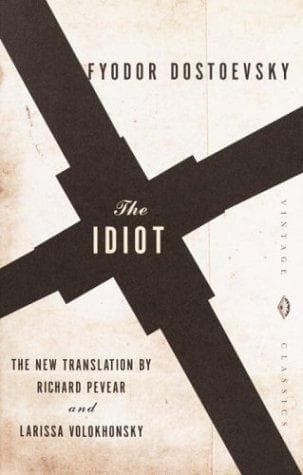
Richard Pevear and Larissa Volokhonsky (Vintage, 2002) is the recommended translation — they capture Dostoevsky's rhythm, his digressions, and his darkly comic social scenes. Their Myshkin is appropriately ambiguous.
Alan Myers (Oxford World's Classics, 1992) is a strong alternative, particularly praised for its handling of the social comedy. Myers occasionally clarifies where P&V preserves ambiguity; both choices are defensible.
Constance Garnett's translation remains widely read and will serve a first reader, but newer translations capture more of what makes Dostoevsky's prose distinctive.
§ 05 · FIT
Who it's for / not for
Read this if you are…
- Anyone who has read Crime and Punishment or The Brothers Karamazov and wants more Dostoevsky.
- Readers interested in what genuine goodness looks like — and what happens to it.
- Anyone drawn to tragic fiction that refuses consolation.
Skip it if you are…
- New to Dostoevsky: start with Crime and Punishment, which is more focused. The Idiot sprawls and requires more tolerance for structural looseness.
- Looking for clear moral resolution: the novel's conclusion offers none.
§ 06 · TIPS
How to read it
Accept the sprawl. The Idiot is the most digressive of Dostoevsky's major novels — there are party scenes, extended social comedies, seemingly tangential conversations that circle back later. This is intentional; the social world has to feel dense and suffocating before Myshkin's failure to navigate it registers fully.
The epilepsy scenes are crucial. Myshkin's seizures are described with Dostoevsky's own autobiographical precision — the aura before the seizure, the moment of ecstatic clarity, the aftermath. They are not just medical description; they are Dostoevsky's investigation of the relationship between altered consciousness and spiritual perception.
§ 07 · COMPARE
Read alongside
- Fyodor Dostoevsky — The Brothers Karamazov (1880). Alyosha Karamazov is Dostoevsky's second attempt at the positively good man — more successfully integrated into the plot than Myshkin. Reading both shows the evolution of Dostoevsky's thinking.
- Miguel de Cervantes — Don Quixote (1605). The original "holy fool": a man whose goodness and idealism are indistinguishable from madness in the world's eyes. Dostoevsky revered the comparison.
- Leo Tolstoy — Resurrection (1899). Tolstoy's late novel about goodness attempting to operate within corrupt institutions. Differently pitched, but the same fundamental question.
§ 08 · DISCUSSION
Discussion questions
- The title calls Myshkin an idiot. Is he? What does it mean to call someone an idiot in this novel?
- Myshkin loves both Nastasya and Aglaya genuinely. Is this a moral failure? Is it even possible for one person to love two people simultaneously?
- Nastasya Filippovna cannot accept that she is worthy of Myshkin's love. Is her self-destruction a choice? Whose fault is it?
- Rogozhin kills the woman he loves. Is he a villain? What is his relationship to Myshkin?
- Dostoevsky said "beauty will save the world." By the end of this novel, do you believe him?
- Myshkin's goodness makes things worse for everyone around him. Is this a critique of goodness, or of the world that surrounds it?
One line to remember
“Beauty will save the world.”— Fyodor Dostoevsky — The Idiot
You might also like
Read next
Fyodor Dostoevsky · 1866
Crime and Punishment
The most gripping novel about guilt ever written. A student murders a pawnbroker to prove he's above morality — and spends 600 pages finding out he isn't.
Read · 6 min
Fyodor Dostoevsky · 1880
The Brothers Karamazov
Dostoevsky's final novel and his fullest argument. Three brothers, a murdered father, and every question about God, freedom, and what human beings owe each other.
Read · 7 min
Fyodor Dostoevsky · 1864
Notes from Underground
The founding document of modern alienation. An unnamed civil servant argues himself into a corner for 130 pages — and means every word.
Read · 5 min