Editor-reviewed
Crime and Punishment
Fyodor Dostoevsky·1866·Various (public domain)·Literature
Reading level: Ages 16+ (adult) · 20-hour read · Intermediate difficulty.
- Reading time
- 20h
- Difficulty
- Intermediate
- Recommended age
- Ages 16+
- Guide read
- 6min
- Editor's rating
- 4.9 / 5
- dostoevsky
- russian-literature
- classic
- 19th-century
- canonical
- guilt
- psychology
— In one sentence —
The most gripping novel about guilt ever written. A student murders a pawnbroker to prove he's above morality — and spends 600 pages finding out he isn't.
§ 01 · WHY READ
Why read
Dostoevsky is not difficult. He is addictive. Crime and Punishment moves at the speed of a thriller — Raskolnikov commits the murder on page 80, and every page after that is the pressure of what he has done, mounting, distorting, breaking him open. People who approach this novel expecting something slow and philosophical are surprised to find themselves unable to stop.
Raskolnikov — Rodion Romanovich Raskolnikov, a former law student in St. Petersburg — has a theory: extraordinary people (Napoleon, Caesar) stand above conventional morality and can commit crimes in service of higher purposes. Ordinary people cannot. He believes himself extraordinary. He murders an old pawnbroker and her sister to prove it and to take her money, and finds immediately that the theory does not work as advertised. The murder has happened; he cannot fit it into the framework he invented to justify it; and something in him — not conscience exactly, more like a physical revulsion — will not let him rest.
This is Dostoevsky's central achievement: he dramatizes a philosophical position from inside, shows what it actually feels like to hold it and to act on it, and lets reality demonstrate what the argument misses. He is not interested in refuting Raskolnikov through counterargument. He lets Raskolnikov refute himself.
The novel also contains Sonya, the detective Porfiry, and Svidrigailov — three of the most vivid characters Dostoevsky ever created — and it is set in a St. Petersburg that registers as physically real: the suffocating heat, the cramped rooms, the canal water, the crowds.
§ 02 · CHARACTERS
Characters
Raskolnikov — the protagonist: brilliant, proud, feverish, genuinely kind in moments, and incapable of accepting ordinary human connection. He helps people impulsively and is disgusted by his own helpfulness. He is two people simultaneously — the cold theorist who committed the murder and the human being who cannot live with what the theorist did.
Sonya Marmeladova — the prostitute's daughter who reads Raskolnikov the story of Lazarus and eventually accompanies him to Siberia. She is Dostoevsky's counterweight to Raskolnikov: she suffers completely, without theory, without resentment, and without losing herself. Some readers find her too saintly; Dostoevsky finds her the novel's answer.
Porfiry Petrovich — the detective investigating the murder: one of the great antagonists in fiction, not because he is menacing but because he is genuinely interested in Raskolnikov, appears to almost like him, and conducts his interrogations as philosophical conversations. His method is to let Raskolnikov destroy himself.
Svidrigailov — the most disturbing character in the novel: a man who has crossed every moral line Raskolnikov has only theorized about, and who lives with it through pure nihilism. His scenes with Raskolnikov are the novel's darkest philosophical encounters. His fate is the novel's most chilling sequence.
§ 03 · HIGHLIGHTS
Three highlights
No. 1 · The murder. The murder scene is not what readers who have heard about "Dostoevsky's psychology" expect: it is chaotic, clumsy, physically specific, and immediately catastrophic. Raskolnikov kills the pawnbroker and then, because her half-sister Lizaveta arrives unexpectedly, kills her too — an act he had not planned, which is the first crack in the theory. The theory required one justified death. There are two. The second one is simply wrong.
No. 2 · Porfiry's interrogations. Over three extended scenes, Porfiry conducts conversations with Raskolnikov that are simultaneously friendly, philosophical, and closing. He never accuses; he speculates; he smiles; he leaves pauses. Raskolnikov cannot stand the pauses. The technique — the detective as interlocutor rather than interrogator — is Dostoevsky's most sustained dramatic achievement.
No. 3 · Svidrigailov's last night. Svidrigailov has committed acts that Raskolnikov only thought about. He is not tormented; he feels nothing. His last night in St. Petersburg — the charitable acts he performs, the dream he has of a dead girl, the grey morning — is the novel's most disturbing sequence, and its most honest portrait of what Raskolnikov's theory, carried to its conclusion, actually produces.
§ 04 · EDITIONS
Recommended editions
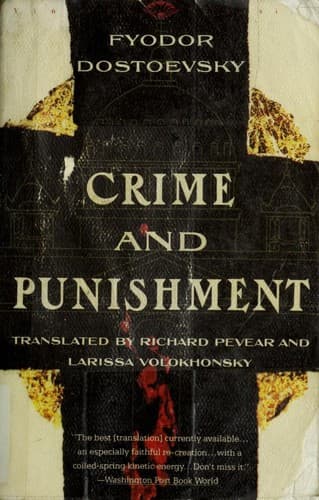
Richard Pevear and Larissa Volokhonsky (Vintage, 1993) is the standard recommendation. Their translation is the most faithful to Dostoevsky's syntax and rhythm — including his repetitions and run-ons, which are deliberate. The breathlessness of the prose is part of the novel.
Michael Katz (Liveright, 2018) is an excellent recent alternative, slightly more idiomatic, and with excellent notes. Worth considering for readers who find P&V occasionally stiff.
Constance Garnett produced the translation that introduced Dostoevsky to the English-speaking world, and it remains readable — but she smoothed his style considerably. If you have a Garnett on the shelf, it will work; if you are buying, choose P&V or Katz.
§ 05 · FIT
Who it's for / not for
Read this if you are…
- Anyone interested in fiction that is simultaneously a psychological thriller and a philosophical argument — and doesn't sacrifice either for the other.
- Readers who have been told Russian literature is slow and want to be corrected.
- Anyone interested in guilt, self-punishment, and what happens when ideas become actions.
Skip it if you are…
- Looking for moral simplicity: Dostoevsky's characters hold contradictory positions simultaneously and mean all of them. If ambiguity is frustrating, this will be difficult.
§ 06 · TIPS
How to read it
Don't be slowed by the Russian names. Raskolnikov is always Raskolnikov (or Rodya, in family conversation); once you have the four or five central characters, you will not lose track. A note at the front of most editions lists the main characters.
The philosophical position Raskolnikov holds — that extraordinary people stand above conventional morality — was a real intellectual current in 1860s Russia, associated with a reading of Hegel and Napoleon. You don't need to know this to read the novel, but knowing that Dostoevsky is arguing against a real position, not a straw man, sharpens the reading.
§ 07 · COMPARE
Read alongside
- Fyodor Dostoevsky — Notes from Underground (1864). Written two years earlier, it is the theoretical companion: the Underground Man states the philosophical position that Raskolnikov acts on. Read Notes first if you want the philosophical context.
- Albert Camus — The Stranger (1942). Meursault commits a motiveless murder and refuses guilt. The comparison — different century, different tradition, same question about moral exemption — is one of the great intellectual pairings in fiction.
- Fyodor Dostoevsky — The Brothers Karamazov (1880). The larger, more expansive treatment of the same questions. Read Crime and Punishment first; it is the controlled experiment.
§ 08 · DISCUSSION
Discussion questions
- Raskolnikov's theory distinguishes "ordinary" and "extraordinary" people. By the end, does the novel refute this theory? Or simply show that Raskolnikov is not who he thought he was?
- The second murder — of Lizaveta — was unplanned. How does this change the meaning of what Raskolnikov did?
- Porfiry never formally accuses Raskolnikov, and seems almost to enjoy their conversations. What is his method? Why does it work?
- Svidrigailov has crossed every line Raskolnikov theorized about and feels nothing. What is Dostoevsky showing us through him?
- Sonya reads Raskolnikov the story of Lazarus. What does this scene mean? Does Raskolnikov believe it?
- The epilogue, set in Siberia, is often criticized as too optimistic. Does Raskolnikov's final regeneration feel earned? What would a more honest ending look like?
One line to remember
“Pain and suffering are always inevitable for a large intelligence and a deep heart.”— Fyodor Dostoevsky — Crime and Punishment
You might also like
Read next
Fyodor Dostoevsky · 1880
The Brothers Karamazov
Dostoevsky's final novel and his fullest argument. Three brothers, a murdered father, and every question about God, freedom, and what human beings owe each other.
Read · 7 min
Fyodor Dostoevsky · 1864
Notes from Underground
The founding document of modern alienation. An unnamed civil servant argues himself into a corner for 130 pages — and means every word.
Read · 5 min
Fyodor Dostoevsky · 1869
The Idiot
What happens when a genuinely good person enters Russian society? It destroys him. And everyone around him.
Read · 6 min