Editor-reviewed
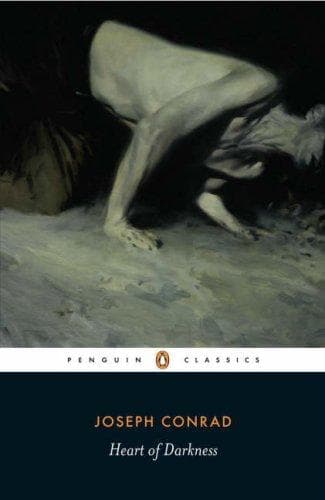
Heart of Darkness
Joseph Conrad·1899·Blackwood's Magazine (serial)·Literature
Reading level: Ages 16+ (adult) · 4-hour read · Intermediate difficulty.
- Reading time
- 4h
- Difficulty
- Intermediate
- Recommended age
- Ages 16+
- Guide read
- 5min
- Editor's rating
- 4.4 / 5
- joseph-conrad
- colonialism
- africa
- british-literature
- modernism
- novella
- canonical
- 1890s
— In one sentence —
A novella about colonialism so honest that it became the standard against which colonialism's literature is measured — and so limited that Chinua Achebe said it dehumanized Africa. Both things are true.
§ 01 · WHY READ
Why read
Joseph Conrad published Heart of Darkness serially in Blackwood's Magazine in 1899, based on his own journey up the Congo River in 1890 as the captain of a Belgian steamboat. He had gone to Africa partly to fulfill a childhood dream — as a boy in Poland, he had put his finger on a blank space on a map of Africa and said he would go there — and partly because he needed work. What he found was the Congo Free State: the private colony of King Leopold II of Belgium, where rubber was extracted from the jungle through forced labor, mutilation, and mass murder. Estimates of the death toll during the Leopold era range from one to ten million Congolese people. Conrad was there for five months, contracted dysentery and malaria, and came back changed.
The novella: Marlow, a sailor, tells a story on a boat on the Thames about his journey up an unnamed river in Africa (obviously the Congo) to find Kurtz, a brilliant ivory trader who has become a god to the local people and whose methods have alarmed the Company. What Marlow finds at the end of the river is what colonial enterprise looks like from inside rather than from the marketing brochures.
Conrad's contribution is real and limited simultaneously. He was among the first major European writers to represent colonialism not as civilization but as horror. The darkness of the title refers to European civilization, not Africa. The Belgians in the novella are the savages; the Africans are dignified in their suffering. For 1899, this is extraordinary.
Chinua Achebe's 1975 essay "An Image of Africa: Racism in Conrad's 'Heart of Darkness'" named the limit: despite Conrad's intentions, Africa in the novella is backdrop — a setting for the drama of a European consciousness, not a place where African people exist with their own interiority. The Africans are described in terms that reproduce exactly the dehumanizing language Conrad meant to critique. Achebe called it a racist text.
Both readings are available. Reading the novella now requires holding both.
§ 02 · CHARACTERS
Characters
Marlow — the narrator; a sailor who has worked for most of his life on ships, who frames the telling of his story on a boat on the Thames as dusk falls. He is Conrad's most important recurring character, deployed across several works. He is perceptive, morally serious, and self-questioning — and limited by his era's assumptions in ways he cannot always see. The narration is his reconstruction of an experience that disturbed him enough that he still needs to talk about it years later.
Kurtz — the man Marlow has been sent to find. He is never described clearly; he exists mostly as report and rumor before Marlow reaches him. He was sent to Africa to bring civilization; he has instead appointed himself a god, conducted rituals the novella doesn't name, and placed the heads of his enemies on posts around his compound. His final words — "The horror! The horror!" — have been interpreted as condemnation, revelation, and evasion for 125 years.
The Intended — Kurtz's fiancée in Brussels, who has waited for him and believes he was a great man. Marlow visits her after Kurtz's death and lies to her about his last words. The lie — and Marlow's explanation for why he told it — is the novella's most debated passage.
The Company's agents — Belgian functionaries in the Congo outpost, described with barely-concealed contempt: the "pilgrims" who carry staves and believe they're doing good while extracting ivory from a system of forced labor. They are Conrad's satirical portrait of the colonial bureaucracy.
§ 03 · HIGHLIGHTS
Three highlights
No. 1 · The outer station. Marlow arrives at the Company's first station and finds Africans dying in the shade — brought from their villages to work, now too sick to be useful, left to die. He gives one man a ship's biscuit and moves on. The scene is Conrad at his most direct: the specific mechanism of how colonial extraction works — the administrative indifference, the dying bodies in the shade, the small gesture that cannot change anything — is rendered with documentary precision.
No. 2 · Kurtz's report. Kurtz has written a pamphlet for the International Society for the Suppression of Savage Customs — seventeen pages about the potential for Europeans to appear as supernatural beings to "primitive" Africans and thereby spread civilization. The pamphlet is eloquent, idealistic, and insane. At the bottom, in a postscript written much later, Kurtz has added: "Exterminate all the brutes!" Conrad's portrait of how civilizing ideology and genocidal violence coexist in the same document, written by the same man, is one of literature's most precise statements about colonialism's self-deception.
No. 3 · "The horror! The horror!" Kurtz's last words. Marlow interprets them as a judgment — that Kurtz, at the end, could see himself and his actions clearly, and that this clarity was a form of moral superiority over those who never saw at all. This interpretation is contested. The words can also be read as narcissistic self-pity, or as meaningless last sounds from a dying man, or as Conrad's formal evasion of a conclusion he didn't know how to write. The ambiguity is the point, or it is the problem. Readers disagree.
§ 04 · EDITIONS
Recommended editions
| Edition | Why pick it |
|---|---|
| Penguin Classics (with Achebe essay) | Several Penguin editions include Achebe's "An Image of Africa" essay as an appendix. Read the essay after the novella. It is essential. |
| Norton Critical Edition | The standard scholarly edition; includes the Achebe essay, Conrad's letters, and extensive critical apparatus. Best for readers who want the full context. |
| Oxford World's Classics | Clean text with a good introduction; reads the novella in its historical context. |
The novella has been adapted twice significantly: Francis Ford Coppola's Apocalypse Now (1979) transposes the story to the Vietnam War (brilliant and worth watching) and Werner Herzog's Fitzcarraldo (1982) is less an adaptation than a parallel journey. Neither replaces the text.
§ 05 · FIT
Who it's for / not for
Read this if you are…
- Interested in how literature has engaged with colonialism — and the limits of that engagement.
- Reading it in relation to Chinua Achebe's Things Fall Apart or An Image of Africa: the comparison is the most productive way to understand what Conrad achieved and what he couldn't see.
- A reader of modernist prose: Conrad's layered narration — a narrator telling a story told by another character — is an important formal development in the history of the novel.
Skip it if you are…
- Looking for a novel in which African characters have interiority. They do not. Achebe's critique applies; read Things Fall Apart first if you want to see what African literature looks like from inside rather than from outside.
- Wanting resolution or clarity. The novella ends ambiguously and Marlow lies; Conrad does not adjudicate his own narrator's morality.
§ 06 · TIPS
Reading tips
- Read Achebe's essay after finishing the novella. Many editions include it. It will change what you understand you just read — not by making you discard the novella but by showing what it cannot see.
- The nested narration is intentional. A narrator tells us that Marlow tells a story. The distance is formal: Conrad is building in the unreliability of any European account of Africa, including his own.
- "Exterminate all the brutes!" is the thesis. Find it on the page. Kurtz's postscript is Conrad's compressed statement about the relationship between civilizing ideology and genocidal violence.
- Marlow's lie to the Intended at the end is the most discussed passage. Why does he lie? Does the novella think he was right to? What does his explanation tell you about his view of women?
§ 07 · COMPARE
Read alongside
- Chinua Achebe — Things Fall Apart (1958). The necessary companion: the Igbo world that colonialism destroyed, told from inside that world. Achebe wrote it in direct response to the tradition Conrad represents.
- Adam Hochschild — King Leopold's Ghost (1998). The history: what actually happened in the Congo Free State. Conrad's novella is fiction; Hochschild's book is the documented record of what Conrad was describing.
- George Orwell — "Shooting an Elephant" (1936). The essay in which Orwell describes shooting an elephant in Burma to avoid losing face in front of the Burmese crowd; the clearest short-form account of how colonial power corrupts the colonizer.
- Frantz Fanon — The Wretched of the Earth (1961). The political theory companion: Fanon's analysis of how colonialism functions psychologically and politically. Where Conrad sees horror in the colonizer, Fanon sees the structural logic.
§ 08 · DISCUSSION
Discussion questions
- Achebe argued that Heart of Darkness dehumanizes Africa and Africans, making them background for a European psychological drama. Having read the novella, do you think the critique is fair? Is it possible to hold both Conrad's achievement and Achebe's critique simultaneously?
- Kurtz's pamphlet advocates using European supernatural authority to "spread civilization"; his postscript says "Exterminate all the brutes." How does Conrad use this document to make an argument about colonial ideology?
- Marlow lies to Kurtz's Intended about his last words. He tells her they were her name. Why does he lie? Does the novella condone his decision?
- The darkness of the title refers, in Conrad's argument, to European civilization rather than Africa. Does the novella succeed in making this reversal? Or does the text undermine its own thesis?
- Marlow describes the Africans he encounters in terms that Achebe identifies as reproducing colonial dehumanization. Is Conrad aware of this? Does intention matter?
- Kurtz is never described clearly — he exists mostly as rumor and report before Marlow reaches him. What effect does this have? Why does Conrad keep him offscreen for so long?
- The novella was serialized in 1899, at the peak of European colonial expansion. What would a contemporary reader have seen that a modern reader doesn't? What do we see now that the 1899 reader couldn't?
- "The horror! The horror!" has been interpreted as moral clarity, narcissistic self-pity, evasion, and meaningless dying sound. Which reading do you find most convincing, and why?
One line to remember
“The horror! The horror!”— Kurtz — Part III
Appears in collections
Reading lists featuring this book
5 books
The Best Books About Colonialism
Five novels that look at empire as a mechanism — what it does to colonizers and colonized, and what it costs to refuse to look away.
Open list →
6 books
Books About Power and Corruption
Six novels, six different mechanisms — all recognizable from today's news.
Open list →
6 books
The Best Books About War and Its Cost
Six novels about what war actually does — not to nations, but to people.
Open list →
8 books
Books You Can Read in One Sitting
Sorted by length — from two hours to a full afternoon. Each one built for continuous reading.
Open list →
10 books
Short and Devastating: Ten Classics You Can Read in a Weekend
The most efficient literature ever written. None longer than 200 pages. All of them permanent.
Open list →
You might also like
Read next
William Faulkner · 1936
Absalom, Absalom!
Four narrators reconstruct a man who destroyed his family. The story keeps changing. That is the point.
Read · 7 min
Toni Morrison · 1987
Beloved
Toni Morrison said she wrote this novel to give voice to the sixty million. It won the Pulitzer, the Nobel, and is the greatest American novel of the second half of the twentieth century.
Read · 6 min
Leo Tolstoy · 1878
Anna Karenina
Not just a love story. Two parallel lives — Anna's destruction, Levin's salvation — ask the same question: how should a person live?
Read · 6 min