Editor-reviewed
The Lion, the Witch and the Wardrobe
C. S. Lewis·1950·Geoffrey Bles·Sci-Fi & Fantasy
Reading level: Ages 8–12 (middle grade) · 5-hour read · Beginner difficulty.
- Reading time
- 5h
- Difficulty
- Beginner
- Recommended age
- Ages 8–12
- Guide read
- 4min
- Editor's rating
- 4.6 / 5
- cs-lewis
- narnia
- fantasy
- childrens-fiction
- allegory
- classic
- series
— In one sentence —
Four children. A wardrobe. A world under permanent winter. The book that made secondary worlds legitimate for children's literature.
§ 01 · WHY READ
Why read
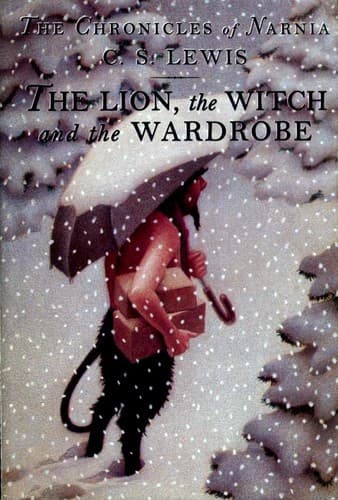
C. S. Lewis began The Lion, the Witch and the Wardrobe in 1939, when children evacuated from London during the Blitz were being housed with him at his home in Oxford. He had been thinking about a story with a faun carrying an umbrella in a snowy wood for years; the evacuees gave him the children. He finished the book in 1949; it was published in 1950 with illustrations by Pauline Baynes, to whom Lewis gave detailed instructions.
The premise is known to almost everyone who has read English-language children's fiction: four siblings — Peter, Susan, Edmund, and Lucy Pevensie — are evacuated from London to an old professor's house in the country. Lucy discovers that a wardrobe leads to another world, Narnia, which is held under permanent winter by the White Witch (who has made it always winter, never Christmas). She is followed eventually by her siblings. Aslan, the great Lion, returns; the Witch's power is broken; the children become kings and queens.
Lewis achieves something technically difficult: he makes a secondary world feel inevitable from the first paragraph. The wardrobe is not introduced with fanfare; it is described the way children actually encounter extraordinary things — accidentally, in a moment of boredom, while looking for somewhere to hide. The entry into Narnia is not an adventure beginning; it is Lucy noticing that the wardrobe doesn't seem to have a back.
The Christian allegory — Aslan as Christ, the Stone Table as the crucifixion, the Witch as evil — is present throughout and has been analyzed extensively. Lewis himself resisted calling it allegory, preferring to say he was asking what might happen if a Christlike figure appeared in a world like Narnia. For readers who don't share the Christianity, the mythic structure holds independently: sacrifice and resurrection are older than Christianity, and Lewis drew on Norse mythology and Greek sources as freely as on the Gospels.
§ 02 · CHARACTERS
Characters
Lucy Pevensie — the youngest sibling and the first to find Narnia. She is the novel's moral center: the one who sees clearly when others don't, who believes when belief requires courage, who is kind to the Faun Tumnus when kindness costs her something. Lewis was reportedly fond of her above the other Pevensie children.
Edmund Pevensie — the second brother, who betrays his siblings to the White Witch for Turkish Delight and a promise of power. His trajectory — betrayal, captivity, rescue, redemption — is the novel's most complete character arc, and Lewis handles his rehabilitation without sentimentality. Edmund becomes, in the later Narnia books, a figure of wisdom precisely because of what he did and what was done for him.
Aslan — the Great Lion; the son of the Emperor-over-the-Sea. Lewis was asked late in his life what he was thinking when he created Aslan and said he had asked himself: suppose there were a Narnian world, and it needed redemption — what might the Son of God look like there? Aslan is not safe, as Mr. Beaver notes. He is good.
The White Witch (Jadis) — makes it always winter, never Christmas. Her power is the deep magic; Aslan's sacrifice invokes the deeper magic. She is frightening because she is logical: her rules are correct within the framework of the world she controls. Her defeat is not the repudiation of rules but the discovery that she didn't know all of them.
Mr. and Mrs. Beaver — who shelter the children and explain Narnia to them. They are among Lewis's most charming creations: domestic, practical, brave, loyal. Mrs. Beaver making sure to bring her sewing machine during the hurried escape is one of the novel's best jokes.
§ 03 · HIGHLIGHTS
Three highlights
No. 1 · The first entry. Lucy pushes through the fur coats in the wardrobe, feels the softness give way to something harder, sees light ahead, and steps out into snow under lamplight. Tumnus is already there, looking as surprised to see her as she is to see him. Lewis renders the transition from the ordinary to the extraordinary without announcement, and the lamppost in the middle of a snowy wood became one of fantasy fiction's defining images.
No. 2 · Aslan's death and resurrection. Edmund is saved by Aslan's sacrifice on the Stone Table — the Deep Magic demands his life; Aslan gives his own instead. The Witch kills him; his resurrection at dawn is discovered by Lucy and Susan, who had stayed with the body. Lewis's rendering of the resurrection uses a different register from the rest of the novel — slower, more solemn — and the scene holds regardless of the reader's relationship to the theological original.
No. 3 · The golden age and departure. The Pevensies reign as kings and queens of Narnia for years, growing into adults, until they follow a white stag close to a lamp-post in a wood, push through branches — and tumble back out of the wardrobe as children, seconds after they left, with no time passed in England. Lewis handles this transition with a single paragraph and no emotional punctuation, which is more devastating than any amount of sentiment would have been.
§ 04 · EDITIONS
Recommended editions
| Edition | Why pick it |
|---|---|
| HarperCollins (Pauline Baynes illustrations) | The standard edition with the original illustrations; the visual language Baynes created for Narnia is integral. Start here. |
| HarperCollins (full-color Baynes illustrations) | A newer edition with the illustrations colorized by Baynes herself late in her life; beautiful. |
| The Complete Chronicles of Narnia (boxed set) | For reading all seven books. The correct reading order debate: publication order (LWW first) vs. chronological (Magician's Nephew first). Lewis said chronological; most Narnia readers recommend publication order for first-time readers. |
| Audiobook (Kenneth Branagh) | Branagh's reading is warm and properly paced; the best widely available audio version. |
§ 05 · FIT
Who it's for / not for
Read this if you are…
- Reading it with a child: the read-aloud experience is exceptional, and Lewis wrote for his goddaughter Lucy Barfield with an adult's voice reading aloud in mind.
- An adult who read it as a child and wants to re-read with the allegorical layer visible. The two readings are genuinely different.
- Anyone interested in the construction of fantasy worlds: Narnia is the clearest example of a secondary world built from an image outward rather than from a map inward.
Skip it if you are…
- Bothered by the Christian allegory and unable to read it as myth. The allegory is not subtle in the later chapters; if it alienates you rather than enriching the story, the book will be frustrating.
- Looking for a fantasy novel with the structural complexity of Tolkien. Narnia is shorter, simpler, and more episodic; it's not trying to do what The Lord of the Rings does.
§ 06 · TIPS
Reading tips
- Read publication order, not chronological order, if this is your first time. The Lion, the Witch and the Wardrobe was written first and works best as a first encounter with Narnia.
- The Baynes illustrations are part of the text. Lewis approved them and considered them integral. Read an edition that includes them.
- Edmund's redemption is quick. Lewis doesn't linger on it — by the battle, Edmund is fully alongside his siblings. This is deliberate; Lewis was making a theological argument about the completeness of forgiveness.
- The ending's emotional economy is unusual. The golden age of the Pevensies' reign is covered in a paragraph; the return through the wardrobe in a sentence. Lewis earns the compression because the preceding pages have earned your investment.
§ 07 · COMPARE
Read alongside
- C. S. Lewis — The Magician's Nephew (1955). The origin story of Narnia; chronologically first but written sixth. Read LWW first; then Magician's Nephew enriches the wardrobe and the lamppost.
- J. R. R. Tolkien — The Hobbit (1937). Lewis and Tolkien were friends and read early drafts to each other. The comparison between their fantasy worlds — Narnia's episodic directness versus Middle-earth's accumulated depth — is illuminating.
- Philip Pullman — The Golden Compass (1995). The direct response: Pullman wrote his trilogy explicitly as a counter-argument to the Narnia books' theology. Reading them together is a genuine literary debate.
- Ursula K. Le Guin — A Wizard of Earthsea (1968). The other great 20th-century children's fantasy: a secondary world built with a different kind of rigor, a different relationship to myth, a different implicit theology.
- George MacDonald — The Princess and the Goblin (1872). Lewis's most important influence; he called MacDonald his master. The fantasies of MacDonald are the direct predecessors of Narnia.
§ 08 · DISCUSSION
Discussion questions
- The allegory — Aslan as Christ, his sacrifice and resurrection — is central. Does it work if you don't share the theology? What makes a myth hold for readers who don't believe the literal version?
- Edmund betrays his siblings for Turkish Delight and power. Lewis doesn't make him a villain; he makes him a child who does a terrible thing. How does the novel handle his redemption? Is it convincing?
- Aslan is "not safe, but good." What does this distinction mean? How does the novel dramatize it?
- The children are crowned kings and queens of Narnia and reign for years before returning through the wardrobe as children with no time elapsed in England. What does this ending argue?
- Susan's eventual exclusion from Narnia (mentioned in The Last Battle) is controversial. Does The Lion, the Witch and the Wardrobe foreshadow it? What do you make of it?
- Lewis wrote the book partly for children evacuated from London during the Blitz. How does the wartime context shape the novel's concerns?
- Pullman has called the Narnia books propaganda. Lewis would have said they were myth. What's the difference? Is Pullman's criticism fair?
- The novel is very short — five hours to read. What does Lewis achieve in that compression that longer fantasies might lose?
One line to remember
“Wrong will be right, when Aslan comes in sight, / At the sound of his roar, sorrows will be no more.”— Mr. Beaver — Chapter 8
Appears in collections
Reading lists featuring this book
7 books
The Best Books for 8-Year-Olds
Seven books an eight-year-old can actually finish — and remember the rest of their life.
Open list →
10 books
The Gateway: Fantasy for Young Readers Ages 8–12
The books that made readers. A curated path into fantasy for children who are ready for a real story.
Open list →
You might also like
Read next
Ted Chiang · 2002
Stories of Your Life and Others
Ted Chiang writes 30-page stories that take longer to think about than most novels. He has won more awards per word than any writer alive.
Read · 5 min
Cixin Liu · 2008
The Dark Forest
Fan + author consensus pick for the best book in the trilogy. Two simple axioms derive the silence of the universe. After this one, you don't look at the night sky the same way.
Read · 5 min
Octavia E. Butler · 1979
Kindred
Octavia Butler sends a Black woman from 1976 Los Angeles back to antebellum Maryland. The time travel is a device. The horror is real.
Read · 5 min