Editor-reviewed
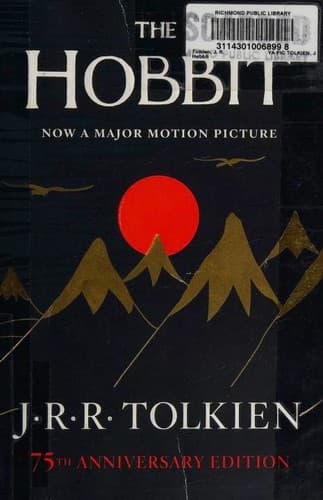
The Hobbit
J. R. R. Tolkien·1937·Allen & Unwin·Sci-Fi & Fantasy
Reading level: Ages 10–12 (middle grade) · 11-hour read · Beginner difficulty.
- Reading time
- 11h
- Difficulty
- Beginner
- Recommended age
- Ages 10–12
- Guide read
- 5min
- Editor's rating
- 4.6 / 5
- fantasy
- middle-earth
- tolkien
- quest
- children
- classic
- read-aloud
- adventure
— In one sentence —
Tolkien wrote this for his children. It became the template for modern fantasy and the gateway to one of the most fully realised imaginary worlds in literature.
§ 01 · WHY READ
Why read
J. R. R. Tolkien wrote the opening sentence of The Hobbit on a blank examination paper he was marking in 1930. "In a hole in the ground there lived a hobbit." He didn't know what a hobbit was — the word appeared before the concept. He spent the following years finding out, and the result was published in 1937 to warm reviews and a letter from Stanley Unwin, his publisher, reporting that his ten-year-old son Rayner had evaluated the manuscript for eight shillings and recommended publication.
This origin — a story told for children, evaluated by children — is essential to reading The Hobbit correctly. Tolkien was a professor of Anglo-Saxon at Oxford and an expert in Norse and Finnish mythology; the world he built has more linguistic and mythological depth than most adult literary fiction manages. But the story he chose to tell within that world, for the first book, is specifically calibrated for the young and the child-in-adults: a comfortable homebody is dragged out of his comfortable home by a wizard and a company of dwarves to reclaim a treasure from a dragon, and in the course of the journey discovers that he is braver, more resourceful, and more essential than anyone expected, including himself.
The emotional argument of The Hobbit is that the life you think you want — comfort, routine, the second breakfast, the doily on the mantelpiece — is less than what you're capable of. This is not a complicated argument. It is, however, an inexhaustible one, and Tolkien makes it with a warmth and a narrative momentum that no amount of knowing it in advance diminishes.
The book is also, simply, an exceptionally well-crafted adventure. The riddle contest between Bilbo and Gollum in the dark (Chapter 5) is one of the best set-pieces in English fantasy; the conversation between Bilbo and Smaug (Chapter 12) is a masterclass in how to write a villain who is intelligent, vain, and genuinely dangerous.
§ 02 · CHARACTERS
Characters
The Hobbit's cast is deliberately large (thirteen dwarves plus Bilbo plus Gandalf) and Tolkien doesn't fully individualize all of them — this is one of the book's acknowledged limitations. What the cast does achieve is a contrast between the types of adventurer and the type Bilbo represents.
Bilbo Baggins — the protagonist. A hobbit of the Shire: respectable, comfortable, attached to his kitchen and his routine. His defining characteristic is that he is braver than he knows, but only in specific moments and only when there is no time to think. The riddle contest works because Bilbo has to answer immediately; the conversation with Smaug works because Bilbo has to improvise. The dragon Bilbo defeats in the end he defeats not by force but by wit — which is Tolkien's portrait of what kind of heroism he finds worth celebrating.
Gandalf — the wizard who sets everything in motion. He is more opaque in The Hobbit than in The Lord of the Rings: we see him mostly as a facilitator, an explainer, and an occasional deus ex machina. He disappears for long stretches and reappears when necessary. The mystery is deliberate; it deepens considerably if you read the later books.
Thorin Oakenshield — the leader of the dwarves, a king in exile trying to reclaim his ancestral home. He is proud, brave, sometimes infuriating, and genuinely tragic: dragon-sickness (the obsessive attachment to gold) is the flaw that makes his arc more than a simple victory. He is not a villain; he is a hero with a fatal weakness, and Tolkien treats him with appropriate complexity.
Gollum — appears in one chapter and becomes one of the most important characters in modern fantasy. The riddle game in the dark is his introduction; what he is and what he becomes is the subject of The Lord of the Rings. In The Hobbit he is an excellent monster: pitiable, dangerous, and genuinely strange.
Smaug — the dragon, who appears relatively late and is gone quickly. What he demonstrates in two chapters is that Tolkien understood how to write a villain: Smaug is vain, perceptive, and too clever, and the conversation with Bilbo — in which Bilbo flatters and misleads him while Smaug tries to extract Bilbo's identity and purpose — is a masterclass in dramatic irony and the comedy of competing intelligences.
§ 03 · HIGHLIGHTS
Three highlights
No. 1 · "Riddles in the Dark." Chapter 5. Bilbo, lost in the goblin tunnels, finds a ring and encounters Gollum. They play a riddle game for stakes: if Bilbo wins, Gollum shows him the way out; if Bilbo loses, Gollum eats him. The riddles themselves are clever and traditionally structured; what makes the chapter exceptional is the atmosphere — total darkness, an underground lake, a creature who is simultaneously pathetic and deadly — and the moral complexity Tolkien introduces: Bilbo wins partly by accident and partly by a question ("What have I got in my pocket?") that doesn't strictly qualify as a riddle. The victory is impure. Tolkien doesn't comment on this; the reader is left with it.
No. 2 · The conversation with Smaug. Chapter 12. Bilbo, invisible (thanks to the ring), enters Smaug's chamber alone. The dragon is awake. The resulting conversation — Bilbo inventing flattering riddle-names for himself, Smaug probing for his real purpose, both of them performing intelligence at each other — is one of the great comic exchanges in fantasy. Its stakes are entirely real: Smaug is looking for a gap in Bilbo's armor while Bilbo is looking for a gap in Smaug's. Bilbo finds it: a patch of bare scales on Smaug's chest that the dragon thought was covered. The information will be used by someone else; Bilbo's contribution is the reconnaissance.
No. 3 · Bilbo's return. The end of the journey: Bilbo returns to the Shire to find that neighbors, assuming he is dead, are auctioning his furniture and silverware. He buys some of it back. He has lost his reputation for respectability and gained something else, which Tolkien does not name precisely — a life worth remembering, a self that has been tested, a story. The contrast between what Bilbo lost (the doily, the reputation) and what he gained (everything he experienced, Gandalf's friendship, a sword, a ring he doesn't yet understand) is Tolkien's argument in miniature.
§ 04 · EDITIONS
Recommended editions
| Edition | Why pick it |
|---|---|
| Houghton Mifflin / Allen & Unwin (standard paperback) | The canonical text, clean and unadorned. |
| Illustrated by Tolkien himself (2020 edition) | Tolkien drew the maps and illustrations for the original edition; several current editions restore these. Get one with his original illustrations. |
| Alan Lee illustrated edition (HarperCollins) | Beautiful painted illustrations; different in feel from Tolkien's own but excellent. |
| The Annotated Hobbit (Douglas A. Anderson) | For readers who want the textual history, the sources, and Tolkien's own commentary. Not a first-read edition; return to it after. |
| Andy Serkis audiobook (HarperCollins, 2020) | Serkis performs all characters, including a memorable Gollum. Exceptional for read-aloud with children or commuting. |
The Peter Jackson film trilogy (2012–2014) expands the novel significantly — three films from one short book. The added material (much of it from Tolkien's appendices) is sometimes excellent and sometimes excessive. See the films after reading; the novel's scale and tone are lighter than Jackson's adaptation.
§ 05 · FIT
Who it's for / not for
Read this if you are…
- A first-time fantasy reader of any age. This is the safest entry point to the genre.
- A parent planning to read aloud: exceptionally suited. Tolkien's prose reads well aloud; the songs and poems work better spoken.
- A reader who has watched the Lord of the Rings films but never read the books. Start here.
- An adult who read this as a child and hasn't returned. The adult reading is different — Tolkien's craft is more visible, and Thorin's arc carries more weight.
Skip it if you are…
- Looking for moral complexity in the characters. Most of the dwarves are not fully individualized, and the story's ethics are relatively clear.
- Starting Middle-earth with the goal of reaching The Lord of the Rings as quickly as possible. That is a reasonable goal; just know that The Hobbit has a lighter tone and different narrative register.
§ 06 · TIPS
Reading tips
- Read the songs and poems, don't skip them. Tolkien was a philologist; the language of the songs is load-bearing, not decoration. "Far over the misty mountains cold" at the opening is the novel's first emotional statement.
- Don't worry too much about which dwarf is which. Tolkien individualizes Thorin, Fíli, Kíli, Balin, and Bombur; the others are largely interchangeable, and this is fine.
- Chapter 5, "Riddles in the Dark," is the novel's moral and narrative peak. If you've been reading steadily and need a reason to continue, read that chapter and see if it works.
- The ending is deliberately quieter than the climax. This is intentional: Tolkien is interested in what the adventure does to Bilbo more than in the victory itself.
§ 07 · COMPARE
Read alongside
- J. R. R. Tolkien — The Lord of the Rings (1954–55). The direct sequel, in which everything The Hobbit established (the ring, Gollum, the world, Gandalf) becomes fully consequential. Begin The Fellowship of the Ring when you've finished here.
- C. S. Lewis — The Lion, the Witch and the Wardrobe (1950). Written by Tolkien's closest friend and literary colleague; both books emerged from the same Oxford circle (the Inklings). The comparison is illuminating.
- Ursula K. Le Guin — A Wizard of Earthsea (1968). The other foundational fantasy novel of the 20th century: a different approach to magic, a non-Western setting, a more philosophically demanding argument.
- Lloyd Alexander — The Book of Three (1964). Tolkien's most direct American successor in children's fantasy; five books of the Prydain Chronicles, beginning here.
- Susan Cooper — The Dark is Rising (1973). British children's fantasy drawing on the same mythological sources (Arthurian legend, Norse myth) as Tolkien, at a different register.
§ 08 · DISCUSSION
Discussion questions
- Bilbo is chosen for the adventure by Gandalf, not by any quality Bilbo himself is aware of. What does Gandalf see in him? Is Gandalf right?
- The riddle contest is a formal game with rules — but Bilbo wins partly through a question that isn't technically a riddle. Is this cheating? Does the novel think so?
- Thorin is proud and sometimes difficult. At what point does his pride become dragon-sickness? Is there a clear line?
- Bilbo steals the Arkenstone and gives it to Thorin's enemies, then confesses. He knows Thorin may kill him for it. What does this act reveal about who Bilbo has become over the course of the journey?
- The dwarves' claim to the Lonely Mountain is a claim of ancestral right — it was their home before Smaug took it. Is their quest just? What about the residents of Lake-town and Dale who live under Smaug's shadow?
- Bilbo returns to find his furniture being auctioned. He buys some of it back but his reputation is gone. Is this a loss or a gain? What does Tolkien think?
- The novel ends with Gandalf and Bilbo discussing how small Bilbo is in the grand scheme of things. What is Tolkien saying about the relationship between individual adventure and large historical forces?
- The Hobbit was written for children, The Lord of the Rings for adults. What changes between them, and what stays the same? If you've read both, which do you find more true?
One line to remember
“In a hole in the ground there lived a hobbit.”— Chapter 1 — An Unexpected Party
Appears in collections
Reading lists featuring this book
7 books
The Best Book Gifts for Christmas
Seven novels that survive being unwrapped in front of an audience.
Open list →
7 books
The Best Books for 10-Year-Olds
Seven books for the year a child stops needing books to be easy.
Open list →
12 books
Best Children's Books by Age
A parent-friendly reading list from baby read-alouds and picture books to early readers, first chapter books, middle grade, and teen crossover.
Open list →
10 books
The Gateway: Fantasy for Young Readers Ages 8–12
The books that made readers. A curated path into fantasy for children who are ready for a real story.
Open list →
You might also like
Read next
Ted Chiang · 2002
Stories of Your Life and Others
Ted Chiang writes 30-page stories that take longer to think about than most novels. He has won more awards per word than any writer alive.
Read · 5 min
Cixin Liu · 2008
The Dark Forest
Fan + author consensus pick for the best book in the trilogy. Two simple axioms derive the silence of the universe. After this one, you don't look at the night sky the same way.
Read · 5 min
Octavia E. Butler · 1979
Kindred
Octavia Butler sends a Black woman from 1976 Los Angeles back to antebellum Maryland. The time travel is a device. The horror is real.
Read · 5 min