Editor-reviewed
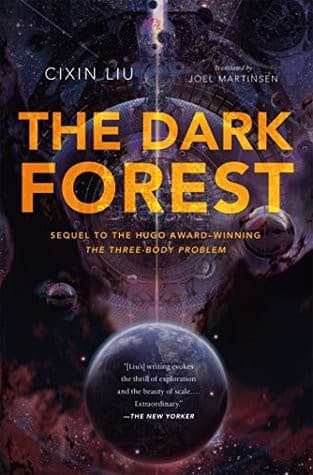
The Dark Forest
Remembrance of Earth's Past · Book Two
Cixin Liu·2008·Tor Books·Sci-Fi & Fantasy
Reading level: Ages 16+ (adult) · 16-hour read · Advanced difficulty.
- Reading time
- 16h
- Difficulty
- Advanced
- Recommended age
- Ages 16+
- Guide read
- 7min
- Editor's rating
- 4.4 / 5
- hard-sf
- chinese-sf
- first-contact
- netflix-adaptation
- series-sequel
— In one sentence —
The second Remembrance of Earth's Past novel, where first contact becomes strategy, secrecy, and cosmic deterrence.
§ 01 · WHY READ
Why read
The Dark Forest is Book 2 of Cixin Liu's Remembrance of Earth's Past trilogy. Netflix identifies 3 Body Problem as based on Liu's bestselling novels and has said the series is continuing into the later material. Macmillan's Tor route lists The Dark Forest in the trilogy and supplies the English edition path.
This is the book many readers mean when they say the trilogy becomes frightening. The Three-Body Problem asks whether humanity deserves to survive first contact. The Dark Forest asks what survival even means when an enemy can see almost everything humans do. The answer is the Wallfacer Project: give a few people massive authority because their private thoughts cannot be monitored.
Read it if the Netflix series made you curious about where the premise goes after first contact. The book is colder, bigger, and more strategic than Book 1. It is also the source of the trilogy's most famous idea: the dark forest theory of cosmic civilization.
§ 02 · CHARACTERS
Characters
Luo Ji is the unlikely center, chosen as a Wallfacer before he understands why. His passivity is frustrating on purpose before the book reveals its shape.
Da Shi returns as the human-scale counterweight to institutions, science, and panic.
The Wallfacers are less traditional heroes than experiments in secrecy. Each represents a different answer to a monitored war.
Trisolaris remains mostly distant, which makes the threat stranger. The enemy's pressure is everywhere before its bodies are anywhere.
§ 03 · HIGHLIGHTS
Three highlights
No. 1 - The Wallfacer premise. It turns privacy into a military technology.
No. 2 - Cosmic horror without monsters. The fear comes from logic, distance, and game theory.
No. 3 - Strong adaptation window. Netflix's continuation keeps Book 2 unusually relevant for show-first readers who want the larger answer.
§ 04 · EDITIONS
Recommended editions
| Edition | Why pick it |
|---|---|
| Tor paperback | Main English reading edition, ISBN 9780765377081. |
| Macmillan Audio | Good if you want the strategic sections in long form. |
| Trilogy boxed set | Best if you already know you will read Death's End. |
| Chinese original | Worth choosing if you read Chinese and want Liu's prose without translation. |
§ 05 · FIT
Who it's for / not for
Read this if you are...
- Continuing after The Three-Body Problem.
- Coming from Netflix and willing to read beyond Season 1 material.
- Interested in hard SF, deterrence, game theory, and civilizational stakes.
- More interested in ideas than intimate character realism.
Skip it if you are...
- New to the trilogy.
- Looking for warm character work.
- Avoiding bleak views of humanity and the universe.
- Impatient with long strategic setup before payoff.
§ 06 · TIPS
Reading tips
- Do not start here. Book 1 supplies the crisis and the emotional cause.
- Be patient with Luo Ji. His apparent drift is part of the design.
- Read the Wallfacers as arguments. Each strategy tells you something about human fear.
- Expect Netflix changes. The show may combine, rename, or relocate characters while keeping the large ideas.
§ 07 · COMPARE
Read alongside
- Cixin Liu - The Three-Body Problem. The required first book.
- Cixin Liu - Death's End. The final escalation after this book.
- Isaac Asimov - Foundation. For civilization-scale SF with a very different faith in prediction.
- Frank Herbert - Dune Messiah. For political consequences after a famous first volume.
- Ted Chiang - Stories of Your Life and Others. For concept-driven SF with more intimate craft.
§ 08 · DISCUSSION
Discussion questions
- Why does the Wallfacer Project depend on privacy rather than intelligence alone?
- Is Luo Ji a weak protagonist, or is the book using weakness as a strategy?
- What makes the dark forest theory persuasive inside the novel?
- Does the book treat deterrence as moral, necessary, or horrifying?
- How does Da Shi change the tone when the ideas become abstract?
- Where might Netflix need to simplify the book for television?
- Does the sequel make Book 1 feel smaller or more important?
- What does the book assume about communication between civilizations?
One line to remember
“When every plan can be watched, the human mind becomes the last locked room.”— bibliotecas editorial summary, not a textual quotation
You might also like
Read next
Ted Chiang · 2002
Stories of Your Life and Others
Ted Chiang writes 30-page stories that take longer to think about than most novels. He has won more awards per word than any writer alive.
Read · 5 min
Octavia E. Butler · 1979
Kindred
Octavia Butler sends a Black woman from 1976 Los Angeles back to antebellum Maryland. The time travel is a device. The horror is real.
Read · 5 min
Octavia E. Butler · 1993
Parable of the Sower
Written in 1993 as a near-future extrapolation of Los Angeles. It reads now as contemporary history.
Read · 5 min