Golden set · editor-reviewed
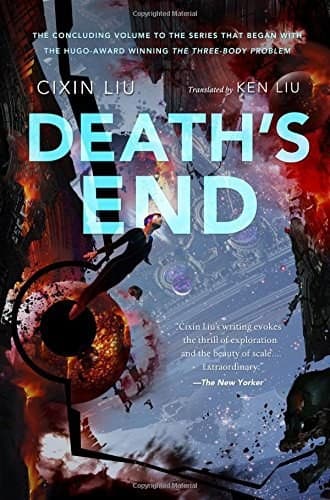
Death's End
Remembrance of Earth's Past · Book Three
Cixin Liu·2010·Tor Books·Sci-Fi & Fantasy
Reading level: Ages 14+ (adult) · 20-hour read · Advanced difficulty.
- Reading time
- 20h
- Difficulty
- Advanced
- Recommended age
- Ages 14+
- Guide read
- 5min
- Editor's rating
- 4.4 / 5
- hard-sf
- chinese-sf
- cosmic-horror
- deep-time
- trilogy-finale
— In one sentence —
The most ambitious and most divisive book in 21st-century SF. 22 billion years of cosmic history. Two morally catastrophic decisions by one woman. One universe reset at the end.
§ 01 · WHY READ
Why read
Death's End is the trilogy's most ambitious and most controversial book, and the controversy is mostly worth reading for.
The ambition. Cixin Liu stretches the timescale from 200 years to 22 billion years, taking humanity from a precarious deterrence equilibrium, through dimensional attack, through the heat death of the universe, to the choice of whether to leave a final pocket-universe behind. Almost no other novel has tried this. The closest comparisons — Stapledon, Clarke at his most cosmic, Egan in Diaspora — are all books that read like thought experiments. Liu writes one that reads like a tragedy.
The controversy. The protagonist, Cheng Xin, is a soft-spoken aerospace engineer who twice makes the morally defensible, strategically catastrophic choice — and each time, her decision ends an entire civilizational epoch. Many readers (a disproportionately male share of them) call her a "Madonna" or worse. Some of that criticism touches a real character-design problem; most of it is gendered overreaction to the fact that Liu has written a woman as the morally serious decider in a trilogy that gave men that role twice already. Both readings are worth holding at the same time.
Whatever you make of Cheng Xin, this book is the trilogy's payoff. It contains some of the most awe-laden set-pieces in 21st-century SF — Yun Tianming's three fairy tales, the dimensional attack that flattens the solar system into a two-dimensional painting, the closing of the pocket universe with a packet of seeds. Reading the trilogy and skipping Death's End is reading The Lord of the Rings and stopping at the end of The Two Towers. You will not have read the books.
§ 02 · CHARACTERS
Characters
The book organizes its cast around three stances toward the universe.
The central trio · three stances
- Cheng Xin — aerospace engineer; the book's protagonist; the embodiment of love as a principle. Twice given decisions of civilizational consequence; twice chooses the option that refuses to inflict harm. Twice this choice destroys humanity's strategic position. Liu is not punishing her in the obvious sense — but he is not exonerating her either. She is the trilogy's most morally serious character and its most catastrophic decider.
- Thomas Wade — cold strategist, willing to spend any human life including his own to keep the species alive; the embodiment of efficacy as a principle. The book's most underrated figure. He cannot win, by the book's design, but his case is fully made.
- Yun Tianming — Cheng Xin's college classmate, dying of cancer in early chapters, brain-launched to the Trisolarans as an experiment, eventually reborn as the trilogy's most quietly heroic figure. Tianming's three fairy tales — coded transmissions from inside the enemy's civilization — are the most beautiful piece of writing in the trilogy.
The peripheral cast
- AA — Cheng Xin's assistant in the Bunker Era. One of the few female characters Liu writes warmly and competently.
- Luo Ji — returns from Dark Forest as the aging Swordholder, then as the curator of humanity's last library. The handoff from Luo Ji to Cheng Xin is the trilogy's true hinge.
- Guan Yifan — cosmologist; the man who accompanies Cheng Xin to the end of time. Almost no page-time; carries the trilogy's final notes.
The opposition · upgraded
- The Singer — agent of an unnamed higher civilization, dispatcher of the dual vector foil. Appears in fragments. Hums to himself while wiping out the solar system. Among the most chilling antagonists in modern SF, and almost weightless on the page.
- Sophons (humanoid) — the surveillance particles given a body; the trilogy's most layered minor figure.
Reading key: Cheng Xin vs. Wade is love vs. efficacy. Liu does not give you a clean answer. He does have a position, and that is the source of the criticism. Read against the position; read for it; you'll likely end up disagreeing with the book in productive ways.
§ 03 · HIGHLIGHTS
Three highlights
No. 1 · Yun Tianming's three fairy tales. Mid-book. Yun Tianming, alive inside Trisolaran civilization and somehow allowed to send messages home, uses the form of fairy tales to encode the universe's actual structure — and the things humanity needs to know to survive. This is the most original "information camouflage" sequence in 21st-century SF. Every detail of the fairy tales — the princess, the bridge, the painter, the soap-bubble — is doing double work. Reread them after the dimensional attack and they shimmer.
No. 2 · The two-dimensional solar system. Roughly thirty pages. An alien civilization fires the dual vector foil at the solar system. Three-dimensional space collapses to two. The planets, the sun, every human structure, every person who chose to stay, is flattened into a painting — beautiful, eternal, dead. From the orbit of Pluto, Cheng Xin watches her civilization become an artwork. This is among the great tragic set-pieces of contemporary literature. Not contemporary SF — contemporary literature.
No. 3 · The universe reboots. The book's coda. Cheng Xin and Guan Yifan in a tiny pocket universe, waiting for the larger universe to reset. They leave behind a packet of seeds — a token that says, we were here. Liu's final statement on the meaning of a civilization is offered in this fifteen-page sequence. It is not the consolation a Western SF reader expects. It is honest, and it sticks.
§ 04 · EDITIONS
Recommended editions
| Edition | Why pick it |
|---|---|
| Tor Books (US, 2016) · Ken Liu translation | The English canonical text. Ken Liu returns as translator after sitting out Book 2; many readers feel the trilogy's prose lifts again in Book 3. |
| Head of Zeus (UK, 2016) | UK edition. Same translation. |
| Chongqing Publishing (China, 2010) · Chinese original | The original. |
| No complete screen adaptation exists | As of 2026 no faithful TV or film adaptation of Death's End has been released. Tencent's third season is unscheduled. Netflix's plan for Books 2–3 is condensed. The book is the only real way to read this story. |
| Audible · P. J. Ochlan narration | About 29 hours. The longest of the three audiobooks. |
§ 05 · FIT
Who it's for / not for
Read this if you are…
- Anyone who finished Books 1 and 2. You cannot stop here; the trilogy doesn't have a meaningful arc without this volume.
- A reader interested in the very long timescales SF rarely commits to — Stapledon and Olaf-style deep-time.
- A reader prepared for the trilogy's view of cosmic survival to be openly tragic. Liu does not soften this one.
Skip it if you are…
- A reader whose tolerance for Cheng Xin's character will be predictably tested. Some readers cannot make peace with her decisions, and the book becomes unreadable for them. That is a defensible response, and skipping the trilogy is fine.
- A reader who wants tidy resolution. The book's resolution is heavy, philosophical, and not consoling.
§ 06 · TIPS
Reading tips
- Difficulty: hard. The most demanding book of the three; the deep-time sequences, in particular, can feel emotionally exhausting.
- Length: about 200,000 words in English; 18–22 hours. The longest book of the trilogy.
- The slow opening 200 pages are setup. They pay off after Yun Tianming's fairy tales. Push through.
- About Cheng Xin — go in with the expectation that she is not a wish-fulfillment protagonist. Liu has designed her, on purpose, to make a series of decisions you will find painful. Treat her as a fourth Wallfacer. The friction will be productive.
- After the last chapter, stop reading anything else for a few days. This is the kind of book whose last page wants air around it.
§ 07 · COMPARE
Read alongside
- Olaf Stapledon — Last and First Men (1930). The most direct ancestor. Two-billion-year timescales; civilizations rising and falling; tragic verdict on the species. Liu has clearly read Stapledon.
- Arthur C. Clarke — The City and the Stars (1956). A different deep-time SF tradition; useful contrast for the values Clarke chose to preserve and Liu chose not to.
- Alfred Bester — The Stars My Destination (1957). The other classic of one person's choices reshape the species. Bester's protagonist is hot and male; Cheng Xin is quiet and female. The genre's range is wider than its reputation.
- Yukio Mishima — The Sea of Fertility (1969–71). Wholly different domain, but the same architectural move: a tetralogy designed so that the meaning of the whole only resolves on the last page, and the resolution is loss.
§ 08 · DISCUSSION
Discussion questions
- Cheng Xin's two decisions are morally defensible and strategically catastrophic. Defend her as the book's hero. Defend her as its tragedy. Which case is the book itself making — and which is yours?
- If Thomas Wade had become Swordholder instead of Cheng Xin, what would humanity have gained, and at what cost? Is the trade-off worth it? Why do you think Liu refuses to let Wade win?
- Cixin Liu has been accused of a systematic gender problem across the trilogy. Compare Cheng Xin to Luo Ji, AA to Zhang Beihai, Yun Tianming to Wade. What patterns do you see? Are they cultural, individual, or structural?
- Yun Tianming's three fairy tales encode the universe's actual structure. As an information-camouflage technique, what does this mode of communication imply for our own moment of algorithmic content moderation and political euphemism?
- The two-dimensional solar system is the most-praised sequence in the trilogy. Beauty as the form of destruction. Is this Liu's final verdict on human pride? Whose pride, specifically?
- Dark forest theory is pushed to its logical extreme here. If the universe really works this way, does human existence have meaning? The trilogy's answer (the seeds in the pocket universe) is a quiet yes. Is it earned?
- The trilogy has been called "China's best entry into world SF." How much of the book is culturally Chinese, and how much is universal? Pull specific scenes.
- If you've read all three books — who in your life would you recommend the trilogy to, and who would you specifically not?
One line to remember
“Death is the only lighthouse that is always lit.”— Narrator's aside — Part V, A Past Outside of Time
Appears in collections
Reading lists featuring this book
3 books
Liu Cixin's Three-Body Trilogy · A 3-Book Reader's Guide
Three novels, two translators, one universe that ends. Where you start depends on what you came for.
Open list →
6 books
What to Read After The Three-Body Problem
Continue the trilogy, then six novels with the same intellectual ambition.
Open list →
You might also like
Read next
Ted Chiang · 2002
Stories of Your Life and Others
Ted Chiang writes 30-page stories that take longer to think about than most novels. He has won more awards per word than any writer alive.
Read · 5 min
Octavia E. Butler · 1979
Kindred
Octavia Butler sends a Black woman from 1976 Los Angeles back to antebellum Maryland. The time travel is a device. The horror is real.
Read · 5 min
Octavia E. Butler · 1993
Parable of the Sower
Written in 1993 as a near-future extrapolation of Los Angeles. It reads now as contemporary history.
Read · 5 min