Editor-reviewed
The Adventures of Tom Sawyer
Mark Twain·1876·American Publishing Company·Literature
Reading level: Ages 9–12 (middle grade) · 7-hour read · Beginner difficulty.
- Reading time
- 7h
- Difficulty
- Beginner
- Recommended age
- Ages 9–12
- Guide read
- 5min
- Editor's rating
- 4.0 / 5
- mark-twain
- classic
- american-literature
- 19th-century
- coming-of-age
- adventure
— In one sentence —
The American boyhood idyll that invented its own mythology — and buried inside it, a portrait of how charisma and performance work as social currency.
§ 01 · WHY READ
Why read
The Adventures of Tom Sawyer is the easier, sunnier prequel to Huckleberry Finn, and it has been so thoroughly mythologized — the whitewashing, the cave, the aunt, the summer on the Mississippi — that it is easy to forget how sharp Twain's eye actually is. This is not simply a nostalgia novel. It is a study of a particular kind of boy: the one who runs on social performance, who understands instinctively that desire is manufactured, and who treats every situation as a stage on which he is always the lead.
Tom Sawyer is a manipulator. This is not a criticism — Twain is too fond of him for that — but it is what the novel is actually about. The whitewashing scene, the most famous in the book, is not about Tom's cleverness. It is about the psychology of manufactured desire: he makes the work look like privilege, and the other boys pay him for the chance to do it. Twain observes this as comedy, but the observation is precise. Tom is practicing something that will later look like salesmanship, advertising, politics.
The novel was the first of Twain's books written from childhood's point of view, and it invents a version of American boyhood — the rope swing, the graveyard at midnight, the cave, the island in the river — that has been reproduced endlessly in American culture ever since. Reading the original is a way of seeing what got fixed and what got softened in the reproductions. Twain's version includes a real murder, real danger, and a villain (Injun Joe) who is frightening precisely because the boy's world and the adult world of violence overlap in him.
§ 02 · KEY CHARACTERS
Key characters
Tom Sawyer — the protagonist, eleven or twelve, living with his Aunt Polly in St. Petersburg, Missouri. He is imaginative, lazy, charismatic, and constitutionally incapable of being honest when a performance will do. He is not the moral heart of the book (that is Huck, who appears here in a supporting role) — he is its engine. His schemes are the novel's structure.
Huckleberry Finn — Tom's friend and the town's pariah: the son of the drunk, unsupervised, free. He is envied by every respectable boy in town for his freedom and avoided by their parents. In this novel he is secondary to Tom; in the sequel he becomes everything the American novel needed.
Becky Thatcher — the judge's daughter, Tom's romantic interest, and one of the few characters who consistently sees through Tom's performances without being charmed by them anyway. Her courage in the cave is the scene that gives her the most agency in the novel.
Injun Joe — the villain, a murderer who witnesses Tom's testimony against him and escapes to pursue revenge. He is the place where the novel's boy-world idyll fails: a genuine adult threat who has done real violence and wants to do more. His presence in the cave sequence transforms what might have been pure adventure into something that carries actual danger.
§ 03 · HIGHLIGHTS
Three highlights
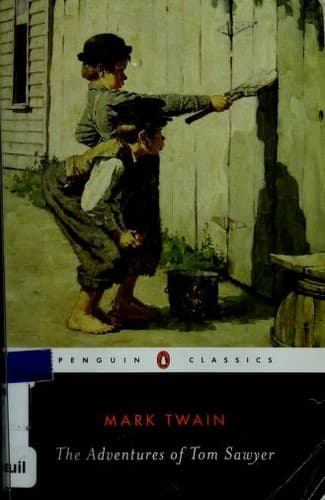
No. 1 · The whitewashing of the fence. Tom is assigned to whitewash a fence as punishment. Within pages he has turned it into a coveted activity and is accepting payment from the neighborhood boys for the privilege of helping. The scene is the novel's thesis: desire is not inherent but manufactured; the person who controls what seems desirable controls everything. Twain makes it comic. It is also a description of the American economy.
No. 2 · The graveyard scene. Tom and Huck witness a murder in the graveyard at midnight: Injun Joe kills the town doctor and frames Muff Potter, who is too drunk to remember what happened. The boys flee and swear in blood to say nothing. The murder is the pivot on which the novel's lighter material and its darker material turn — the moment the boy's world of games and performance collides with the adult world of real violence and real consequences.
No. 3 · The cave. Tom and Becky, lost in McDougal's Cave during the school picnic, wandering in the dark for days while the town searches for them above. Twain handles the terror and exhaustion with restraint; the scene's power comes from the contrast with everything that precedes it. This is not a game. The cave is real. Injun Joe is in it. The children have no adult to rescue them because adults cannot find them.
§ 04 · EDITIONS
Recommended editions
| Edition | Why pick it |
|---|---|
| Penguin Classics (paperback) | The standard reading edition; good introduction placing the novel in Twain's biography and in the context of the subsequent Huckleberry Finn. |
| Oxford World's Classics | Clean text, useful notes, reasonable price. |
| Mark Twain Library (UC Press) | The authoritative scholarly text; more apparatus than a casual reader needs but definitive. |
| Audiobook (Nick Offerman) | Offerman's reading captures Twain's dry comedy and the novel's affection for its material without sentimentalizing it. |
§ 05 · FIT
Who it's for / not for
Read this if you are…
- Planning to read Huckleberry Finn. This is the necessary prequel: Tom and Huck's friendship, the town of St. Petersburg, and the world they inhabit are all established here, and Twain assumes you know them in the sequel.
- Interested in what mythologized American boyhood actually contains in its source text, before it became Norman Rockwell. Twain is fonder and funnier than the mythology suggests — but also darker.
- A reader looking for something genuinely enjoyable in two or three sittings. It is the most accessible book on this list.
Skip it if you are…
- Looking for the moral complexity and formal ambition of Huckleberry Finn. This is the lighter novel, and deliberately so. Twain himself said he wrote it "for the entertainment of boys and girls," though he added he hoped adults would find it a reminder of what it was like to feel and think and talk as children do.
- Troubled by the representation of Injun Joe. Twain's rendering of this character draws on racial caricature; he is the novel's villain partly through his association with a racial identity presented as inherently threatening. This was unreflective in 1876 and is not defensible now.
§ 06 · TIPS
How to read it
Read it fast. It is a short, quick novel and Twain's comedy works best at pace. The setpiece chapters — whitewashing, graveyard, island, cave — are what you're here for.
Read it before Huckleberry Finn, not after. As a prequel it gains from being read in order; Tom's appearance in the final section of Huckleberry Finn is much more legible once you know what he is: a boy for whom everything is performance, including another person's freedom.
If you have children, this is one of the very few nineteenth-century novels that reads naturally aloud to a ten-year-old — but read it with them, and talk about Injun Joe, and about what Twain is doing with Tom's manipulativeness. The novel is richer in those conversations than as a simple adventure.
§ 07 · COMPARE
Read alongside
- Mark Twain — Adventures of Huckleberry Finn (1884). The essential sequel; the darker, more morally serious novel this one points toward. Read them in order.
- Twain — Life on the Mississippi (1883). Twain's memoir of his years as a Mississippi riverboat pilot; the autobiography of the world Tom Sawyer fictionalizes. A useful companion to understand the actual river.
- Booth Tarkington — Penrod (1914). The direct descendant of Tom Sawyer in American boys' fiction; less famous now but popular for decades. Shows the tradition Twain established.
§ 08 · DISCUSSION
Discussion questions
- Tom understands instinctively how to manufacture desire. Is this presented as a flaw, a talent, or both? What does Twain seem to feel about Tom's manipulativeness?
- Huck Finn is envied by the respectable boys for his freedom and avoided by their parents. What does this double response tell you about the town's values?
- Injun Joe is the novel's villain, and his threat is partly racial — he is frightening partly because he is presented as Other. How does this sit alongside the rest of the novel? Does it undermine the book's effect?
- Tom testifies against Injun Joe in court, saving Muff Potter. This is the most straightforwardly heroic thing Tom does in the novel. Why does it feel slightly out of character? What does Twain do to make it consistent with the Tom we know?
- The cave sequence is the novel's most genuinely frightening section. What changes when Becky and Tom are genuinely in danger, with no audience? Does Tom behave differently when the performance doesn't work?
- Aunt Polly knows Tom is manipulating her but loves him anyway. What does Twain suggest about the relationship between love and clear-sightedness in families?
One line to remember
“Tom said to himself that it was not such a hollow world, after all. He had discovered a great law of human action, without knowing it — namely, that in order to make a man or a boy covet a thing, it is only necessary to make the thing difficult to attain.”— Chapter 2
Appears in collections
Reading lists featuring this book
You might also like
Read next
Mark Twain · 1884
Adventures of Huckleberry Finn
The novel Hemingway said all American literature descends from — and also the one that most honestly confronts what that literature is built on.
Read · 7 min
William Faulkner · 1936
Absalom, Absalom!
Four narrators reconstruct a man who destroyed his family. The story keeps changing. That is the point.
Read · 7 min
Toni Morrison · 1987
Beloved
Toni Morrison said she wrote this novel to give voice to the sixty million. It won the Pulitzer, the Nobel, and is the greatest American novel of the second half of the twentieth century.
Read · 6 min