Editor-reviewed
Adventures of Huckleberry Finn
Mark Twain·1884·Chatto & Windus / Charles L. Webster and Company·Literature
Reading level: Ages 12+ (YA) · 10-hour read · Intermediate difficulty.
- Reading time
- 10h
- Difficulty
- Intermediate
- Recommended age
- Ages 12+ (YA)
- Guide read
- 7min
- Editor's rating
- 4.6 / 5
- mark-twain
- classic
- american-literature
- 19th-century
- race
- coming-of-age
— In one sentence —
The novel Hemingway said all American literature descends from — and also the one that most honestly confronts what that literature is built on.
§ 01 · WHY READ
Why read
Ernest Hemingway wrote that all modern American literature comes from Adventures of Huckleberry Finn — that it is the first and necessary book. He was right, and the reason is not the river or the frontier or the vernacular voice, though all of those matter. The reason is the moral structure of Chapter 31.
Huck Finn has helped Jim, an enslaved man, escape from his legal owner. He is sitting with a letter in his hand — a letter to Jim's owner telling her where Jim is. Huck believes, because every authority in his life has told him this, that helping Jim is a sin. He believes he will go to hell for it. He sits with the letter for a long time. Then he says the most consequential sentence in American fiction: "All right, then, I'll go to hell." He tears up the letter.
He chooses Jim over civilization. He chooses his own moral perception over everything he has been taught. He is wrong about the theology (he will not go to hell) and right about the ethics (helping Jim is right), and the novel's entire machinery has been built to make you feel, as Huck does, that this is a hard choice between two clear obligations — and then to show you that the hard choice is the right one, and that civilization was the obstacle.
This is also the most controversial novel in the American canon. The word "nigger" appears 219 times. Jim is sometimes rendered in a way that seems to confirm rather than challenge racial stereotypes. Schools have been fighting over this book for 140 years. None of this cancels the moral argument of Chapter 31. Understanding the tension — what the novel achieves and what it contains — is exactly what reading it requires.
§ 02 · KEY CHARACTERS
Key characters
Huck Finn — the narrator, thirteen or fourteen, son of the town drunk, raised mostly by himself. He is the first great American vernacular narrator: uneducated, direct, capable of moral clarity precisely because he has not been fully trained out of it. He notices things — the river, Jim, the cruelty of the people around him — and reports them without the acquired blindness of respectable society. His unreliability is his honesty.
Jim — Miss Watson's enslaved man, who escapes when he learns he is about to be sold down the river (to harsher conditions in the Deep South), away from his wife and children. He is the novel's moral center and its most contested element. Twain gives him dignity, intelligence, and the novel's most affecting moment of parental grief. He also, at moments — particularly in the Tom Sawyer chapters that close the novel — is rendered in ways that are more minstrel show than person. The tension is real and has not been resolved.
Tom Sawyer — Huck's friend from the previous novel, who appears in the final sequence. His arrival is the novel's catastrophe: he knows Jim is already legally free, and he does not say so, because he wants to conduct an elaborate fictional "rescue" styled after adventure novels. Tom treats Jim's captivity as a game. Twain uses him to indict a particular kind of American boy — the one who has read all the right books and uses them to avoid reality.
The King and the Duke — two confidence men who attach themselves to Huck and Jim's raft and spend several chapters grifting their way through river towns. They are among the funniest sustained characters in American fiction, and they represent the river's version of civilization: entrepreneurial, amoral, opportunistic. They eventually sell Jim for $40.
§ 03 · HIGHLIGHTS
Three highlights
No. 1 · Chapter 31 — "I'll go to hell." The moral and formal center of the novel. Huck alone with the letter, working through his decision in his own syntax, unable to pray because he is doing wrong, finally choosing Jim. The scene works because Twain has spent thirty chapters building Huck's voice — its cadence, its honesty, its specific way of processing the world — so that when it confronts this decision, you feel the weight from inside. It is one page. It is the most important page in American fiction.
No. 2 · The fog chapters. When Huck and Jim are separated in the fog on the river — Jim on the raft, Huck in the canoe — and reunite, Huck tries to convince Jim the separation was a dream. Jim sees through the trick; his response ("En when I wake up en fine you back agin', all safe en soun', de tears come en I could a got down on my knees en kiss' yo' foot I's so thankful") is the novel's first moment in which Huck fully sees Jim as a person with a real interior. The guilt that follows is the beginning of Huck's moral education.
No. 3 · The Grangerford-Shepherdson feud. Two aristocratic river families in a multigenerational blood feud, each attending the same church on Sunday with their guns. Twain's satire of Southern honor culture is at its most corrosive here: the respectability, the courtesy, the religiosity, all coexisting with casual violence. Huck observes it with his characteristic incomprehension — why do they do this? — and the incomprehension is the critique.
§ 04 · EDITIONS
Recommended editions
| Edition | Why pick it |
|---|---|
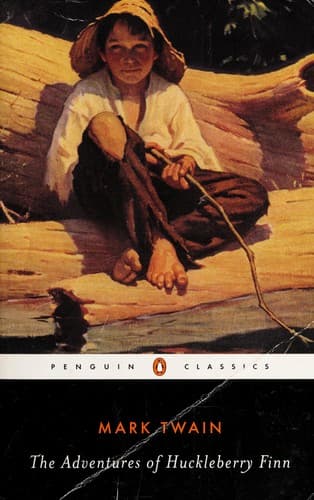
| Penguin Classics (paperback) | The standard reading edition; includes a solid introduction addressing both the novel's achievement and its racial complexity. |
| Norton Critical Edition | Includes critical essays addressing the racial controversy directly; the best edition for serious readers who want to engage with the debate. The Shelley Fisher Fishkin essay on the African American roots of Huck's voice is essential. |
| NewSouth Books edition | Replaced "nigger" with "slave" — a decision widely criticized as distorting the historical record and Twain's intent. Mentioned here to advise against it. |
| Audiobook (Patrick Fraley) | The vernacular voice of this novel works especially well in audio; a good narrator makes Huck's rhythm audible. |
§ 05 · FIT
Who it's for / not for
Read this if you are…
- Any serious reader of American literature who has not read it. The claim that it is the source of everything that follows is defensible; understanding it is understanding a large part of how American fiction thinks about voice, freedom, and the river as moral space.
- A reader willing to hold two things simultaneously: this novel is a major moral achievement, and it contains material that is racist in ways that cannot be wished away. Both statements are true.
- Someone interested in what vernacular narration — a narrator who is wrong about some things and right about others, who speaks in dialect, who does not explain himself — can do that formal literary narration cannot.
Skip it if you are…
- Likely to find the language of the novel prohibitive. The word appears 219 times. Some readers find it impossible to remain in the novel once they encounter the repetition. This is a legitimate response. The novel's moral argument does not require you to override your own reaction to the language it uses.
- Expecting a children's adventure story. It is often assigned as one; it is not one. The King and the Duke's grifts, the Grangerford feud, the final Tom Sawyer sections — these are adult satire, and the moral seriousness of Chapter 31 is not a children's theme.
§ 06 · TIPS
How to read it
The first six chapters set up Huck's world — the widow's house, his father, Tom Sawyer's gang — and are the slowest. Get through them. The novel becomes itself when Huck and Jim get on the river.
The river chapters move at the rhythm of the current — episodic, variable, sometimes idyllic, sometimes violent. Let them accumulate. The peace of the raft (Huck and Jim lying on their backs watching the stars, talking) is not incidental; it is the novel's baseline argument about what life could be, against which the shore's violence is measured.
The final Tom Sawyer section (roughly the last ten chapters) has frustrated readers since 1884. Twain seemed to lose control of the ending, or to abandon the moral seriousness of Chapter 31 for slapstick. Read those chapters as satire of Tom — of the kind of boy who uses adventure fiction as a way to avoid engaging with real human consequences.
§ 07 · COMPARE
Read alongside
- Mark Twain — Adventures of Tom Sawyer (1876). The predecessor novel; useful for understanding who these characters are before the darker book begins. Much lighter in tone.
- Ralph Ellison — Invisible Man (1952). Ellison wrote extensively about Twain and about how Black invisibility operates in American culture; Invisible Man is in direct conversation with the questions Huckleberry Finn raises and cannot fully answer.
- Toni Morrison — "Introduction" to Adventures of Huckleberry Finn (1996 Oxford edition). Morrison's essay on the novel's racial complexity is the most important single piece of criticism on the book. Find it.
§ 08 · DISCUSSION
Discussion questions
- Huck says "All right, then, I'll go to hell" and tears up the letter. He believes he is doing wrong. What does it mean that the novel's moral climax comes from a character acting against his own conscience — and that his conscience is wrong?
- Jim is the novel's moral center, but he is also rendered at moments in ways that draw on minstrel stereotypes. Can both things be true simultaneously? How do you hold that tension as a reader?
- The final Tom Sawyer sequence is widely considered the novel's weakest section. What is Twain doing there? Is it a failure of the novel's moral vision, or is Tom's behavior a deliberate satire of something?
- Huck is an unreliable narrator — he consistently misreads the social world around him. How does Twain use that misreading? What does Huck's incomprehension reveal that a knowing narrator would conceal?
- The river is freedom; the shore is civilization. Is Twain's argument that civilization is simply bad, or is he making a more specific claim?
- The novel has been banned from school curricula and defended as essential. Having read it: where do you come down on how it should be taught, and to whom, and with what framing?
One line to remember
“All right, then, I'll go to hell.”— Chapter 31
Appears in collections
Reading lists featuring this book
You might also like
Read next
Mark Twain · 1876
The Adventures of Tom Sawyer
The American boyhood idyll that invented its own mythology — and buried inside it, a portrait of how charisma and performance work as social currency.
Read · 5 min
William Faulkner · 1936
Absalom, Absalom!
Four narrators reconstruct a man who destroyed his family. The story keeps changing. That is the point.
Read · 7 min
Toni Morrison · 1987
Beloved
Toni Morrison said she wrote this novel to give voice to the sixty million. It won the Pulitzer, the Nobel, and is the greatest American novel of the second half of the twentieth century.
Read · 6 min