Editor-reviewed
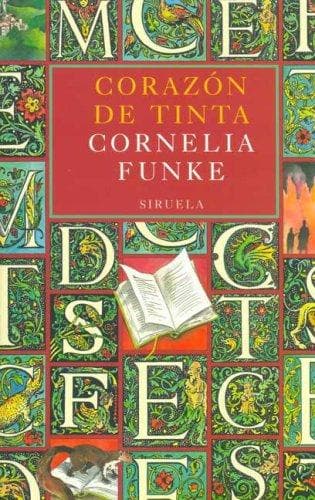
Inkheart
Cornelia Funke·2003·Cecilie Dressler Verlag (German); Scholastic (English)·Sci-Fi & Fantasy
Reading level: Ages 9–12 (middle grade) · 12-hour read · Beginner difficulty.
- Reading time
- 12h
- Difficulty
- Beginner
- Recommended age
- Ages 9–12
- Guide read
- 4min
- Editor's rating
- 4.4 / 5
- cornelia-funke
- childrens-fiction
- books-about-books
- reading
- fantasy
- germany
- magic
- series
— In one sentence —
A girl discovers her father can read characters out of books by reading aloud. One of the great premises in children's fantasy, and a love letter to the act of reading.
§ 01 · WHY READ
Why read
Cornelia Funke published Tintenherz (Inkheart) in Germany in 2003. It was translated into English in the same year by Anthea Bell, one of the finest translators of children's literature from German, and became an international bestseller. Funke was already well-known in Germany; Inkheart made her known everywhere. Philip Pullman called her "the German J. K. Rowling" — a comparison that pleased no one, including Funke, but indicated the scale of the response.
The premise is one of children's fiction's great premises: Mo Folchart has a voice that reads characters out of books — when he reads aloud, the characters emerge into the real world, and something or someone is pulled in to take their place. He discovered this ability when Meggie was a baby: he read aloud from a book called Inkheart, and three characters emerged — including the villain Capricorn — and his wife Resa disappeared into the book. He has been searching for a copy of Inkheart for nine years to read her back out.
Meggie discovers the secret when Capricorn's people find them and force Mo to read for Capricorn. The novel becomes a chase and a battle over the power of reading and who gets to control it.
What the book is about beneath the plot: reading, and what it does. Funke's premise externalizes the experience of being transported by a book — of characters becoming real — and makes it literally true. Meggie's love of books, which is the emotional center of the novel, is Funke's argument that reading is not passive consumption but an active engagement with other worlds. The book is a love letter to the act of reading, written for children who feel most themselves when they have a book in their hands.
§ 02 · CHARACTERS
Characters
Meggie Folchart — twelve years old at the novel's start, a reader of voracious appetite. She does not know her father's secret; discovering it is the novel's first act. She inherits his ability.
Mo (Mortimer Folchart) — her father, a bookbinder who loves books and is terrified of his own voice. His care for Meggie, his guilt about her mother, and his devotion to books are the emotional engine. He is one of children's fiction's best fathers: genuinely good without being passive.
Elinor — Meggie's great-aunt, a wealthy woman who lives alone in a house full of books and loves no one more than her library. She is the novel's comic figure and one of its most lovable: eccentric, sharp-tongued, and fundamentally brave.
Capricorn — the villain who emerged from Inkheart and has built a criminal empire in the real world. He wants to use Mo's voice to extract more power from books. He is one of children's fiction's more genuinely frightening antagonists.
Dustfinger — a fire-eater who emerged from Inkheart alongside Capricorn and who wants nothing more than to be read back in. He is the novel's most interesting character: morally ambiguous, sorrowful, genuinely unable to belong in a world that isn't his. His storyline is the trilogy's deepest.
Fenoglio — the elderly author who wrote Inkheart, who is delighted and horrified to meet his own characters.
§ 03 · HIGHLIGHTS
Three highlights
No. 1 · The premise revealed. The moment when Meggie understands that her father's voice reads characters out of books — and that her mother disappeared into a book when she was an infant — is the novel's first great scene. Funke doesn't delay it too long; the premise is generous enough to carry the rest of the story.
No. 2 · Elinor's library. Elinor's house, where every room is a library and the books are organized and catalogued and protected with the passion of a collector who actually loves what she collects. It is the novel's image of what a life built around reading looks like — unusual, solitary, full. For children who feel this way about books, it is recognition.
No. 3 · Dustfinger's homesickness. Dustfinger wants to go home, but home is a book — a fictional world he was extracted from without consent. His homesickness is for a place that doesn't exist outside language. Funke's rendering of this longing is the trilogy's most original emotional note: not nostalgia for a real place but for a fictional one that is as real to him as any physical location.
§ 04 · EDITIONS
Recommended editions
| Edition | Why pick it |
|---|---|
| Scholastic (Anthea Bell translation) | Bell's translation is the standard English version; the correct edition. |
| Inkheart trilogy (boxed set) | Inkheart, Inkspell (2005), Inkdeath (2007); the story continues in the sequels and Dustfinger's arc in particular requires them. |
| Audiobook (Brendan Fraser and Lynne Frederick) | The audiobook production is unusual in having multiple readers; Fraser reads Mo, which is appropriate (he played Mo in the 2008 film). |
§ 05 · FIT
Who it's for / not for
Read this if you are…
- A child who loves reading and wants a novel that is explicitly about loving reading.
- Anyone interested in meta-fiction for children: the premise is a book about the power of books, which creates specific pleasures for readers who know what it's like to be transported by a story.
- Reading aloud to a child: Mo's voice is the novel's central image, and reading a novel about a father who reads aloud, aloud, is a recursive experience with specific rewards.
Skip it if you are…
- Looking for the most tightly plotted fantasy. Inkheart is generous and sometimes leisurely; it is a novel that likes being where it is.
- Not interested in meta-fiction. If self-referential books-about-books irritates you, the premise will feel precious.
§ 06 · TIPS
Reading tips
- Each chapter opens with a quotation from another book. Funke selected quotations that comment on the chapter's events. They are worth reading carefully; they are also a reading list.
- Dustfinger is the character to follow. His arc in the first book is the setup for everything that follows in the trilogy; the character who seems like a supporting figure is actually the trilogy's center.
- Read the sequels. Inkspell and Inkdeath complete the story; Inkheart ends at a satisfying but provisional point.
§ 07 · COMPARE
Read alongside
- Michael Ende — The Neverending Story (1979). The German predecessor: a boy reading a book that reads him back; the most direct forerunner of Inkheart in German children's literature.
- Norton Juster — The Phantom Tollbooth (1961). Another children's fantasy built on the premise that language and abstraction can become physically real.
- Jasper Fforde — The Eyre Affair (2001). For older readers: a thriller set in a world where literary characters exist, crimes are committed inside novels, and a detective must enter Jane Eyre. The adult parallel to Funke's premise.
§ 08 · DISCUSSION
Discussion questions
- Mo's ability to read characters out of books externalizes the feeling of being transported by a story. What does Funke gain by making this literal rather than metaphorical?
- Dustfinger wants to go back into Inkheart — to return to a fictional world. Is his homesickness comprehensible? What does Funke mean by suggesting that fictional worlds can be as real as physical ones?
- Capricorn was the villain in Inkheart the book; he is now a villain in the real world. Does the novel suggest his villainy is essential to his nature, or could he have become something else?
- Elinor lives alone with her books and values them more than most people. Is the novel endorsing this? Is there something the novel is saying about the person who loves books above everything else?
- Each chapter opens with a quotation from another book. What effect does this create? Is Funke building an argument about the conversation between books?
- The novel is explicitly about loving reading. Does it work for readers who don't already love books, or does it require that prior attachment to be fully felt?
One line to remember
“Books have to be heavy because the whole world's inside them.”— Cornelia Funke — Inkheart
Appears in collections
Reading lists featuring this book
7 books
The Best Books for 8-Year-Olds
Seven books an eight-year-old can actually finish — and remember the rest of their life.
Open list →
10 books
The Gateway: Fantasy for Young Readers Ages 8–12
The books that made readers. A curated path into fantasy for children who are ready for a real story.
Open list →
You might also like
Read next
Ted Chiang · 2002
Stories of Your Life and Others
Ted Chiang writes 30-page stories that take longer to think about than most novels. He has won more awards per word than any writer alive.
Read · 5 min
Cixin Liu · 2008
The Dark Forest
Fan + author consensus pick for the best book in the trilogy. Two simple axioms derive the silence of the universe. After this one, you don't look at the night sky the same way.
Read · 5 min
Octavia E. Butler · 1979
Kindred
Octavia Butler sends a Black woman from 1976 Los Angeles back to antebellum Maryland. The time travel is a device. The horror is real.
Read · 5 min