Editor-reviewed
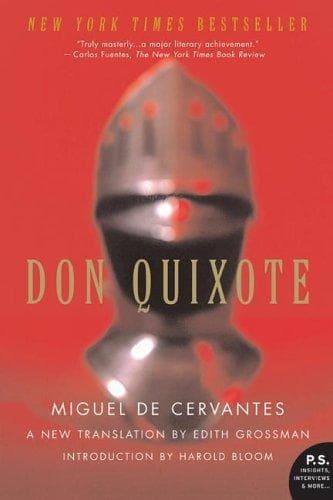
Don Quixote
Miguel de Cervantes·1605·Various (public domain)·Literature
Reading level: Ages 14+ (adult) · 40-hour read · Intermediate difficulty.
- Reading time
- 40h
- Difficulty
- Intermediate
- Recommended age
- Ages 14+
- Guide read
- 5min
- Editor's rating
- 4.8 / 5
- cervantes
- spanish-literature
- comedy
- knight
- quixote
- sancho-panza
- canonical
- classic
— In one sentence —
The first novel. A man who has read too many chivalric romances sets out to become a knight-errant in a world that no longer contains knights. Four hundred years old and funnier than most books published this year.
§ 01 · WHY READ
Why read
Miguel de Cervantes published Part I of Don Quixote in 1605 and Part II in 1615. He was in his late fifties and had spent much of his adult life in military service, captivity, and poverty; the first part was written while he was imprisoned for debt. The novel is considered the first modern novel, the founding work of Western fiction, and one of the funniest books ever written.
The premise: Alonso Quijano, a minor nobleman in La Mancha who has read so many chivalric romances that he has lost his sanity, renames himself Don Quixote and sets out to become a knight-errant — to seek adventure, protect the innocent, and serve the honor of Dulcinea del Toboso, an ordinary peasant woman he has elevated in his imagination to a great lady. He recruits a local farmer named Sancho Panza as his squire. The misadventures that follow arise from the collision between Don Quixote's chivalric worldview and a Spain that no longer contains the things he's looking for.
What makes it new: Cervantes is not simply mocking his protagonist. The relationship between Don Quixote's madness and reality is more complex than it appears — his idealism occasionally achieves something that mere sanity cannot, and the novel gradually makes clear that Sancho is being changed by his time with the Don as much as the Don is being changed by reality. Part II (1615) is even more sophisticated: it acknowledges that the characters have read Part I and became famous, which creates a hall-of-mirrors effect about fiction, reality, and character.
The humor: The comedy is physical (windmills, inns mistaken for castles, beatings sustained in pursuit of chivalric ideals) and philosophical (the gap between how Don Quixote describes what he sees and what is actually there). Four hundred years have not dimmed it.
§ 02 · CHARACTERS
Characters
Don Quixote (Alonso Quijano) — a man who has made himself into a character, and who then, over two long volumes, gradually comes back into contact with reality. His dying repudiation of chivalric romances is one of the most affecting endings in fiction.
Sancho Panza — Don Quixote's squire: a fat, practical, illiterate farmer who joins the adventures partly for the promised governorship of an island, partly out of genuine affection, partly out of a slowly developing sense that his master's madness contains something worth following. He is one of the great comic inventions in world literature.
Dulcinea del Toboso — the idealized beloved who never appears; a real woman (Aldonza Lorenzo) transformed by Don Quixote's imagination into the lady every knight requires. She is an idea more than a character.
§ 03 · HIGHLIGHTS
Three highlights
No. 1 · The windmills. Don Quixote charges a field of windmills he believes are giants. The episode (Chapter 8 of Part I) is so famous it has given English the word "quixotic" and the phrase "tilting at windmills." What most readers who haven't read the book don't know: it is funnier and more complicated in context than the summary suggests. Sancho pleads with him; the Don insists; the windmill knocks him off his horse; the Don explains that an enchanter transformed the giants into windmills to rob him of glory.
No. 2 · Sancho's governorship. In Part II, Don Quixote and Sancho are taken up by a Duke and Duchess who have read Part I and decide to play elaborate practical jokes on them, including actually making Sancho governor of a mock island. Sancho, to everyone's surprise including his own, turns out to be an excellent governor — dispensing practical justice that outdoes the courtly sophistication around him. The sequence is the novel's most direct meditation on wisdom and class.
No. 3 · The ending. Don Quixote, sick and dying, recovers his sanity. He repudiates everything he has done and believed; he dies as Alonso Quijano the Good. The reader, who has spent hundreds of pages following the Don's madness with something resembling love, is left to decide whether the recovery is a restoration or a loss. Cervantes provides no answer.
§ 04 · EDITIONS
Recommended editions
Translation matters enormously.
| Translation | Why pick it |
|---|---|
| Edith Grossman (HarperCollins, 2003) | The best modern translation; fluent, funny, accurate. Harold Bloom calls it the definitive English Don Quixote. Start here. |
| John Rutherford (Penguin Classics, 2000) | A strong alternative; particularly good at rendering the comedy. |
| Tobias Smollett (1755, various) | Historical interest; the first major English translation; more antiquated but has its partisans. |
| Tom Lathrop (2005) | Designed for reading groups; includes notes. Good for first-time readers. |
Read Part I and Part II together if possible; Part II requires I, and the two parts together are the complete novel.
§ 05 · FIT
Who it's for / not for
Read this if you are…
- Anyone who wants to understand where the novel came from: this is the source.
- Readers who enjoy comic fiction at its most expansive and structural.
- Anyone interested in the relationship between reading fiction and living — Don Quixote has too much fiction in his head and it breaks him; the novel is partly about this risk.
Skip it if you are…
- Looking for continuous narrative drive. The novel is episodic; some adventures are better than others; the middle sections of Part I can drag. Skip ahead if you bog down.
- Not prepared for 1,000+ pages. It is long. But it is not difficult — the prose (in Grossman's translation) is genuinely enjoyable.
§ 06 · TIPS
Reading tips
- Read Part II. Many readers stop after Part I, which is the funnier half. Part II is the greater achievement — more philosophically complex, more interested in Don Quixote's inner life, and culminating in the ending.
- The episode structure is fine to navigate. Unlike some episodic novels, the episodes are genuinely self-contained; if one doesn't work for you, the next is different.
- Sancho is not the sidekick. He is the novel's other protagonist, and his development over 1,000 pages is as interesting as Don Quixote's.
§ 07 · COMPARE
Read alongside
- John Kennedy Toole — A Confederacy of Dunces (1980). The modern descendant: another man with a medieval worldview attempting to function in a hostile modern world. Toole knew the connection.
- Gustave Flaubert — Madame Bovary (1857). The feminine version of the same problem: a woman destroyed by having read too many romantic novels and taken them literally. Flaubert considered Don Quixote the template.
- Italo Calvino — If on a winter's night a traveler (1979). The postmodern descendant of Part II's meta-fictional games: a novel about the act of reading fiction that could not exist without Cervantes.
§ 08 · DISCUSSION
Discussion questions
- Don Quixote is mad, but his madness sometimes achieves things that sanity cannot. Can you identify moments in the novel where his worldview produces better outcomes than the "sane" alternative?
- At the end, Don Quixote recovers his sanity and dies as Alonso Quijano. Is this a restoration or a tragedy? What has been lost?
- Sancho Panza is illiterate and practical, yet turns out to be a good governor. What is Cervantes arguing through this sequence about wisdom and class?
- Part II knows about Part I — the characters are famous, have been read about, are performing versions of themselves. What does this do to the novel's relationship with reality?
- Don Quixote is often called the first novel. What makes a novel a novel? What did Cervantes invent that wasn't there before?
- The novel is a satire of chivalric romances. But most modern readers have never read a chivalric romance. How does this affect the reading experience?
One line to remember
“The truth may be stretched thin, but it never breaks, and it always surfaces above lies, as oil floats above water.”— Miguel de Cervantes — Don Quixote
Appears in collections
Reading lists featuring this book
6 books
Books to Read When You Feel Lost in Life
Protagonists with no map who keep moving anyway — each one a different kind of lost.
Open list →
5 books
Classics That Are Actually Readable
Five books that carry their age well.
Open list →
10 books
Books That Earn Every Hour: Ten Essential Long Reads
Not long because they couldn't be shorter. Long because the size is the point.
Open list →
You might also like
Read next
William Faulkner · 1936
Absalom, Absalom!
Four narrators reconstruct a man who destroyed his family. The story keeps changing. That is the point.
Read · 7 min
Toni Morrison · 1987
Beloved
Toni Morrison said she wrote this novel to give voice to the sixty million. It won the Pulitzer, the Nobel, and is the greatest American novel of the second half of the twentieth century.
Read · 6 min
Leo Tolstoy · 1878
Anna Karenina
Not just a love story. Two parallel lives — Anna's destruction, Levin's salvation — ask the same question: how should a person live?
Read · 6 min