Editor-reviewed
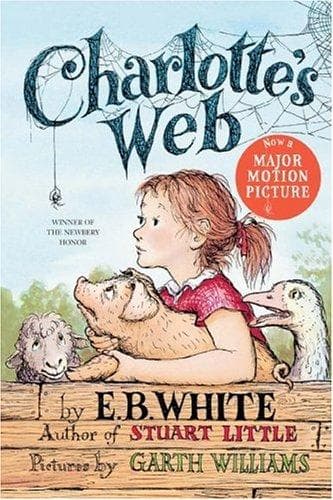
Charlotte's Web
E. B. White·1952·Harper & Brothers·Children
Reading level: Ages 7–9 (early reader) · 3-hour read · Beginner difficulty.
- Reading time
- 3h
- Difficulty
- Beginner
- Recommended age
- Ages 7–9
- Guide read
- 4min
- Editor's rating
- 4.7 / 5
- eb-white
- childrens-fiction
- friendship
- death
- pigs
- spiders
- classic
- newbery-honor
For parents
More age-near children's picks
— In one sentence —
E. B. White wrote it to explain what a spider's web actually is. It became the best-selling children's paperback of all time and the book that has taught the most children what death is.
§ 01 · WHY READ
Why read
E. B. White began thinking about Charlotte's Web in 1949 when he observed a spider in his barn at his farm in Maine and started to feel, he wrote in his journal, that he wanted to save her. He researched spider biology carefully — the book's description of how Charlotte spins her egg sac is anatomically exact — and spent two years writing. The novel was published in 1952 with Garth Williams's illustrations. It has sold 45 million copies. It received a Newbery Honor in 1953.
The premise everyone knows: Wilbur the pig is saved from slaughter by Charlotte, a spider, who writes words in her web — "Some Pig," "Terrific," "Radiant" — that persuade the farmers he is extraordinary. The fair. The words in the web. Charlotte's death.
What the book does that almost no other children's book does: it tells the truth about death. Charlotte dies. She dies at the county fair, away from the barn, alone, after completing her work. Wilbur cannot carry her body home. He carries her egg sac, and in the spring her children hatch and most of them leave, and a few stay. The cycle is complete. White does not lie about any of this.
He does not soften Charlotte's death. He does not have Wilbur save her. He does not imply that she goes to a better place. He says: she was a true friend and a good writer, and she is dead, and the world is better because she was in it, and Wilbur will never forget her. This is White's argument about what we owe to those we lose: not false consolation, but honest grief and honest gratitude.
§ 02 · CHARACTERS
Characters
Wilbur — the pig, young and trusting and lovable in the way that pigs actually are. He is afraid of death and cannot save himself. His willingness to be saved — his openness to the help Charlotte offers — is the novel's image of what trust looks like.
Charlotte A. Cavatica — the barn spider, whose full name is given once. She is wise, kind, precise, and modest about her craft. She writes to save Wilbur not because she expects anything in return but because he is her friend and she can. Her death is the novel's central loss.
Templeton — the rat, who helps Charlotte and Wilbur for entirely selfish reasons and is not pretending otherwise. He is the novel's realist: he will do good things if there's something in it for him. Wilbur thanks him honestly for his help without pretending Templeton is something he's not.
Fern Arable — the girl who saves Wilbur from slaughter at the novel's opening and who can initially hear the animals talk. She grows away from the barn as she grows older; by the novel's end she is more interested in boys at the fair than in the animals. White's rendering of her drift is quiet and not sentimental: children grow up and move away from childhood's vision.
§ 03 · HIGHLIGHTS
Three highlights
No. 1 · "Some Pig." The first word Charlotte writes in her web, discovered by the Zuckerman farmhands. Their response — wonder, reverence, certainty that the pig must be special — is the joke and the argument. The pig is not special by any measure they can observe; the word makes it special. Charlotte is writing advertising copy. White is making an argument about how language creates the reality it names.
No. 2 · Charlotte's death. Charlotte dies at the fairgrounds after Wilbur wins his prize and the egg sac is safe. She is alone; Wilbur cannot reach her. The description of her death is two paragraphs: she is tired, she has been failing for some time, her work is done, she dies. White does not comfort the reader. He trusts the reader — who is a child — to sit with this.
No. 3 · "It is not often that someone comes along who is a true friend and a good writer." The novel's last line about Charlotte, before the epilogue. White's summary of what Charlotte was — the conjunction of the personal and the craft — is the most economical tribute in children's literature. It says everything by saying exactly two things.
§ 04 · EDITIONS
Recommended editions
| Edition | Why pick it |
|---|---|
| Harper (Garth Williams illustrations) | The definitive edition; Williams's illustrations are integral to the book's visual world. The version to get. |
| Full-color anniversary editions | The illustrations colorized; some readers prefer them, some prefer the original black-and-white. |
| Audiobook (E. B. White reading) | White read the audiobook himself in 1970; his reading of Charlotte's death is one of the essential performances in children's audio. Essential. |
§ 05 · FIT
Who it's for / not for
Read this if you are…
- Reading it aloud to a child: the experience is different from reading silently and better. White wrote it for the speaking voice.
- An adult who read it as a child and wants to return: the adult reading of Charlotte's death is different from the child reading, and both are worth having.
- Anyone who wants to understand how to write about death for children — how to tell the truth without destroying the child.
Skip it if you are…
- Not prepared for the ending. Charlotte dies. If you are reading to a child who has recently lost someone, consider the timing.
§ 06 · TIPS
Reading tips
- Read it aloud. White wrote for the voice; the prose has rhythms that are lost in silent reading.
- Don't prepare the child for Charlotte's death. Let it arrive the way White arranged it.
- Templeton is not reformed. He helps for selfish reasons and stays selfish. White is honest about this, and Wilbur thanks him honestly. The novel does not require Templeton to become good.
- Fern's drift away from the animals is important. She stops being able to hear them. White is saying something about childhood's special access to the world and what growing up costs.
§ 07 · COMPARE
Read alongside
- E. B. White — Stuart Little (1945). White's earlier children's novel: a mouse born to a human family, also illustrated by Williams. Less thematically complete than Charlotte's Web but full of the same quality of attention.
- Kenneth Grahame — The Wind in the Willows (1908). The animal-community predecessor: anthropomorphized animals whose relationships carry adult emotional weight. Darker in places; different tone.
- Roald Dahl — Fantastic Mr. Fox (1970). The contemporary: another farm story with an animal protagonist. Dahl's animals are purely comic; White's are elegiac. The comparison clarifies what each was doing.
§ 08 · DISCUSSION
Discussion questions
- Charlotte writes words in her web to save Wilbur. She is essentially writing advertising copy. What is White saying about the relationship between language and reality?
- Templeton helps Wilbur and Charlotte for purely selfish reasons. Wilbur thanks him for this honestly. Is Templeton a friend? Does the novel think selfishness is compatible with genuine usefulness?
- Charlotte dies alone, away from home, after her work is complete. White does not soften this. Is this the right way to write about death for children? What would be lost by softening it?
- Fern can hear the animals talk at the beginning; by the end she has grown away from this. What is White saying about childhood's special perception and what growing up costs?
- "It is not often that someone comes along who is a true friend and a good writer." Why does White add "a good writer"? What does craft have to do with friendship?
- The novel ends with the promise that Charlotte's memory will never leave Wilbur, and that each spring, some of her children will stay. Is this consolation or something more honest?
One line to remember
“It is not often that someone comes along who is a true friend and a good writer. Charlotte was both.”— Chapter 22
Appears in collections
Reading lists featuring this book
7 books
The Best Book Gifts for Christmas
Seven novels that survive being unwrapped in front of an audience.
Open list →
7 books
The Best Books for 8-Year-Olds
Seven books an eight-year-old can actually finish — and remember the rest of their life.
Open list →
12 books
Best Children's Books by Age
A parent-friendly reading list from baby read-alouds and picture books to early readers, first chapter books, middle grade, and teen crossover.
Open list →
6 books
Best Books About Grief and Loss
Six different kinds of grief — romantic, existential, maternal, historical, friendship, childhood.
Open list →
7 books
The Best Books About Fatherhood and Loss
Seven novels about fathers and sons, fathers who fail, fathers who carry the boy on the road — the grief specific to fatherhood.
Open list →
6 books
Books That Give You Hope
Six books that earn the word hope by refusing to look away from what makes hope hard.
Open list →
6 books
Books That Will Make You Cry
Direct about what hits and why — no sentimentality, just the moments that break through.
Open list →
10 books
The Gateway: Fantasy for Young Readers Ages 8–12
The books that made readers. A curated path into fantasy for children who are ready for a real story.
Open list →
You might also like
Read next
Maurice Sendak · 1963
Where the Wild Things Are
A picture book about anger, imagination, wildness, and the relief of coming home to someone who still loves you.
Read · 3 min
Arnold Lobel · 1970
Frog and Toad Are Friends
An early-reader classic with short chapters, gentle jokes, and two friends whose differences make the stories easy to love.
Read · 3 min
Margaret Wise Brown · 1947
Goodnight Moon
A bedtime picture book built from rhythm, repetition, soft attention, and the comfort of saying goodnight to everything in the room.
Read · 3 min