Editor-reviewed
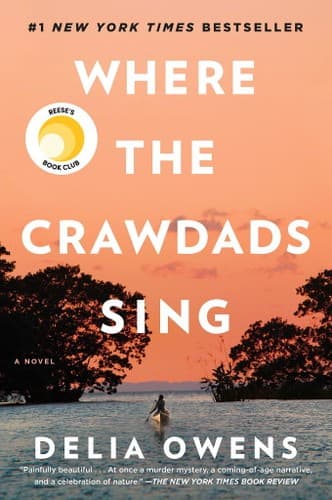
Where the Crawdads Sing
Delia Owens·2018·G.P. Putnam's Sons·literary-fiction
- Reading time
- 12h
- Difficulty
- Intermediate
- Recommended age
- Ages 14+ (YA)
- Guide read
- 7min
- Editor's rating
- 4.1 / 5
- coming-of-age
- nature-writing
- murder-mystery
- american-south
- book-club
- owens
— In one sentence —
A coming-of-age novel about a girl raised by the North Carolina marsh — wrapped around a murder trial, and shadowed by questions about its author the book has never quite outrun.
§ 01 · WHY READ
Why read
Where the Crawdads Sing is one of the unlikeliest commercial phenomena of the late 2010s. A first novel by a seventy-year-old wildlife biologist with no previous fiction credits, published by a major house with modest expectations, it sold more than fifteen million copies, sat on the New York Times bestseller list for over 150 weeks, and was adapted into a 2022 film produced by Reese Witherspoon. Whatever the book is, it is one of the things the 2010s American reader most wanted to read. Any honest guide has to take that seriously.
The novel braids two strands. The first is a coming-of-age story about Kya Clark, the "Marsh Girl," abandoned in stages — mother first, then siblings, then father — in a shack on the North Carolina coast in the 1950s and '60s. Kya raises herself on what the marsh provides and on what she teaches herself to recognize: birds, shells, the migrations of fish, the rhythms of tide and grass. The second strand is a 1969 murder trial. A local golden-boy named Chase Andrews has been found dead at the base of a fire tower. The town's prevailing theory is that the Marsh Girl killed him, and Kya is on trial.
Owens, a wildlife biologist with a long career studying lions and elephants in Africa, is best when she is writing about the marsh itself. The nature writing is genuinely accomplished — patient, observed, unhurried, with the texture of someone who has spent decades looking at landscapes. The trial mechanics are competent. The romance plots (there are two, with Tate and with Chase) are conventional. The prose veers between lyrical and overwritten, sometimes within the same paragraph.
There is also the matter of the author's biography. In the early 1990s, Owens, her husband Mark, and her stepson Christopher were involved in a contested incident in Zambia in which a suspected poacher was shot and killed; an ABC documentary aired footage of the killing. The Zambian government has, periodically, indicated it would like to question members of the Owens family about the incident. None have returned to the country. We mention this not to litigate it — the facts are genuinely contested — but because the novel is, at its center, about who is permitted to kill in self-defense and who is believed when they say they did, and the parallel is one many serious readers find difficult to put aside. You may or may not. That is your call to make.
The book sold what it sold for reasons that are mostly about the marsh — the texture of Kya's solitude, the patience of the natural-history sentences — and partly about a courtroom drama that knows how to deliver. It is not a great novel. It is, in places, a quite good one.
§ 02 · CHARACTERS
Characters
The cast is small; the marsh is half of it.
Catherine Danielle "Kya" Clark — the novel's center. Abandoned at six by her mother, then by older siblings one by one, then by her violent father, Kya raises herself in a shack on the marsh. She is functionally illiterate until late adolescence and is the most fully realized character in the book: stubborn, watchful, capable of an interiority the rest of the cast doesn't quite reach. The novel's best stretches are the ones spent alone with her.
Tate Walker — the local boy who teaches Kya to read using bird guides, becomes her first love, leaves for college, returns. Tate is the novel's emotional moral center — the character whose decisions the book asks you to evaluate Kya's choices against. He is also somewhat too good, a familiar problem in this kind of coming-of-age.
Chase Andrews — the dead man. Quarterback, town favorite, Kya's second relationship. Chase is the most conventional character in the novel and the most necessary: the book needs a victim whose social position makes Kya's vulnerability legible.
Jumpin' and Mabel — the Black couple who run the only gas-and-bait store Kya can reach by boat. They become her surrogate family in a way the novel handles with more care than some critics have credited, though the dynamic is also one of the places the book's race politics deserve scrutiny.
Tom Milton — Kya's retired defense attorney, brought out of retirement for the trial. Milton is a stock figure of Southern legal fiction (the gentleman lawyer who believes in justice) and is used well.
The marsh itself — Owens means this as character, and the novel is largely successful in making it so. The fireflies, the herons, the tides, the seasonal cycles — these are the book's most distinctive achievement.
§ 03 · HIGHLIGHTS
Three highlights
No. 1 · The natural history is the novel's real subject. Strip the trial out, strip the romance plots out, and what's left is an unusually patient piece of nature writing about one specific stretch of North Carolina coast. Owens has spent her professional life watching animals and writing field notes, and that training is visible. The chapters in which Kya learns to recognize the courtship displays of fireflies, or studies the molt cycles of seabirds, or compiles the shell collection that will eventually become a book of her own, are the chapters that justify the novel's reputation. If you read it for nothing else, read it for these.
No. 2 · The dual timeline. The novel alternates between the 1950s–60s coming-of-age and the 1969 trial in chapters that are short, well-paced, and structurally elegant in a way the prose is not always. The trial sections build the question — did she kill him? — while the coming-of-age sections build the more interesting question — what kind of person did the marsh make her? The two timelines converge in the final act in a way that satisfies the murder-mystery contract while quietly raising the harder moral question underneath. The structure is the book's most professional element.
No. 3 · The verdict and the coda. The trial reaches its verdict, and the novel then keeps going for several chapters, which is the right decision. The coda — Kya's adult life, the publication of her shell books, her death and what is found afterward — is where the novel makes its actual moral argument, and it is a colder argument than the trial chapters lead you to expect. The final pages reframe what kind of book you have been reading. They are also the pages most responsible for the discomfort that some readers carry away from the book and that, in light of Owens's biography, lands with particular weight. Read them carefully.
§ 04 · EDITIONS
Recommended editions
| Edition | Why pick it |
|---|---|
| G.P. Putnam's Sons hardcover (US, 2018) | The first edition. Standard trade hardcover; the one most book clubs read. |
| Corsair (UK, 2019) | The British first edition. Same text, slightly more restrained cover design. |
| Putnam paperback (2021) | Includes a Reese Witherspoon afterword tied to the film. Brief and skippable. |
| Audiobook (Cassandra Campbell, Penguin Audio, 2018) | Campbell's reading handles the natural-history passages well and gives Kya a voice that doesn't tip into caricature. One of the better mainstream audiobook performances of the late 2010s. |
The 2022 film (dir. Olivia Newman, with Daisy Edgar-Jones) is faithful and well-photographed and removes most of what makes the book interesting — the patience of the natural-history chapters, the texture of Kya's solitude. Read the book first. The Taylor Swift song "Carolina" was written for the film and is the more efficient experience of the novel's emotional palette if you are short on time.
§ 05 · FIT
Who it's for and who it's not for
Read this if you are…
- A reader who wants the comfort of a strong dual-timeline structure with a built-in mystery engine.
- Drawn to nature writing and willing to slow down for the natural-history passages.
- Interested in coming-of-age fiction in the Educated / Glass Castle register — solitary protagonists, hostile worlds, eventual emergence.
- Reading for a book club and want a novel that produces real disagreement.
Skip it if you are…
- Looking for sentence-level literary writing. Owens's prose is patient but uneven; the lyrical passages are sometimes overwritten in a way more careful editing would have caught.
- Unable to set aside the questions about the author's biography. The parallels to the novel's central moral question are real and many readers find them disqualifying. That is a coherent position.
- A skeptic of romance plots. Both of Kya's relationships are conventional in ways that contrast unfavorably with the precision of the nature writing.
- Unable to read fiction that is set in the Jim Crow South and depicts Black characters from a white narrator's perspective. The book handles this with care in places and with a lighter touch than it should in others; some readers will find this disqualifying as well.
§ 06 · TIPS
Reading tips
- Slow down for the marsh. The temptation will be to rush through the natural-history chapters to get back to the trial. Resist it. The marsh chapters are the actual book.
- Read in long sittings. The dual-timeline structure works best when you can hold one timeline's texture in your head while reading the other.
- Note what you make of Kya before the verdict. The novel asks the reader to render judgment in parallel with the jury, and the most honest reading is the one where you've written down your verdict before the last act.
- Read the coda with attention. It is short and easy to skim. It is also where the book is most honest about what it has been doing.
- Bring your discomfort with you. The biographical questions, the race politics, the romance conventions — these are real, and the most useful reading is one that holds them in view rather than setting them aside.
§ 07 · COMPARE
Read alongside
- Tara Westover — Educated (2018). The non-fiction sister text: a self-taught isolate emerging from a hostile family into a world that won't quite know what to do with her. Read both and notice what fiction permits that memoir doesn't.
- Barbara Kingsolver — Prodigal Summer (2000). The novel by an actual literary biologist that Crawdads readers should know about. Three braided plots; the nature writing is at a different level.
- Marilynne Robinson — Housekeeping (1980). The literary-prestige version of the abandoned-girl-in-a-wild-landscape novel. The prose is at a register Owens does not approach.
- Harper Lee — To Kill a Mockingbird (1960). The Southern courtroom novel against which all subsequent Southern courtroom novels are measured. Crawdads knows it; the comparison is not always to its benefit.
- Annie Dillard — Pilgrim at Tinker Creek (1974). The non-fiction nature writing that Crawdads's best passages reach toward. Dillard is the standard for this kind of observed attention.
§ 08 · DISCUSSION
Discussion questions
- The novel's best passages are the natural-history chapters. Pick one. What is the writing doing that the romance or trial passages aren't?
- Kya is the most fully realized character in the book. Make a case for the most fully realized of the secondary characters. Who is closest to having interiority? Who is closest to a function?
- Both of Kya's romantic relationships are presented in fairly conventional terms. Does this damage the book, or does the convention make the more unusual elements (the marsh, the solitude) more legible by contrast?
- The dual timeline structure is the book's most professional element. Read the first three chapters of each timeline. What is each timeline doing for the other?
- The race politics of the novel — Jumpin' and Mabel, the broader Black community in 1960s North Carolina — are handled with care in places and with a lighter touch in others. Identify one passage of each and discuss.
- The coda reframes the entire novel. Did the reframing feel earned, or did it feel imposed? What does it ask you to do with the verdict you reached during the trial?
- The author's biography — the contested 1990s killing in Zambia — parallels the novel's central moral question. Some readers find this disqualifying. Others find it irrelevant. What is the case for separating the work from the author here, and what is the case against?
- Fifteen million people bought this book. Take that seriously as a question. What does the book give a reader that other 2018 novels didn't?
One line to remember
“She knew the years of isolation had altered her behavior until she was different from others, but it wasn't her fault she'd been alone. Most of what she knew, she'd learned from the wild.”— Narrator on Kya Clark — Part One, Chapter 17
You might also like
Read next
Gabriel García Márquez · 1967
One Hundred Years of Solitude
A century of one family in one village, told in prose so densely accumulating that you finish it remembering it as a single, very long afternoon.
Read · 8 min
Chinua Achebe · 1958
Things Fall Apart
The novel that ended the era in which the African could only be the colonized subject of someone else's English-language fiction.
Read · 7 min
Juan Rulfo · 1955
Pedro Páramo
A 124-page novel from 1955 that taught Latin American literature how to let the dead speak in the same paragraph as the living.
Read · 7 min