Golden set · editor-reviewed
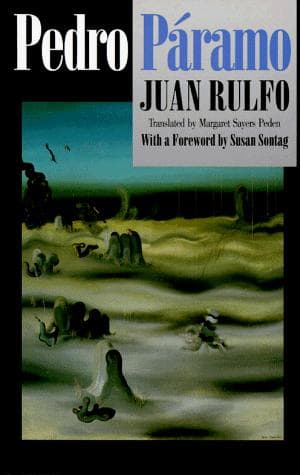
Pedro Páramo
Juan Rulfo·1955·Grove Press·literary-fiction
Reading level: Ages 14+ (YA) · 4-hour read · Advanced difficulty.
- Reading time
- 4h
- Difficulty
- Advanced
- Recommended age
- Ages 14+ (YA)
- Guide read
- 7min
- Editor's rating
- 4.5 / 5
- mexico
- magical-realism
- modernism
- fragmentation
- ghosts
- boom
— In one sentence —
A 124-page novel from 1955 that taught Latin American literature how to let the dead speak in the same paragraph as the living.
§ 01 · WHY READ
Why read
Juan Rulfo published two books in his lifetime: a story collection, The Burning Plain (1953), and one novel, Pedro Páramo (1955). Then, with most of his career still ahead of him, he stopped. For the next thirty years, until his death in 1986, he wrote almost nothing else. The novel he left behind is 124 pages long in most editions, and it is one of the most consequential pieces of fiction ever written in Spanish.
The premise sounds simple. A man named Juan Preciado, honoring a deathbed promise to his mother, travels to a Mexican village called Comala to find his father, Pedro Páramo, a man he has never met. He arrives, and slowly — without the narration ever stopping to explain — the reader begins to realize that almost everyone Juan encounters is dead, that Comala itself is a town of ghosts, and that Juan himself is closer to that condition than to the one he started in. The novel proceeds in roughly seventy short fragments, jumping between Juan's narration, Pedro Páramo's history, the voices of the village's dead, and unattributed dialogue that the reader must learn to assign.
This was 1955. Faulkner had done the fragmentary thing in The Sound and the Fury in 1929, but in a different idiom and for different ends. What Rulfo invented was the formal vocabulary that the Latin American Boom would inherit, sharpen, and globalize. Gabriel García Márquez has said, repeatedly, that he could recite long passages of Pedro Páramo from memory before he wrote One Hundred Years of Solitude, and that without Rulfo's example he would not have written that novel. Borges called it one of the finest pieces of literature in any language. Susan Sontag called it a masterpiece.
Read it because everything that came after — Márquez, Vargas Llosa, Bolaño's debt to the same regional dread — runs through this book. Read it also because, even bracketed from its influence, it is a deeply strange, deeply Mexican meditation on land, power, the church, and the dead, written in prose so compressed that almost every sentence carries its full meaning twice.
§ 02 · CHARACTERS
Characters
The novel has more than seventy named figures across its short span, but four matter most.
Juan Preciado — the framing narrator, who arrives in Comala at the start of the novel looking for his father. His narration runs about the first third of the book, and then changes register in a way the novel does not announce. Juan is the reader's surrogate; what he learns about Comala, we learn alongside him, including what it means to be there.
Pedro Páramo — the absent father, the local cacique (rural strongman) whose history occupies more pages than any other character's. Pedro is a study in concentrated, unsentimental cruelty: a man who acquires land by murder, debt, and intimidation, who weaponizes the Church and the law, and who loves exactly one person — a woman named Susana San Juan, who does not love him back. He is the village's god in the Old Testament sense.
Susana San Juan — the woman Pedro has wanted since childhood, and who returns to Comala only when she is psychologically broken. Her interior monologues, especially in the novel's final third, are among Rulfo's most intense prose, and her unreachability — even when she lies in Pedro's house — is the engine of the novel's ending.
Father Rentería — the village priest, who knows what Pedro Páramo is and continues to absolve him. The novel's hardest pages are the ones that hold Rentería responsible for what the institution he serves chooses not to refuse.
§ 03 · HIGHLIGHTS
Three highlights
No. 1 · The arrival in Comala. The opening twenty pages, in which Juan Preciado walks down into Comala in unbearable heat, meets a series of figures who seem ordinary but are not, and gradually understands what kind of town he has entered, are one of the great openings in twentieth-century fiction. Rulfo gives the reader exactly enough disorientation to suspect what is happening, and exactly enough surface ordinariness to suppress that suspicion. The shift, when it lands, lands without a sentence of exposition.
No. 2 · Miguel Páramo's death and confession. Pedro's son Miguel — a young man who has inherited his father's casual cruelty — dies in a riding accident early in the novel's chronology. The scenes around his death, including the priest's refusal and then concession of absolution, condense the novel's whole argument about the Mexican Church and the rural ruling class into about ten pages.
No. 3 · Susana San Juan's final pages. The closing movement of the novel, in which Susana dies in a state Pedro cannot reach, the village rings its bells until the bells become meaningless, and Pedro watches Comala empty out around him — this is the structural payoff. The novel has been building toward an ending in which power is finally seen to be useless against the only thing power wanted. Rulfo refuses any melodrama; the prose stays compressed to the last page.
§ 04 · EDITIONS
Recommended editions
| Edition | Why pick it |
|---|---|
| Grove Press (Margaret Sayers Peden, 1994) | The canonical English translation. Peden's version is the one most American readers know, and it preserves the texture of Rulfo's compression better than its predecessor. |
| Serpent's Tail (Lysander Kemp, 1959) | The first English translation. Historically important, occasionally smoother than the original; useful as a comparison. |
| Grove Press (Douglas J. Weatherford, 2023) | The newest English translation. Faithful and well-annotated; Peden remains the reader's first choice unless you want the apparatus. |
| Editorial RM / Fondo de Cultura Económica (Spanish) | If you read Spanish at all, read it in Spanish. Rulfo's prose is part of why this novel matters, and translation can only approximate it. |
§ 05 · FIT
Who it's for / not for
Read this if you are…
- A reader who wants to understand where magical realism comes from. Pedro Páramo is the source.
- Anyone willing to be temporarily disoriented as a condition of the experience. The novel withholds explanation by design.
- A reader interested in twentieth-century Mexico — the cacique system, the post-revolutionary countryside, the Church's complicity with rural power.
- Someone who appreciates compression. Rulfo says in 124 pages what most novelists need 400 to attempt.
Skip it if you are…
- A reader who needs a clear chronology and a stable narrator. The novel jumps in time, voice, and reality without signaling the shifts.
- Looking for a plot-driven historical novel about the Mexican Revolution. The Revolution is in the background, not the foreground.
- Unwilling to re-read. Most readers benefit from a second pass; some scenes only resolve on the second reading.
§ 06 · TIPS
Reading tips
- Read it twice. Seriously. The novel is short enough to make this realistic, and the second reading is when the structure becomes legible. Most committed readers consider the second pass the real one.
- Don't try to assign every voice on first read. Some of the unattributed dialogue belongs to the dead, some to the living, and some to figures the novel does not name. Let it wash over you on the first pass.
- Keep a list of names. With more than seventy named figures, a small reference list helps. Some translations include one at the back.
- Read it in one or two sittings. The novel's compression rewards sustained attention. Breaking it across many sessions dilutes the cumulative effect.
§ 07 · COMPARE
Read alongside
- Gabriel García Márquez — One Hundred Years of Solitude (1967). The novel that Pedro Páramo made possible. Read Rulfo first if you can; the influence becomes visible in real time.
- Haruki Murakami — Kafka on the Shore (2002). A different tradition's version of the same trick: ordinary surfaces gradually revealed to contain other realities, with no explanation offered.
- William Faulkner — As I Lay Dying (1930). A clear formal precedent for Rulfo's fragmentation. Faulkner's multiple narrators and short chapters are part of the toolkit Rulfo inherited and concentrated.
- Toni Morrison — Beloved (1987). Another novel in which the dead refuse to stay dead, written by a novelist who acknowledged Rulfo's example.
- Mikhail Bulgakov — The Master and Margarita (1967). A different regional supernatural — Soviet Moscow rather than rural Mexico — but a comparable willingness to let the impossible occupy ordinary prose.
§ 08 · DISCUSSION
Discussion questions
- At what point in your reading did you understand what Comala is? Did the novel give you the realization, or did you arrive at it on your own?
- Pedro Páramo is monstrous. He is also given more interior life than almost any other character. What is Rulfo doing by granting him that interiority?
- Father Rentería knows what Pedro is and continues to absolve him. Is the novel condemning him, the institution, or both?
- Susana San Juan is, in some sense, the only person Pedro Páramo cannot have. Why does Rulfo make her unreachability the structural climax?
- The novel has roughly seventy fragments. How did the fragmentation affect your reading? Did you try to assemble a chronology, or did you accept the order Rulfo gave?
- Comala is described in dialogue as having been, once, a green and fertile place. By the time of the novel it is dust. What is Rulfo saying about land, power, and what they leave behind?
- Compare the opening with the closing. The novel begins with Juan walking down into Comala; it ends with Pedro Páramo collapsing "like a pile of stones." What is the symmetry doing?
- García Márquez said Pedro Páramo taught him how to write. What did he learn from it? What can you see in One Hundred Years of Solitude that begins here?
One line to remember
“I came to Comala because I had been told that my father, a man named Pedro Páramo, lived there.”— Juan Preciado — opening line
You might also like
Read next
Gabriel García Márquez · 1967
One Hundred Years of Solitude
A century of one family in one village, told in prose so densely accumulating that you finish it remembering it as a single, very long afternoon.
Read · 8 min
Chinua Achebe · 1958
Things Fall Apart
The novel that ended the era in which the African could only be the colonized subject of someone else's English-language fiction.
Read · 7 min
Elena Ferrante · 2011
My Brilliant Friend
The first volume of the Neapolitan Quartet — a sixty-year friendship recorded with the kind of unsentimental attention most fiction reserves for marriages and wars.
Read · 7 min