Golden set · editor-reviewed
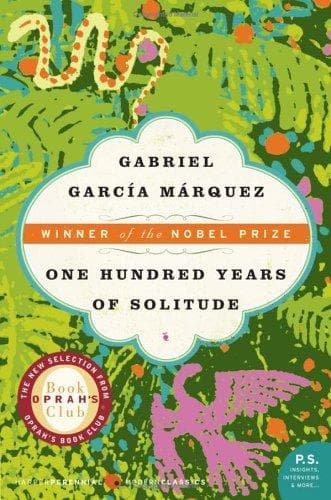
One Hundred Years of Solitude
Gabriel García Márquez·1967·Harper Perennial Modern Classics·literary-fiction
Reading level: Ages 16+ (adult) · 22-hour read · Advanced difficulty.
- Reading time
- 22h
- Difficulty
- Advanced
- Recommended age
- Ages 16+
- Guide read
- 8min
- Editor's rating
- 4.7 / 5
- colombian-literature
- magical-realism
- latin-american-boom
- nobel-prize
- family-saga
- marquez
— In one sentence —
A century of one family in one village, told in prose so densely accumulating that you finish it remembering it as a single, very long afternoon.
§ 01 · WHY READ
Why read
One Hundred Years of Solitude is the novel by which most readers outside Latin America first encountered magical realism, and it remains the form's most concentrated expression. Márquez was a journalist before he was a novelist, and the book reads like a journalist's chronicle of a place that does not exist — the village of Macondo — written with the same patient attention to dates, weather, family resemblance, and political grievance that a reporter might give to a real town in coastal Colombia.
What makes the book extraordinary is that the supernatural events are reported in exactly that same register. A priest levitates after drinking hot chocolate. A young woman ascends to heaven while folding sheets. Yellow butterflies follow a mechanic. The dead return for conversations. None of this is presented as marvelous; it is presented as the kind of thing that happens. The narrative voice never breaks. The realism is not embedded in the magic; the magic is embedded in the realism. This was the formal breakthrough.
The novel covers a hundred years and seven generations of the Buendía family, founders and inhabitants of Macondo. It is a history of Colombia and of Latin America in the nineteenth and early twentieth centuries — the civil wars, the arrival of the railroad, the foreign banana company, the strikes, the massacres, the official forgetting of the massacres — written as a family saga. It is also, more privately, a meditation on solitude as a Buendía inheritance, the kind that runs in the blood and cannot be argued with.
It won the Nobel Prize in 1982 in recognition of a body of work, but everyone understood that the prize was largely for this book. Pablo Neruda called it "the greatest revelation in the Spanish language since the Don Quixote of Cervantes." Márquez himself said, after reading Gregory Rabassa's English translation, that he thought it was better than the original.
§ 02 · CHARACTERS
Characters
The novel has dozens of named characters and a deliberately confusing tendency to give them the same names. We list only the most essential.
José Arcadio Buendía — patriarch, founder of Macondo. A man of obsessive curiosity who builds the village in the jungle after killing a neighbor in a duel and being haunted by the ghost. He becomes progressively more unhinged by his pursuit of knowledge brought by the gypsies — magnets, magnifying glasses, ice — and is eventually tied to a chestnut tree in the courtyard, where he dies and continues to exist for the rest of the novel.
Úrsula Iguarán — his wife. The novel's quiet structural backbone. She lives more than a hundred years, watches almost everyone she loves die or destroy themselves, and holds the family and house together by force of will. She is the character to whom Márquez gives the most patient and least magical attention.
Colonel Aureliano Buendía — their second son. Fights thirty-two civil wars, loses all of them, fathers seventeen sons by seventeen different women (every one of whom is named Aureliano and marked with a cross of ash), and ends his life making little gold fishes in his workshop, melting them down to make more. The most famous Buendía and the one through whom the novel's politics most clearly speak.
José Arcadio (the second), Aureliano José, Aureliano Segundo, José Arcadio Segundo, Remedios the Beauty, Amaranta, Amaranta Úrsula, the seventeen Aurelianos… Márquez gives the men two names — José Arcadio or Aureliano — in deliberate rotation, and the women variations on Úrsula, Remedios, and Amaranta. The repetition is the point: this is a family in which the same patterns recur, in which the names mark inheritance more than individuality. Read with the family tree open. Most editions include one.
§ 03 · HIGHLIGHTS
Three highlights
No. 1 · The insomnia plague. Early in the novel, Macondo is afflicted by a plague of insomnia that gradually erases the inhabitants' memory of what objects are called. José Arcadio Buendía responds by labeling everything in the village — "table," "chair," "clock" — and then, as the disease progresses, by writing explanations of what each thing is for. Eventually he posts a sign at the entrance to Macondo: "God exists." It is one of the most famous passages in the novel and a perfect miniature of Márquez's method: a fantastical premise, treated as practical problem, illuminating something true about how language and memory hold the world together.
No. 2 · The banana company massacre. Midway through, the foreign banana company arrives, transforms Macondo, exploits its workers, and — when the workers strike — orders the army to fire on a crowd of three thousand gathered in the town square. The bodies are loaded onto a train and dumped in the sea. José Arcadio Segundo, who survives, spends the rest of the novel trying to convince anyone that it happened. The official version, repeated by everyone, is that there was no strike, no crowd, and no massacre. This episode is closely based on the real 1928 massacre of United Fruit Company workers in Ciénaga, Colombia. Márquez's grandfather, who witnessed it, told him about it as a child. The novel is at its most explicitly political here, and its most quietly furious.
No. 3 · The deciphering of Melquíades's manuscripts. At the novel's end, the last Aureliano sits in the room of the gypsy Melquíades — who died on page 75 and whose room has remained intact for a century — and finally deciphers the parchments Melquíades left behind, written in Sanskrit. They turn out to be the complete history of the Buendía family, written in advance, "to a point one hundred years ahead of its time." As Aureliano reads, the events he reads about happen to him, and Macondo is destroyed by a biblical wind. The novel ends with the realization that it has been Melquíades's book, and yours, all along. This is one of the most quoted endings in twentieth-century fiction.
§ 04 · EDITIONS
Recommended editions
| Edition | Why pick it |
|---|---|
| Harper Perennial Modern Classics (Gregory Rabassa translation) | The standard English text since 1970. Rabassa's translation is the one Márquez preferred to his own Spanish. Includes a family tree, which you will need. |
| Everyman's Library (Rabassa, 1995) | Same translation, hardcover, durable, with a useful introduction. The edition to own. |
| Penguin Classics UK (Rabassa) | Identical text, lighter weight, the cheapest serious edition. |
| Audiobook (John Lee, Recorded Books) | Lee's voice has the right gravity for the chronicle tone. Long — about twenty hours — and best taken in patient stretches. |
Avoid abridged editions. The novel's effect depends on accumulation; a shorter version is a different book.
§ 05 · FIT
Who it's for / not for
Read this if you are…
- A reader who wants to understand what magical realism actually means as a literary technique, not as a vague atmospheric label.
- Interested in twentieth-century Latin American history and the literary culture of the Boom (Vargas Llosa, Cortázar, Fuentes, Donoso).
- Comfortable with a novel that rewards patience, repetition, and surrender of conventional plot expectations.
- Willing to read with a family tree in hand.
Skip it if you are…
- A reader who needs clear plot signposts and individuated protagonists. The novel resists both.
- Frustrated by repeated names. The Aurelianos and José Arcadios are deliberately disorienting, and the disorientation is the experience.
- Looking for a novel about romance, even though the book contains many romances. The dominant emotional key is melancholy, not love.
§ 06 · TIPS
Reading tips
- Use the family tree. Don't try to remember the generations from context. The tree at the front of any reputable edition is essential equipment.
- Read in long sittings. The prose is hypnotic and accumulative; short sessions break the spell.
- Don't try to map every magical event to an allegory. Some things are political, some are mythic, some are simply Macondo. Let them coexist.
- The first hundred pages are the hardest. Once Macondo is established and the first generation is in place, the novel's rhythm becomes legible. Push through.
- Pay attention to the gypsies. Melquíades is the novel's hidden author. Every time he appears or is referenced, the book is telling you something about itself.
§ 07 · COMPARE
Read alongside
- Toni Morrison — Beloved (1987). The American novel that did for slavery what Márquez did for Colombian history: braided the supernatural into the historical record, on the grounds that a strictly realist account cannot hold the weight.
- Haruki Murakami — The Wind-Up Bird Chronicle (1995). Different culture, different politics, but a kindred faith that the daily and the uncanny share a single register.
- Mikhail Bulgakov — The Master and Margarita (1967). Published the same year and operating on similar premises in a wildly different key: history is too strange for realism alone.
- Fyodor Dostoevsky — The Brothers Karamazov (1880). Another novel in which a family is the structure through which a country examines itself.
- Franz Kafka — The Metamorphosis (1915). Márquez has said that reading Kafka's opening sentence — "When Gregor Samsa awoke one morning…" — was the moment he realized literature could do this.
§ 08 · DISCUSSION
Discussion questions
- The supernatural events in Macondo are reported in the same register as the realistic ones. What is the effect of this on you as a reader? When, if ever, did you start to read the magical events as metaphor rather than fact?
- Úrsula Iguarán is arguably the novel's central character, but she rarely takes dramatic action. What does her endurance mean in a book otherwise about doomed Buendía men?
- The recurring names (Aureliano, José Arcadio) are deliberately confusing. Did this work on you as a reader? What does the repetition argue about inheritance and individuality?
- The banana company massacre is treated, by the village afterward, as if it never happened. What is Márquez saying about historical memory in Latin America — and in your own country?
- Melquíades's manuscripts turn out to contain the entire history of the family, written in advance. Does this make the novel fatalistic? If everything was already written, why read?
- Solitude is the title's key word. List the kinds of solitude in the novel — political, romantic, familial, sexual, mystical. Are they the same thing under different names?
- Why do you think Márquez preferred Rabassa's English translation to his own Spanish? What might that say about translation as a creative act?
- One Hundred Years of Solitude is sometimes accused of being a tourist version of Latin America that flattered the European literary market in the 1970s. Did anything in the novel feel exoticized to you? Where is the line between cultural specificity and performance?
One line to remember
“Many years later, as he faced the firing squad, Colonel Aureliano Buendía was to remember that distant afternoon when his father took him to discover ice.”— Opening sentence — Gregory Rabassa translation
Appears in collections
Reading lists featuring this book
You might also like
Read next
Chinua Achebe · 1958
Things Fall Apart
The novel that ended the era in which the African could only be the colonized subject of someone else's English-language fiction.
Read · 7 min
Juan Rulfo · 1955
Pedro Páramo
A 124-page novel from 1955 that taught Latin American literature how to let the dead speak in the same paragraph as the living.
Read · 7 min
Elena Ferrante · 2011
My Brilliant Friend
The first volume of the Neapolitan Quartet — a sixty-year friendship recorded with the kind of unsentimental attention most fiction reserves for marriages and wars.
Read · 7 min