Golden set · editor-reviewed
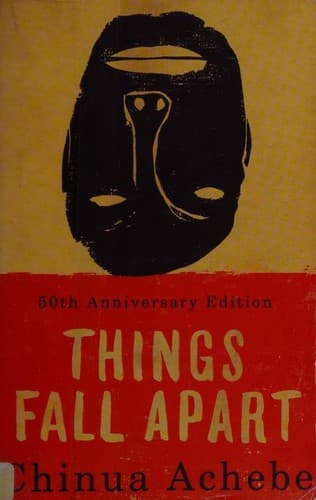
Things Fall Apart
Chinua Achebe·1958·Anchor Books·literary-fiction
Reading level: Ages 14+ (YA) · 5-hour read · Intermediate difficulty.
- Reading time
- 5h
- Difficulty
- Intermediate
- Recommended age
- Ages 14+ (YA)
- Guide read
- 7min
- Editor's rating
- 4.6 / 5
- nigerian-literature
- african-literature
- postcolonial
- igbo
- colonialism
- achebe
— In one sentence —
The novel that ended the era in which the African could only be the colonized subject of someone else's English-language fiction.
§ 01 · WHY READ
Why read
Things Fall Apart is the most widely read African novel in the world — more than twenty million copies, translated into more than fifty languages — and the founding text of modern African literature written in English. Achebe published it in 1958, when he was twenty-eight years old and working as a broadcaster in Lagos. It was his first novel.
The book had a specific argument to make. The dominant English-language fiction about Africa, as Achebe had read it in his colonial-era schooling — Conrad's Heart of Darkness, Joyce Cary's Mister Johnson, Rider Haggard, the long Victorian shelf — had treated Africans as a backdrop, a moral test for European protagonists, an undifferentiated darkness against which white interiority became legible. Achebe wrote Things Fall Apart to do what those novels had refused to do: to depict a specific African society, in this case the Igbo of southeastern Nigeria in the 1890s, with the same psychological seriousness, internal critique, religious complexity, and political texture that English fiction routinely afforded to Yorkshire villages or Russian estates. He used the colonizer's language to do it. That choice — to write in English rather than Igbo — has remained controversial in African letters ever since, and Achebe defended it on practical grounds: he wanted to be read by the largest possible audience, including by Europeans, in the language they had taught him.
The novel's first two-thirds describe Umuofia, the village where Okonkwo lives and farms and contends for status. The final third describes the arrival of British missionaries and administrators, and Okonkwo's catastrophic response. Achebe is not sentimental about pre-colonial Igbo society — he depicts its violence, its harsh treatment of women and twins, its capacity for cruelty — but he refuses to let those things become a justification for what arrives next. The novel is short, declarative, and devastating. It can be read in a weekend and reread for a lifetime.
The title is from W. B. Yeats's "The Second Coming": "Things fall apart; the centre cannot hold; / Mere anarchy is loosed upon the world." Achebe took it not as a description of Africa but as a description of what happens when a society's center is destroyed from outside.
§ 02 · CHARACTERS
Characters
Okonkwo — the protagonist, a wealthy and powerful man of Umuofia. His character is established immediately: he is defined by his hatred of his father, Unoka, a debt-ridden flute player who died poorly, and by his determination to be everything Unoka was not. Okonkwo is masculine, hard-working, contemptuous of weakness, prone to violence, and incapable of expressing the affection he sometimes feels. He is not the novel's hero in any uncomplicated sense. Achebe is interested in him as a specific kind of man — the man who has organized his entire life around a refusal — and in what such a man will do when the world he has organized against changes shape.
Nwoye — Okonkwo's eldest son. A gentle boy who disappoints his father and who, when the missionaries arrive, becomes one of their first converts. The novel's clearest tragedy of inheritance.
Ezinma — Okonkwo's daughter by his second wife, Ekwefi. Okonkwo's favorite child, and the one of whom he often thinks, "I wish she were a boy." The novel's most affecting portrait of love that cannot speak its own name.
Ikemefuna — a boy from a neighboring village given to Umuofia in reparation for a killing, raised in Okonkwo's compound for three years until the village's oracle demands his death. The episode of Ikemefuna's death is one of the novel's structural pivots, and one of its most discussed scenes.
Mr. Brown and Reverend Smith — the two successive English missionaries. Achebe deliberately gives us a moderate first and a fanatic second, refusing the easy version of colonial encounter in either direction.
Obierika — Okonkwo's closest friend. The character Achebe uses to voice the village's own internal critique of its customs, and to articulate what is being lost.
§ 03 · HIGHLIGHTS
Three highlights
No. 1 · The killing of Ikemefuna. After three years living in Okonkwo's compound as a son, Ikemefuna is told he is being taken home. Okonkwo, warned by the wise elder Ezeudu not to participate, accompanies the party anyway. When the first machete blow falls and Ikemefuna runs to Okonkwo crying "Father, they have killed me!", Okonkwo, "dazed with fear," cuts him down himself — because he is afraid of being thought weak. The scene is the novel's moral hinge. Achebe writes it without commentary, and the absence of commentary is the commentary.
No. 2 · The locust passage. Late in the first half of the novel, a great cloud of locusts descends on Umuofia, and the village rejoices because locusts are a delicacy and a sign of fortune. The chapter is famous because the locusts are also, of course, the missionaries who arrive a few chapters later. Achebe lets you see the figure forming without ever pointing at it. This is the book at its formal best: structural symbolism that does not announce itself.
No. 3 · The District Commissioner's last paragraph. The novel's final paragraph is delivered from the perspective of the British District Commissioner, who, contemplating the day's events, thinks about a book he plans to write. He has, he reflects, "already chosen the title" — The Pacification of the Primitive Tribes of the Lower Niger. Okonkwo, whose interior life has filled two hundred pages, becomes for the Commissioner "an interesting reading… perhaps a whole chapter… or a reasonable paragraph." The reversal is brutal. The novel ends by making explicit the kind of book it was written against.
§ 04 · EDITIONS
Recommended editions
| Edition | Why pick it |
|---|---|
| Anchor Books (US, current) | The standard US trade paperback. Achebe wrote in English; no translator is involved. Includes a useful glossary of Igbo terms and proverbs at the back. |
| Penguin Modern Classics (UK) | Same text, slightly more academic apparatus, with an introduction by Biyi Bandele. |
| Everyman's Library African Trilogy (2010) | The hardcover edition that collects Things Fall Apart with No Longer at Ease and Arrow of God. The best way to read the whole sequence — Okonkwo's son and grandson recur in the later books. |
| Audiobook (Peter Francis James, Recorded Books) | One of the great literary audiobook performances of the last twenty years. James handles the proverbs, the Igbo names, and the gradual shift in narrative register with extraordinary control. |
§ 05 · FIT
Who it's for / not for
Read this if you are…
- A reader who has encountered Africa primarily through Western fiction, journalism, or news coverage, and wants to read it from inside.
- Interested in how a society's encounter with colonialism actually unfolds — through trade, through religion, through individual converts, through small administrative cruelties — rather than as an abstract historical event.
- Looking for a short, complete, formally controlled novel that can be taught, discussed, and reread.
- Reading toward Heart of Darkness and wanting Achebe's response in your head first.
Skip it if you are…
- Expecting an idealized portrait of pre-colonial Africa. Achebe refuses this from page one.
- Looking for a sympathetic protagonist in any conventional sense. Okonkwo is meant to be reckoned with, not loved.
§ 06 · TIPS
Reading tips
- Read it as part of a trilogy. Things Fall Apart is the first of three loosely connected novels (with No Longer at Ease and Arrow of God) that follow the Okonkwo family through three generations of Nigerian colonial history. The single novel is complete in itself, but the trilogy is one of the great achievements of twentieth-century fiction.
- Pay attention to the proverbs. Achebe says explicitly in the text that "among the Igbo the art of conversation is regarded very highly, and proverbs are the palm-oil with which words are eaten." The proverbs are not local color; they are the novel's argument about a culture in which language is a serious craft.
- Read Achebe's essay "An Image of Africa" afterward. His 1975 lecture on Conrad's Heart of Darkness makes explicit the literary-critical argument the novel is dramatizing. The two texts are best read in sequence.
- Notice when the narrative voice shifts. For most of the book, the narrator speaks from inside Umuofia. By the final chapter, the camera has pulled back. The shift is doing work.
§ 07 · COMPARE
Read alongside
- Joseph Conrad — Heart of Darkness (1899). Read this after Achebe, with his essay "An Image of Africa" in mind. The two books are in direct, unresolved conversation.
- Toni Morrison — Beloved (1987). A different reckoning with what colonialism and slavery did to specific bodies and communities, written with comparable formal seriousness.
- Octavia E. Butler — Kindred (1979). A confrontation with the daily mechanics of racial violence as lived experience rather than abstraction.
- Zora Neale Hurston — Their Eyes Were Watching God (1937). Another foundational novel that gave a specific community its own interior voice against a literature that had refused it.
- Trevor Noah — Born a Crime (2016). A contemporary southern African memoir that picks up, in nonfiction and a comic register, some of the long aftermath that Things Fall Apart maps.
§ 08 · DISCUSSION
Discussion questions
- Okonkwo is built around the refusal to be his father. How does this single psychological fact organize the rest of his life? Where does the refusal succeed, and where does it cost him?
- The killing of Ikemefuna is the moment from which Okonkwo never recovers. Is this Achebe's judgment, or is it Okonkwo's? How can you tell?
- Achebe shows us Igbo customs — the killing of twins, the treatment of osu outcasts, the violence against women — that the missionaries will eventually use as justification for their work. How does the novel hold these two truths at the same time: that the customs are real, and that the justification is false?
- Nwoye converts to Christianity. The novel treats this as both a personal liberation and a historical wound. Are these compatible readings?
- The District Commissioner's final paragraph collapses Okonkwo into a "reasonable paragraph" in a book about the pacification of primitive tribes. What is the effect of giving him the last word? Why is it him and not Obierika?
- Achebe wrote this novel in English, the colonizer's language, and made it the most-read African novel in the world. Was this the right choice? Read his essay "The African Writer and the English Language" and decide.
- The title comes from Yeats. Why a European poem for a novel about the destruction of an African society by Europeans?
- If Things Fall Apart had been written in Igbo and never translated, would it have done what it did?
One line to remember
“He was a man of action, a man of war. Unlike his father he could stand the look of blood.”— Narrator, Chapter 2
You might also like
Read next
Gabriel García Márquez · 1967
One Hundred Years of Solitude
A century of one family in one village, told in prose so densely accumulating that you finish it remembering it as a single, very long afternoon.
Read · 8 min
Juan Rulfo · 1955
Pedro Páramo
A 124-page novel from 1955 that taught Latin American literature how to let the dead speak in the same paragraph as the living.
Read · 7 min
Elena Ferrante · 2011
My Brilliant Friend
The first volume of the Neapolitan Quartet — a sixty-year friendship recorded with the kind of unsentimental attention most fiction reserves for marriages and wars.
Read · 7 min