Editor-reviewed
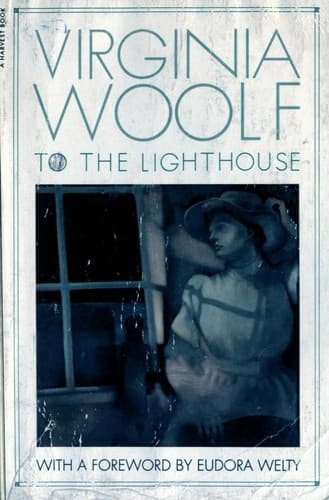
To the Lighthouse
Virginia Woolf·1927·Hogarth Press·Literature
Reading level: Ages 16+ (adult) · 10-hour read · Advanced difficulty.
- Reading time
- 10h
- Difficulty
- Advanced
- Recommended age
- Ages 16+
- Guide read
- 7min
- Editor's rating
- 4.9 / 5
- woolf
- modernist
- stream-of-consciousness
- british-literature
- classic
- canonical
— In one sentence —
A family summer before the First World War. Time passes. What survives is not memory but something memory cannot hold.
§ 01 · WHY READ
Why read
To the Lighthouse is about consciousness — about the gap between what we experience and what we can say about it, between what another person is and what we imagine them to be, between what we intend and what we accomplish. But it is also, plainly, about grief: about the fact that people die and take something irreplaceable with them, and that life continues regardless, and that what continues is both diminished and, in some way, carrying the dead forward.
The novel is structured in three parts: "The Window," set on a single afternoon and evening before the First World War; "Time Passes," ten pages in which the Ramsay house stands empty and the war occurs; and "The Lighthouse," a morning years later when the surviving family returns. This structure is itself an argument: the war — in which two of the Ramsay children die — is not the novel's drama. It is parenthetical. The novel's drama is before and after, in the texture of consciousness, in what a summer afternoon contains when you are paying full attention.
Woolf's technique here is not stream-of-consciousness in Joyce's sense — she moves between minds, free indirect discourse rather than direct transcription — but it produces something he did not: the experience of multiple consciousnesses held in relation, registering each other across an irreducible gap. Mr. Ramsay and Mrs. Ramsay love each other and cannot quite reach each other. Lily Briscoe paints something she cannot finish. James Ramsay, promised a trip to the lighthouse that cannot happen today, hates his father for the clarity of his practical intelligence and slowly, over decades, comes to something like understanding.
This is Woolf's most personal novel — Mrs. Ramsay is drawn from her mother Julia, who died when Woolf was thirteen — and it does what great fiction can do with biographical material: transforms it into something that belongs to everyone.
§ 02 · CHARACTERS
Characters
Mrs. Ramsay — the novel's center, though she dies at the end of the first section (in parentheses, barely mentioned). She is beautiful, generous, matchmaking, effortlessly social, and aware — at some level — that she is living a life that does not use everything she has. Her dinner party in Part One is the novel's set piece: the moment when the family and their guests cohere into something whole that cannot last.
Mr. Ramsay — a philosopher who has reached Q in his work and may never reach R; a man of genuine intellectual courage and daily emotional tyranny; demanding, self-dramatizing, and capable of real tenderness. His relationship with his children and with his wife is the novel's central emotional engine.
Lily Briscoe — the artist, unmarried, who paints the Ramsay house across both sections of the novel and completes her painting in Part Three in a moment that is the novel's resolution. She is the character whose consciousness most closely approximates Woolf's own.
James Ramsay — the youngest child, promised the lighthouse trip at the novel's opening and taken there at its close. His experience of his father — the hatred, the admiration, the complexity of receiving love from someone you have hated — is one of the novel's most psychologically exact threads.
§ 03 · HIGHLIGHTS
Three highlights
No. 1 · Mrs. Ramsay's dinner. The boeuf en daube, the candlelight, the moment when "something" coheres among the guests and Mrs. Ramsay feels it. The scene is Woolf's most direct account of what consciousness can make of shared experience — how a dinner becomes, for a moment, what a dinner aspires to be — and how that moment is already passing as it occurs.
No. 2 · "Time Passes." Ten pages covering ten years: the war, the deaths of Mrs. Ramsay (in brackets), Andrew (killed in France), and Prue (dead in childbirth). The house stands empty; the house decays; nature reclaims the edges. Woolf gives the house's emptiness more space than the deaths, which are parenthetical. The formal choice is devastating: this is what time does to the things that mattered. It continues.
No. 3 · Lily's painting. The final pages: Lily stands at her easel on the lawn, painting the view she tried to paint in Part One. She has been unable to finish it. She thinks of Mrs. Ramsay; she thinks of Ramsay reaching the lighthouse at last; she draws a final line. "It was done; it was finished. Yes, she thought, laying down her brush in extreme fatigue, I have had my vision." The novel's resolution is not emotional reconciliation or understanding — it is the completion of an act of art. Woolf is arguing something precise about what art is for.
§ 04 · EDITIONS
Recommended editions
The text is stable; editions vary in supplementary material.
| Edition | Why pick it |
|---|---|
| Harcourt (Harvest Books, various) | The standard American paperback; clean text; this is the edition most readers use. |
| Oxford World's Classics | Good scholarly apparatus; introduction and notes. Recommended for serious reading. |
| Penguin Modern Classics | Accessible; introduction by Hermione Lee (Woolf's best biographer). Good first choice. |
Audiobook: The audiobook narrated by Juliet Stevenson (Naxos Audiobooks) is exceptionally good — among the best audiobook recordings of any modernist novel. Woolf's prose is inherently rhythmic, and hearing it read aloud clarifies the technique in a way that silent reading sometimes cannot. Recommended as a companion to the text, not a replacement.
§ 05 · FIT
Who it's for / not for
Read this if you are…
- Anyone interested in what modernist fiction is actually doing. This is the best single introduction to the technique and the ambition.
- Readers who have experienced the loss of someone whose absence reshapes how everything else looks.
- Anyone interested in what art is for — Lily's question and Mrs. Ramsay's question are versions of the same question.
Consider carefully if you are…
- A reader who needs plot. Nothing much happens in the conventional sense; the entire drama is in consciousness. This is not a limitation but a choice, and the choice requires patience.
- Someone looking for emotional comfort in a grief narrative. The novel does not comfort — it clarifies.
§ 06 · TIPS
How to read it
Read Part One ("The Window") slowly — it covers only an afternoon and evening, but it contains the entire novel's emotional substance. The dinner party section requires time.
Read "Time Passes" as what it is: a formal gesture. Don't try to feel each death as you read it. The form — parenthetical, hurried, matter-of-fact — is the feeling.
Read "The Lighthouse" knowing that Lily's final line is the novel's resolution, and that it is not about the painting.
§ 07 · COMPARE
Read alongside
- Virginia Woolf — Mrs Dalloway (1925). The earlier one-day novel; similar technique, different emotional register. Read Mrs Dalloway first if you want to understand Woolf's method before tackling its most refined application.
- James Joyce — Ulysses (1922). The companion in modernist ambition: both novels use a single day as their unit of consciousness, both invented the technique Woolf and Joyce worked from independently. Reading them together makes the differences as interesting as the similarities.
- Hermione Lee — Virginia Woolf (1996). The biography. Knowing the biographical source of Mrs. Ramsay — Woolf's mother Julia, dead when Woolf was thirteen — transforms the novel. Read the biography after, not before.
§ 08 · DISCUSSION
Discussion questions
- Mrs. Ramsay dies in parentheses, in "Time Passes," almost without mention. Why does Woolf give her death this form rather than a scene?
- Lily Briscoe completes her painting at the novel's end. What has she achieved? Is it the painting that matters, or something else?
- Mr. Ramsay is difficult to love — demanding, self-dramatizing, emotionally tyrannical. Does the novel love him? Do you?
- "Time Passes" covers ten years in ten pages; "The Window" covers one afternoon in 150 pages. What does this ratio argue about what matters?
- James's hatred for his father and his eventual arrival at the lighthouse are the novel's most psychologically precise arc. What happens to that hatred?
- The lighthouse is variously a symbol, a destination, a disappointment, and a completion. What is it by the end of the novel?
One line to remember
“What is the meaning of life? That was all — a simple question; one that tended to close in on one with years. The great revelation had never come. The great revelation perhaps never did come. Instead there were little daily miracles, illuminations, matches struck unexpectedly in the dark.”— Virginia Woolf — To the Lighthouse
You might also like
Read next
Virginia Woolf · 1925
Mrs Dalloway
Clarissa Dalloway plans a party. Septimus Warren Smith cannot live with what the war did to him. One day, two minds, one city.
Read · 7 min
William Faulkner · 1936
Absalom, Absalom!
Four narrators reconstruct a man who destroyed his family. The story keeps changing. That is the point.
Read · 7 min
Toni Morrison · 1987
Beloved
Toni Morrison said she wrote this novel to give voice to the sixty million. It won the Pulitzer, the Nobel, and is the greatest American novel of the second half of the twentieth century.
Read · 6 min