Editor-reviewed
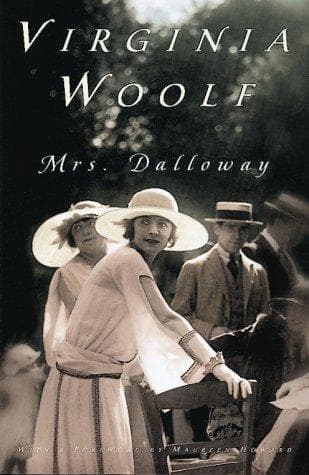
Mrs Dalloway
Virginia Woolf·1925·Hogarth Press·Literature
Reading level: Ages 16+ (adult) · 7-hour read · Advanced difficulty.
- Reading time
- 7h
- Difficulty
- Advanced
- Recommended age
- Ages 16+
- Guide read
- 7min
- Editor's rating
- 4.8 / 5
- woolf
- modernist
- stream-of-consciousness
- british-literature
- classic
- canonical
- mental-health
— In one sentence —
Clarissa Dalloway plans a party. Septimus Warren Smith cannot live with what the war did to him. One day, two minds, one city.
§ 01 · WHY READ
Why read
Mrs Dalloway was published in 1925, six years after the end of the First World War, and it is saturated with the war's aftermath without ever showing the war directly. This is one of the novel's most important formal choices: the war exists in what it has done to two people — Clarissa Dalloway, a society hostess in her fifties who survived but was reshaped, and Septimus Warren Smith, a veteran who cannot survive at all.
The novel covers a single June day in London. Clarissa walks through the city to buy flowers for her party; Septimus and his Italian wife Rezia sit in the park while doctors discuss his treatment. The two never meet. But they rhyme: both have a heightened, almost hallucinatory sensitivity to beauty and to pain; both are threatened by people who want to normalize them; both represent something Woolf is arguing about consciousness, the pressure of social expectation, and what it costs to feel things too completely.
Woolf's technique here — free indirect discourse, movement between minds, present tense interiority — gives the London streets a quality unlike any other novel's depiction of a city. This is not the Dickensian London of social surfaces; it is the London of consciousness registering surfaces, noting what they mean, carrying memory and anticipation through a present that is always about to become the past. The chimes of Big Ben measure the day and mark the difference between clock time (external, public, indifferent) and lived time (uneven, associative, the way consciousness actually moves).
The party at the end brings together the novel's emotional threads — not in resolution, but in the way that real parties hold different grief and different joy in the same room.
§ 02 · CHARACTERS
Characters
Clarissa Dalloway — fifty-two, married to a Conservative MP, planning a party. Not a figure of satire: Woolf is serious about what Clarissa's parties are and what she makes of them — the gift of bringing people together, the value of social pleasure as a form of life-affirmation. But Clarissa is also aware of what her choices cost: she chose Richard Dalloway over Peter Walsh, chose safety over intensity, and the question of whether she chose correctly has never been fully answered.
Septimus Warren Smith — a veteran suffering what would now be called PTSD (Woolf knew it as shell shock). His mind is vivid, perceptive, poetic, and cannot function in the world the doctors want to return him to. He is not a portrait of madness but of extreme sensitivity under unbearable pressure — Woolf is drawing on her own experience of mental breakdown, and the connection between Septimus and Clarissa is biographical as well as structural.
Peter Walsh — Clarissa's former lover, just returned from India; the road not taken. His presence through the day provides a counterpoint to everything Clarissa's life has become. He still loves her; she still feels something; neither knows what to do with this.
Rezia (Lucrezia) Warren Smith — Septimus's Italian wife, who married him before his breakdown and now cannot recognize the man she married. Her perspective on Septimus — loving, frightened, exhausted — is one of the novel's most honest portrayals of what it is like to be close to someone's mental illness without being inside it.
§ 03 · HIGHLIGHTS
Three highlights
No. 1 · Clarissa's morning walk. The novel's opening, in which Clarissa walks through London to buy flowers, is one of the great passages of modernist prose. Her consciousness moves through the city and through time simultaneously — registering the street, the air, the sounds, while simultaneously moving through memory. The technique announces what the novel will do: the present moment contains everything, if you are paying attention.
No. 2 · Septimus in the park. The contrast between Clarissa's morning and Septimus's is one of the novel's formal arguments: the same city, the same air, the same morning — utterly different experience. Septimus sees things Clarissa does not; his consciousness is more intense and cannot be managed. The doctors who want to "cure" him want to reduce this intensity to something socially manageable. Woolf is skeptical of the cure.
No. 3 · The party. Clarissa's party in the final section brings Peter Walsh, old friends, the world that Clarissa has organized her life around. Then she hears the news of Septimus's death — a man she never met, whose suicide she processes in a few minutes alone in a small room. Her response is not grief but recognition: "He had preserved her." She returns to the party. The ending is neither resolution nor evasion — it is the way things actually end, in the middle of ordinary life, with the party still going on.
§ 04 · EDITIONS
Recommended editions
The text is stable; edition choice is about supplementary material.
| Edition | Why pick it |
|---|---|
| Harcourt (Harvest Books, various) | The standard American paperback; what most readers use. |
| Oxford World's Classics | Best annotation; introduction by David Bradshaw with historical and biographical context. Recommended for serious reading. |
| Penguin Modern Classics | Good introduction; accessible format. |
Audiobook: The audiobook narrated by Juliet Stevenson (Naxos Audiobooks) is superb — Woolf's prose rhythms are inherently musical and Stevenson finds them. Particularly useful for understanding how the novel moves between minds; hearing the transitions makes them legible in a way that silent reading can miss. Strongly recommended as a companion to the text.
§ 05 · FIT
Who it's for / not for
Read this if you are…
- A reader coming to Woolf for the first time — this is the best entry point; shorter and more accessible than To the Lighthouse, equally great.
- Anyone interested in how fiction can render consciousness from the inside without losing the world outside it.
- Readers who want to understand what the First World War did to British culture — the novel is one of its most precise accounts, and it does so without a single battlefield scene.
Consider carefully if you are…
- A reader who needs external plot. The entire novel's drama is internal; the events that happen are minor; the meaning is entirely in how they register.
- Someone expecting the mental illness strand to have a therapeutic resolution. Woolf does not offer one.
§ 06 · TIPS
How to read it
Pay attention to transitions between minds — Woolf signals them, but not always with attribution. The novel moves between Clarissa, Septimus, Rezia, Peter, and others without announcement. If you lose track of whose consciousness you are in, slow down.
The clock — Big Ben striking the hours — is the novel's structural spine. Each time the clock strikes, you know where you are in the day. Track the time; it is important that so much occurs in so few hours.
Read Peter Walsh's sections with the awareness that he is also a consciousness in time, also carrying loss, also trying to make sense of what a life is.
§ 07 · COMPARE
Read alongside
- Virginia Woolf — To the Lighthouse (1927). The companion novel; more formally ambitious, more emotionally comprehensive. Read Mrs Dalloway first.
- James Joyce — Ulysses (1922). The formal parallel: both novels use a single day in a city, both render consciousness in motion. Joyce is more exuberant; Woolf is more precisely attuned to what consciousness does with loss. Reading them together is a course in modernism.
- Michael Cunningham — The Hours (1998). A novel written in direct dialogue with Mrs Dalloway, following three women across different decades and cities whose lives rhyme with Woolf's and Clarissa's. The best way to understand what Mrs Dalloway has meant to subsequent writers.
§ 08 · DISCUSSION
Discussion questions
- Clarissa and Septimus never meet. Why does Woolf need both of them? What does each one have that the other lacks?
- Septimus's suicide reaches Clarissa at her own party, and she processes it in private as a kind of preservation of something she herself has given up. What has she given up, and does the novel endorse her interpretation?
- Peter Walsh represents the life Clarissa didn't choose. Does the novel suggest she chose correctly?
- The doctors — Sir William Bradshaw and Holmes — are the novel's only clear villains. What specifically does Woolf accuse them of?
- The novel was written while Woolf was recovering from a serious breakdown. Does knowing this change how you read Septimus?
- Big Ben striking the hours is a constant presence. What does the clock mean in a novel about consciousness that moves through time differently from clock time?
One line to remember
“She had the oddest sense of being herself invisible, unseen; unknown; there being no more marrying, no more having of children now, but only this astonishing and rather solemn progress with the rest of them, up Bond Street, this being Mrs Dalloway; not even Clarissa any more; this being Mrs Richard Dalloway.”— Virginia Woolf — Mrs Dalloway
Appears in collections
Reading lists featuring this book
You might also like
Read next
Virginia Woolf · 1927
To the Lighthouse
A family summer before the First World War. Time passes. What survives is not memory but something memory cannot hold.
Read · 7 min
William Faulkner · 1936
Absalom, Absalom!
Four narrators reconstruct a man who destroyed his family. The story keeps changing. That is the point.
Read · 7 min
Toni Morrison · 1987
Beloved
Toni Morrison said she wrote this novel to give voice to the sixty million. It won the Pulitzer, the Nobel, and is the greatest American novel of the second half of the twentieth century.
Read · 6 min