Editor-reviewed
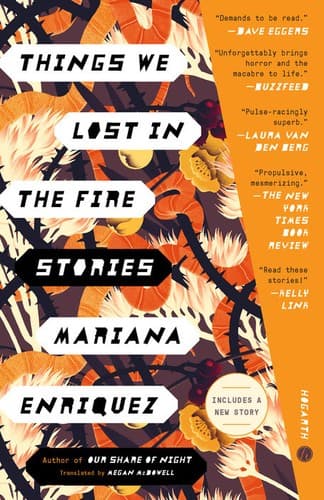
Things We Lost in the Fire
Mariana Enriquez·2016·Hogarth·Literature
Reading level: Ages 18+ (adult) · 5-hour read · moderate difficulty.
- Reading time
- 5h
- Difficulty
- moderate
- Recommended age
- Ages 18+
- Guide read
- 6min
- Editor's rating
- 4.3 / 5
- mariana-enriquez
- netflix-series
- argentine-literature
- horror-stories
- read-before-the-show
— In one sentence —
Mariana Enriquez's Argentine horror stories behind Netflix's 2026 project.
§ 01 · WHY READ
Why read
Things We Lost in the Fire collects Mariana Enriquez's short fiction in English translation by Megan McDowell. Netflix Tudum's 2026 book-adaptation slate describes a project based on stories by the Argentine author, and Penguin Random House lists the Hogarth paperback edition with ISBN 9780451495129.
The collection is horror, but not in a narrow haunted-house sense. Enriquez writes about class violence, dictatorship memory, gendered danger, desire, addiction, and children learning that adults cannot always explain the dark. The supernatural often feels less like an escape from reality than a shape reality was already taking.
Read it before Netflix's project if you want the source atmosphere first. The screen version can choose specific stories and characters; the book gives the wider emotional weather of Enriquez's world.
§ 02 · CHARACTERS
Characters
Girls and young women often enter the stories before they understand the danger around them.
Mothers, daughters, and wives carry private fear into public streets and damaged homes.
Men in power are not always monsters in the literal sense, which is part of the horror.
Buenos Aires and other Argentine settings give the collection its social pressure and memory.
§ 03 · HIGHLIGHTS
Three highlights
No. 1 - Current Netflix source signal. Tudum places Enriquez's stories in the 2026 adaptation slate.
No. 2 - Strong English edition. Hogarth's English paperback keeps the source accessible to U.S. readers.
No. 3 - Literary horror fit. The stories suit readers who want dread with political and emotional weight.
§ 04 · EDITIONS
Recommended editions
| Edition | Why pick it |
|---|---|
| Hogarth paperback | English edition with ISBN 9780451495129. |
| Hogarth hardcover | Earlier English route with ISBN 9780451495112. |
| Spanish edition | Best if you can read Enriquez in the original language. |
| Audiobook | Useful if you want the stories one at a time. |
§ 05 · FIT
Who it's for / not for
Read this if you are...
- Coming from Netflix's Mariana Enriquez project.
- Interested in literary horror from Argentina.
- Looking for short stories with dread, politics, and bodily unease.
- Comfortable with ambiguity and open endings.
Skip it if you are...
- Avoiding violence against women, children in danger, self-harm, or body horror.
- Wanting a single continuous plot.
- Looking for cozy supernatural fiction.
- Frustrated when horror refuses to explain every image.
§ 06 · TIPS
Reading tips
- Read slowly. The stories often turn on one image that keeps changing meaning.
- Watch public space. Streets, houses, shrines, and neighborhoods carry history.
- Do not force one monster type. Enriquez moves between social, psychological, and supernatural horror.
- Use the adaptation as a selection, not a replacement. A screen project will inevitably choose only part of the collection's range.
§ 07 · COMPARE
Read alongside
- Shirley Jackson - The Haunting of Hill House. For psychological dread built from domestic space.
- Silvia Moreno-Garcia - Mexican Gothic. For gothic horror with social rot underneath.
- Octavia E. Butler - Kindred. For speculative fiction where historical violence remains immediate.
- Laura Esquivel - Like Water for Chocolate. For another Latin American work with a major screen route, though in a very different mode.
- Boleslaw Prus - The Doll. For translated fiction entering Netflix through a classic-source lane.
§ 08 · DISCUSSION
Discussion questions
- Which story feels most grounded in ordinary social fear?
- How does Enriquez use houses and neighborhoods as sources of danger?
- When does the supernatural clarify reality rather than distort it?
- What should a Netflix adaptation avoid simplifying?
- How does the collection write women living with threat?
- Which images stay unresolved in a productive way?
- Does the short-story form make the horror stronger?
- How does translation shape your sense of voice and place?
One line to remember
“Enriquez turns haunted houses, blackout streets, and wounded bodies into social horror.”— bibliotecas editorial summary, not a textual quotation
You might also like
Read next
William Faulkner · 1936
Absalom, Absalom!
Four narrators reconstruct a man who destroyed his family. The story keeps changing. That is the point.
Read · 7 min
Toni Morrison · 1987
Beloved
Toni Morrison said she wrote this novel to give voice to the sixty million. It won the Pulitzer, the Nobel, and is the greatest American novel of the second half of the twentieth century.
Read · 6 min
Leo Tolstoy · 1878
Anna Karenina
Not just a love story. Two parallel lives — Anna's destruction, Levin's salvation — ask the same question: how should a person live?
Read · 6 min