Editor-reviewed
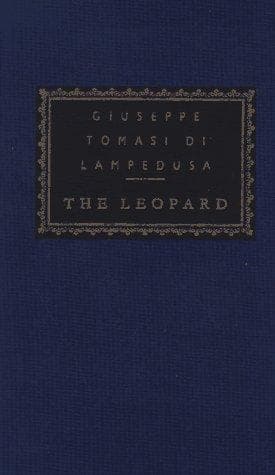
The Leopard
Giuseppe Tomasi di Lampedusa·1958·Everyman's Library·Literature
Reading level: Ages 16+ (adult) · 6-hour read · Intermediate difficulty.
- Reading time
- 6h
- Difficulty
- Intermediate
- Recommended age
- Ages 16+
- Guide read
- 6min
- Editor's rating
- 5.0 / 5
- giuseppe-tomasi-di-lampedusa
- netflix-series
- the-leopard
- sicily
- italian-literature
— In one sentence —
The Sicilian classic behind Netflix's Italian limited series.
§ 01 · WHY READ
Why read
The Leopard is Giuseppe Tomasi di Lampedusa's novel of Sicily during the Risorgimento, centered on Don Fabrizio, Prince of Salina, as political change presses against aristocratic habit. It is a historical novel, a family portrait, and a study of power that understands how compromise can look like dignity from one angle and surrender from another.
Netflix Tudum identifies the limited series as based on Lampedusa's classic novel, and Netflix Media Center keeps the series page active. Penguin Random House lists the Everyman's Library English edition translated by Archibald Colquhoun under ISBN 9780679407577.
Read it if the Netflix series drew you in through costume, landscape, or political intrigue. The book is quieter and sharper: less interested in spectacle than in the private calculations beneath public change.
§ 02 · CHARACTERS
Characters
Don Fabrizio, Prince of Salina is observant, proud, sensual, and painfully aware that his world is losing authority.
Tancredi is the prince's nephew, adaptable enough to survive the new order.
Angelica brings beauty, money, and social mobility into the Salina orbit.
Sicily is not decoration. The island's politics, heat, rooms, rituals, and social codes hold the book together.
§ 03 · HIGHLIGHTS
Three highlights
No. 1 - Direct Netflix route. Tudum and Netflix Media Center both anchor the current screen adaptation.
No. 2 - Short classic, large scale. The novel is not long, but it carries family, politics, class, and mortality.
No. 3 - Screen history. Readers may also know the story through Luchino Visconti's earlier film, which makes the Netflix version part of a longer adaptation life.
§ 04 · EDITIONS
Recommended editions
| Edition | Why pick it |
|---|---|
| Everyman's Library hardcover | Current PRH route with ISBN 9780679407577. |
| Everyman's Library UK edition | Compact classic edition with ISBN 9781857150230. |
| Ebook | Useful for checking names and historical notes. |
| Audiobook | Good if you want the book's ceremonial pace read aloud. |
§ 05 · FIT
Who it's for / not for
Read this if you are...
- Coming from Netflix's The Leopard.
- Interested in aristocracy, revolution, and family decline.
- Looking for a classic that is rich but not enormous.
- Drawn to historical fiction with psychological restraint.
Skip it if you are...
- Wanting a plot-heavy thriller.
- Avoiding dense social and political context.
- Looking for a romance-centered read.
- Sensitive to melancholy stories about decline and death.
§ 06 · TIPS
Reading tips
- Read for adjustment. Much of the drama is in how people adapt to change without saying so plainly.
- Watch Tancredi. His choices explain the new order as much as any speech.
- Do not rush the rooms and meals. Social ritual is where power shows itself.
- Compare after watching. The series can make Sicily visible; the novel makes the prince's judgment intimate.
§ 07 · COMPARE
Read alongside
- Giovanni di Lampedusa - The Last Leopard. External biography route if you want more context on the author.
- Leo Tolstoy - War and Peace. For historical change seen through families and class.
- Ian McEwan - Atonement. For social order, memory, and class pressure before rupture.
- Michael Ondaatje - The English Patient. For another literary screen classic with war and memory.
- Jane Austen - Pride and Prejudice. For a much lighter class-marriage comparison.
§ 08 · DISCUSSION
Discussion questions
- What does Don Fabrizio understand about change that others miss?
- Is Tancredi practical, opportunistic, loyal, or all three?
- How does the novel treat aristocratic beauty without fully endorsing it?
- What role does Angelica play in the family's future?
- How does Sicily shape the book's political feeling?
- Which scenes feel most cinematic, and which feel most inward?
- What should Netflix preserve from the novel's restraint?
- Does the ending feel elegiac, critical, or both?
One line to remember
“A Sicilian prince watches his class survive by learning how to yield.”— bibliotecas editorial summary, not a textual quotation
You might also like
Read next
William Faulkner · 1936
Absalom, Absalom!
Four narrators reconstruct a man who destroyed his family. The story keeps changing. That is the point.
Read · 7 min
Toni Morrison · 1987
Beloved
Toni Morrison said she wrote this novel to give voice to the sixty million. It won the Pulitzer, the Nobel, and is the greatest American novel of the second half of the twentieth century.
Read · 6 min
Leo Tolstoy · 1878
Anna Karenina
Not just a love story. Two parallel lives — Anna's destruction, Levin's salvation — ask the same question: how should a person live?
Read · 6 min