Editor-reviewed
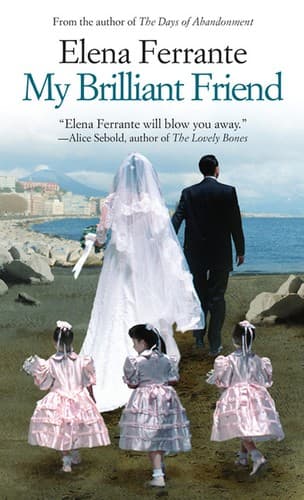
My Brilliant Friend
Elena Ferrante·2011·Europa Editions·literary-fiction
- Reading time
- 13h
- Difficulty
- Intermediate
- Recommended age
- Ages 14+ (YA)
- Guide read
- 7min
- Editor's rating
- 4.4 / 5
- italian-literature
- naples
- female-friendship
- coming-of-age
- neapolitan-quartet
- ferrante
— In one sentence —
The first volume of the Neapolitan Quartet — a sixty-year friendship recorded with the kind of unsentimental attention most fiction reserves for marriages and wars.
§ 01 · WHY READ
Why read
My Brilliant Friend is the first of four novels that, taken together, run to about sixteen hundred pages and cover sixty years in the lives of two women born in 1944 in a poor neighborhood on the outskirts of Naples. The Italian original appeared in 2011, the Ann Goldstein English translation in 2012. The quartet had been almost entirely absent from English-language conversation until that translation, and was then suddenly everywhere — endorsed by James Wood in the New Yorker, by Zadie Smith, by Hilary Mantel — and became, over the next five years, one of the very rare contemporary literary phenomena that crossed every reader category at once. Literary critics, casual readers, book clubs, the HBO drama-series audience: all of them ended up reading these books.
The novels are framed, in the first chapter of the first book, by an event in the present: Elena receives a phone call telling her that her oldest friend, Lila, has disappeared, leaving no trace, taking even the photographs of herself out of the family albums. Elena reacts not with grief but with anger — she sits down, that night, and begins to write down everything she remembers about Lila, from the moment they met as children. The four novels that follow are that act of writing.
Ferrante is interested in friendship between women in the way that nineteenth-century novels were interested in marriage: as the central drama, not the support structure, of a life. Lila and Elena love each other, compete with each other, sabotage each other, save each other, leave each other for years, return to each other. The novel takes that relationship as seriously as Tolstoy took Anna and Vronsky. It is also, simultaneously, a portrait of postwar Italy — of the Camorra's grip on the neighborhood, of the student left, of feminism's arrival in academic and working-class lives, of what social mobility costs the person who achieves it. My Brilliant Friend itself covers only the first twenty years: childhood, adolescence, and Lila's wedding. The remaining three books cover everything after.
It is also, famously, the work of an author whose real identity is unknown. Elena Ferrante is a pseudonym. The author has stated, in written interviews, that books once published do not need their authors. In 2016 a journalist published a financial investigation claiming to have identified her — a claim that was widely condemned as a violation of an author's clearly stated wish, and that we will not repeat or relitigate here. The pseudonym is part of the work.
§ 02 · CHARACTERS
Characters
Elena Greco — the narrator. Studious, anxious, watchful, the daughter of a porter, the only girl in the neighborhood whose family allows her to continue school past elementary. Elena tells us, repeatedly, that she is the secondary one: that Lila is the genius and she is the diligent imitator. The novels' central ambiguity is how much we are meant to believe her about this.
Raffaella "Lila" Cerullo — the daughter of a shoemaker. Brilliant, ferocious, frightening, capable of teaching herself Latin and Greek at ten, and of cutting any social relationship dead at any moment. The novel's most concentrated literary creation. Lila is what the books are about, and Lila is, by Elena's own description, the reason the books exist.
Stefano Carracci — son of the murdered grocer Don Achille. The boy Lila marries at sixteen, in the wedding scene that closes this first book and reorganizes everything in the three that follow.
Nino Sarratore — the railway poet's son, the boy Elena loves from childhood. He will become the quartet's most consequential man, in ways that will be unspooled over the next three volumes.
The Solara brothers (Marcello and Michele) — sons of the Camorra-linked Solara family. Their relationship to Lila is one of the novels' through-lines, and an early portrait of the kind of male power that Ferrante is most interested in: the kind that is also a form of money.
The neighborhood itself. Ferrante gives a character index at the front of each volume, by family. Use it. The neighborhood is the third major character in these books; everyone in it has a history that recurs.
§ 03 · HIGHLIGHTS
Three highlights
No. 1 · The dolls in the cellar. The first significant scene between Lila and Elena, when they are perhaps eight years old: Lila throws Elena's doll into the cellar window of Don Achille, the most feared man in the neighborhood. Elena, terrified, throws Lila's doll in after. The two girls then descend into the cellar together to retrieve them. The scene is the novel's primal image of the friendship: a small reciprocal cruelty, instantly forgiven, that binds them together more than any kindness could.
No. 2 · The plebs passage. Late in the book, after the engagement, Lila tells Elena that she had read the school primer and now understood what the word plebe — plebs — meant, and that she had realized it described their families, their neighborhood, and herself. The passage is famous because it articulates the novel's class consciousness in the voice of the child who is about to be trapped by it. Elena, who will escape, hears it as condemnation; Lila, who will not, hears it as fact.
No. 3 · The wedding (and the shoes). The novel ends at Lila's wedding. The scene is forty pages long and is constructed so carefully that almost every relationship and political tension in the neighborhood pays off in it. The final image — Lila looking at her husband's feet, and what she sees on them — is one of the most devastating last pages in twenty-first-century fiction, and it is the kind of devastation that depends entirely on the three hundred pages that have come before. We will not say more.
§ 04 · EDITIONS
Recommended editions
| Edition | Why pick it |
|---|---|
| Europa Editions paperback (Ann Goldstein translation) | The only English-language edition. Goldstein's translation is the canonical one — she has translated all four volumes plus Ferrante's other fiction and essays, and her work is the reason these books exist in English at all. |
| Europa Editions hardcover boxed set (all four volumes) | The sensible choice if you suspect you will read all four. You will. |
| Audiobook (Hillary Huber, Recorded Books) | Huber narrates all four volumes — over sixty hours of audio — with the right tonal restraint. Be aware that some Neapolitan dialect renders awkwardly in English audio; the print edition handles it more elegantly. |
The 2018 HBO/RAI series L'amica geniale is, unusually for a literary adaptation, almost as good as the book. Filmed in Italian and Neapolitan dialect, with subtitles, it is faithful in detail and in tone. Read the novel first, then watch.
§ 05 · FIT
Who it's for / not for
Read this if you are…
- A reader interested in friendship as a serious literary subject, treated with the unsentimental attention usually reserved for romantic love.
- Curious about postwar Italy, the Camorra, the student movements of the late 1960s, and the texture of Italian class.
- Willing to commit to a long series. My Brilliant Friend is complete in itself, but the friendship doesn't reach its full shape until book four.
- Tolerant of a narrator whose self-deprecation may or may not be reliable.
Skip it if you are…
- Looking for resolution. Ferrante is interested in the way friendships actually move — by accumulation, by absence, by misreading — not in arcs that close.
- Allergic to a large cast of named characters with overlapping families. Use the index at the front.
§ 06 · TIPS
Reading tips
- Use the character index. Each volume opens with a list of every family in the neighborhood, by parents and children. Bookmark it.
- Don't rush to book two. My Brilliant Friend is a complete novel. Sit with the wedding ending before you start The Story of a New Name.
- Read the Frantumaglia essays after the quartet. Ferrante's collected interviews and letters, also translated by Goldstein, are the closest thing we have to an authorial poetics. Save them for after.
- Read the books in publication order. Don't watch the show first. The show is faithful, but Elena's interior voice — the engine of the books — does not transfer.
§ 07 · COMPARE
Read alongside
- Haruki Murakami — Norwegian Wood (1987). Another novel about young friendship and love framed from a long retrospective distance, with comparable interest in what the narrator does and does not see.
- Toni Morrison — Beloved (1987). Different register, but the same conviction that women's interior lives carry historical weight.
- Virginia Woolf — Mrs Dalloway (1925). A foundational novel of female interiority that the Neapolitan books are, in their own way, in conversation with.
- Marcel Proust — Swann's Way (1913). Ferrante has said repeatedly that the Recherche is her template — the long retrospective project of recovering a life by writing it down.
- Zora Neale Hurston — Their Eyes Were Watching God (1937). Another novel constructed as one woman telling another the story of her own life, with comparable attention to what friendship can carry.
§ 08 · DISCUSSION
Discussion questions
- Elena repeatedly tells us that Lila is the brilliant one and she is the diligent imitator. How much of this do you believe? What does it serve her, as a narrator, to insist on?
- The novel opens with Lila's disappearance in old age, then jumps to childhood. How does that framing change your reading of every scene that follows?
- The wedding scene is the novel's structural climax. What has the book been building toward in those forty pages? What is it that Lila sees on her husband's feet, and why does it matter?
- Ferrante is interested in friendships between women as central, not supporting, dramas. How does her treatment differ from the way other novels you've read handle female friendship?
- The neighborhood is controlled, in subtle and not-so-subtle ways, by the Camorra. How does Ferrante show economic and criminal power working on the daily lives of children?
- Elena's escape from the neighborhood depends on education. Lila's intellect is at least equal but she does not escape. What does the novel say about who gets out and why?
- Ferrante writes under a pseudonym and has stated that the author of a published book does not need to be a public person. Does that position change how you read the books? Should the identity question be in your reading at all?
- The Goldstein translation is the only English-language version. Read a paragraph aloud. What kind of English voice has Goldstein given to a Neapolitan original? What might be different in the Italian?
One line to remember
“She had a brilliance. It was a brilliance that demanded effort to be near, that frightened me, that made me feel that I was less.”— Elena Greco, Adolescence section
You might also like
Read next
Gabriel García Márquez · 1967
One Hundred Years of Solitude
A century of one family in one village, told in prose so densely accumulating that you finish it remembering it as a single, very long afternoon.
Read · 8 min
Chinua Achebe · 1958
Things Fall Apart
The novel that ended the era in which the African could only be the colonized subject of someone else's English-language fiction.
Read · 7 min
Juan Rulfo · 1955
Pedro Páramo
A 124-page novel from 1955 that taught Latin American literature how to let the dead speak in the same paragraph as the living.
Read · 7 min