Golden set · editor-reviewed
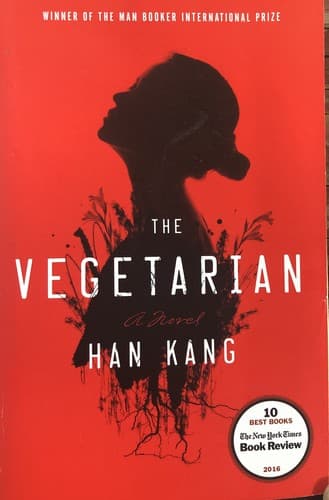
The Vegetarian
Han Kang·2007·Hogarth·literary-fiction
- Reading time
- 5h
- Difficulty
- Intermediate
- Recommended age
- Ages 18+ (mature)
- Guide read
- 7min
- Editor's rating
- 4.3 / 5
- korean-literature
- body-horror
- nobel-prize
- translation
- patriarchy
- han-kang
— In one sentence —
Three novellas about a woman who stops eating meat, told entirely by the people who cannot or will not understand her.
§ 01 · WHY READ
Why read
The Vegetarian is a short novel built from three linked novellas, each told from the perspective of a different family member of a woman named Yeong-hye after she stops eating meat. The husband narrates the first. The brother-in-law narrates the second. The sister narrates the third. Yeong-hye herself never narrates. We see her, throughout, only from outside — as wife, as object of desire, as patient, as problem — and the absence of her own voice is the book's central argument.
Han Kang published the novel in Korean in 2007. It appeared in English in 2015 in Deborah Smith's translation, which the following year won the inaugural Man Booker International Prize in its new format that split the award equally between author and translator. The English-language reception was extraordinary and almost immediately controversial: a small number of Korean-speaking critics, most notably the translator and scholar Charse Yun, began publishing close comparisons of Smith's English to Han's Korean and arguing that the translation had taken substantial liberties — adding descriptive intensity, smoothing rhythmic registers, occasionally rendering plain Korean sentences as more lyrical or more grotesque English ones. Smith and her defenders responded that all literary translation involves recreation and that the English novel was a defensible artistic object on its own terms. We think both sides of this argument are honest. Smith brought Han Kang to English-language readers; the translation she produced is also, in places, demonstrably bolder than the source. Readers who care about translation should read Yun's essays after the novel.
In 2024 Han Kang was awarded the Nobel Prize in Literature, the first Korean writer to receive it, "for her intense poetic prose that confronts historical traumas and exposes the fragility of human life." The Vegetarian is the work most non-Korean readers have read, but it is not necessarily her best book — Human Acts (about the 1980 Gwangju massacre) and The White Book are arguably more controlled. The Vegetarian is the most extreme, the most unsettling, and the most useful as an entry point.
The book is not about vegetarianism. It is about a woman who, after a dream she will not fully describe, refuses to participate in the daily violences her family takes for granted. The refusal is read by everyone around her as illness. The novel asks what the difference might be.
§ 02 · CHARACTERS
Characters
Yeong-hye — the silent center. A married, ordinary woman whose only described qualities, before the dream, are her quietness and the fact that she does not wear a bra (a detail her husband notes with mild irritation in the first sentence of the book). After the dream, she stops eating meat, then stops cooking it, then stops eating most things, then refuses food entirely. We are given exactly five short italicized passages of her interior voice in the entire novel; the rest is what other people make of her.
Mr. Cheong — Yeong-hye's husband, the narrator of Part One ("The Vegetarian"). A self-described ordinary man who married Yeong-hye because she was unremarkable and would not threaten his sense of his own averageness. His narration is one of the most precise portraits in recent fiction of unexamined patriarchal mediocrity. He is appalled by his wife's vegetarianism and ultimately abandons her.
The brother-in-law — unnamed, a video artist married to Yeong-hye's sister. The narrator of Part Two ("Mongolian Mark"). He becomes obsessed with the idea of painting flowers onto Yeong-hye's naked body and filming her, ostensibly as art. The novella is one of the most disturbing in contemporary literature about the way male artistic ambition can dress predation in vocabulary.
In-hye — Yeong-hye's older sister, the narrator of Part Three ("Flaming Trees"). A practical, dutiful woman who runs a cosmetics shop and ultimately becomes Yeong-hye's only caretaker after the events of the second novella. Her interior monologue, alone among the narrators', registers what has happened to her sister as something other than a problem requiring management.
The father — Yeong-hye's father. Briefly present, central. A Vietnam veteran whose violence against his daughters is the novel's quietly stated historical context.
§ 03 · HIGHLIGHTS
Three highlights
No. 1 · The dream that opens the novel. We learn early that Yeong-hye has had a dream of blood, of faces, of something done in a barn. The dream is not described in detail until one of the short italicized interior passages, and even then it is partial. Han Kang refuses to give the dream a clean meaning. Whatever it is — historical violence, sexual violence, the cumulative violence of being inside a body that has been required to consume other bodies — the novel insists that it is enough to organize a life around refusing.
No. 2 · The family dinner. In the first novella, Yeong-hye's parents and siblings gather at her sister's house and her father, enraged by her refusal to eat meat, attempts to force a piece of pork into her mouth. The scene escalates with terrible velocity — the slap, the held arms, the smear of pork on her closed mouth — and ends with Yeong-hye seizing a fruit knife and cutting her own wrist. It is the moment the novel's title becomes legible as a description of violence rather than of diet.
No. 3 · The painted flowers. The entire second novella is a sustained scene in which the brother-in-law convinces Yeong-hye to let him paint flowers across her body and film her. The writing is deliberately, queasily beautiful. Han Kang refuses to clarify whether what is happening is liberation, exploitation, mutual art, mutual delusion, or simply the most articulate version of a familiar story. The reader is required to hold all of these at once.
§ 04 · EDITIONS
Recommended editions
| Edition | Why pick it |
|---|---|
| Hogarth / Crown (US, Deborah Smith translation) | The standard English-language edition. The translation is canonical, prizewinning, and the basis of all anglophone discussion of the book. Read this first. |
| Portobello / Granta (UK, Deborah Smith translation) | Identical text, slightly different cover. The UK edition is the one that won the 2016 Booker International. |
| Audiobook (Janet Song, Stephen Park, Kevin Henderson, HighBridge) | Three narrators for the three perspectives, which is the right structural choice. Strong performances. |
A note on translation. If you read Korean, read the Korean. If you do not but care about the translation debate, the most accessible entries are Charse Yun's essay "How the Bestseller 'The Vegetarian,' Translated from Han Kang's Original, Caused an Uproar in South Korea" (Korea Exposé, 2017) and the various responses, including Han Kang's own measured public comments. The Smith translation is the only English version we have, and it is the version on which the international reception was built.
§ 05 · FIT
Who it's for / not for
Read this if you are…
- A reader who can tolerate body horror, sexual violence, force-feeding, and self-harm as elements of a literary work that does not treat them lightly.
- Interested in how patriarchal violence appears in ordinary registers — at dinner tables, in marriages, in art-world conversations — rather than in dramatic public ones.
- Willing to read a book in which the central character is the silence that everyone speaks around.
- Reading toward Han Kang's other work, especially Human Acts.
Skip it if you are…
- Going through a period in which you cannot read about eating disorders, sexual coercion, or psychiatric institutions. This book will be hard. There is no version of this guide that softens that.
- Looking for resolution. The novel ends in suspension, not in healing.
§ 06 · TIPS
Reading tips
- Read each novella in one sitting. They are short — roughly seventy pages each — and the cumulative effect depends on the rhythm.
- Notice who narrates. The novel never gives Yeong-hye the floor. Every reading of her behavior is, by construction, an outsider's. Track what each narrator wants from her.
- Don't read the title as a description of the plot. The vegetarianism is the smallest visible part of the refusal. The novel is about what the refusal is for.
- Read Human Acts afterward. Han Kang's 2014 novel about the 1980 Gwangju massacre makes explicit a kind of historical pressure that, in The Vegetarian, is mostly implicit. The two books illuminate each other.
§ 07 · COMPARE
Read alongside
- Franz Kafka — The Metamorphosis (1915). The other great short novel about a person who, overnight, becomes something the people around them cannot handle. Han Kang has cited Kafka explicitly.
- Toni Morrison — Beloved (1987). A different reckoning with the body as the site where historical violence is registered and refused.
- Haruki Murakami — The Wind-Up Bird Chronicle (1995). Another East Asian novel in which dreams and bodily transformation carry political weight the realist surface cannot.
- Kazuo Ishiguro — Never Let Me Go (2005). Another novel about what a body is permitted to refuse, told largely by characters who decline to use direct language.
- Margaret Atwood — The Handmaid's Tale (1985). A more explicit treatment of the same underlying question: what does it take, and what does it cost, to stop participating?
§ 08 · DISCUSSION
Discussion questions
- The novel never gives Yeong-hye a sustained interior voice. What does this formal choice argue? Whose book is The Vegetarian?
- Yeong-hye's vegetarianism is treated by her family as an illness. Is it? On what grounds would you say it is, or isn't?
- Mr. Cheong, the husband, is one of the most quietly horrifying narrators in contemporary fiction. What makes his ordinariness so disturbing? Could you imagine a version of Part One that is narrated more sympathetically? Should it have been?
- The brother-in-law genuinely believes he is making art. Han Kang refuses to fully condemn him. Where does the novel draw the line between artistic vision and predation, if it draws one at all?
- In-hye, the older sister, is the only narrator whose perspective shifts across the book. What changes in her, and when?
- The father is briefly described as a Vietnam veteran. The father's violence is largely undescribed but heavily implied. How does this small biographical detail change your reading of the family?
- Read a Yun-style comparison of the Smith translation against the Korean. Where does the English add intensity? Where does it smooth complication? Does it matter?
- Han Kang has said that the book is, at its core, about whether a person can refuse to be human. What would that mean? Is Yeong-hye's path a refusal, an escape, a death, or a transformation? Does the novel let you choose?
One line to remember
“I had a dream. … My hands, my fingers — they're hideous. They look like animal claws.”— Yeong-hye, Part One
You might also like
Read next
Gabriel García Márquez · 1967
One Hundred Years of Solitude
A century of one family in one village, told in prose so densely accumulating that you finish it remembering it as a single, very long afternoon.
Read · 8 min
Chinua Achebe · 1958
Things Fall Apart
The novel that ended the era in which the African could only be the colonized subject of someone else's English-language fiction.
Read · 7 min
Juan Rulfo · 1955
Pedro Páramo
A 124-page novel from 1955 that taught Latin American literature how to let the dead speak in the same paragraph as the living.
Read · 7 min