Editor-reviewed
The Turn of the Screw
Henry James·1898·Macmillan (serial)·Literature
Reading level: Ages 14+ (adult) · 4-hour read · Intermediate difficulty.
- Reading time
- 4h
- Difficulty
- Intermediate
- Recommended age
- Ages 14+
- Guide read
- 4min
- Editor's rating
- 4.5 / 5
- henry-james
- gothic
- ghost-story
- victorian
- ambiguity
- psychological-horror
- novella
- unreliable-narrator
— In one sentence —
A governess sees ghosts at an English country house. Or she doesn't. The ambiguity is not a puzzle to be solved — it is the point.
§ 01 · WHY READ
Why read
Henry James published The Turn of the Screw serially in Collier's Weekly in 1898, then revised it for book publication. He described it as a "trap for the unwary." He was not wrong.
The premise: a young governess is hired to care for two children, Miles and Flora, at a country house called Bly. The children's uncle, who hired her, has left instructions that he is not to be contacted on any account. The previous governess, Miss Jessel, died under unclear circumstances. At Bly, the governess begins to see figures on the grounds — a man on a tower, a woman at a window — whom she comes to believe are the ghosts of the dead Miss Jessel and the uncle's former valet, Peter Quint, who had been forbidden from seeing the children before he died.
Whether the ghosts are real is the question that has occupied readers and critics for 125 years.
The ambiguity is structural: James gives us the governess's first-person account, filtered through a frame narrator who has the manuscript. The governess is clearly in love with the uncle, clearly under psychological strain, clearly capable of projection. She is also clearly seeing something — the physical descriptions of the apparitions are specific and detailed. James provides enough evidence for both readings and enough gaps to prevent either reading from being definitive.
Edmund Wilson published the psychoanalytic reading in 1934 — the ghosts are the governess's sexual hysteria, the children are not corrupted, she destroys Miles by forcing him to name a ghost he cannot see. James's defenders argued the ghosts are real and the children genuinely corrupted. Neither reading is provable; both are available.
§ 02 · CHARACTERS
Characters
The Governess — unnamed; the narrator of the central manuscript. She is young, inexperienced, in love with her employer, and at Bly entirely alone with two children and the housekeeper. Her account is the only account we have. Whether it is reliable is the novel's question.
Miles — the older child, ten years old, recently expelled from school for reasons not disclosed. Charming, articulate, affectionate — and, possibly, corrupted by contact with Quint before Quint's death. Or innocent and destroyed by the governess's certainty of his corruption.
Flora — the younger child, eight. Angelic in appearance; possibly complicit in seeing and concealing the ghosts; possibly entirely innocent.
Mrs. Grose — the housekeeper, the governess's only adult companion. She confirms the governess's identifications of the ghosts — but she has not seen them herself; she is responding to descriptions. Whether her confirmation is evidence or compliance is part of the ambiguity.
§ 03 · HIGHLIGHTS
Three highlights
No. 1 · The first apparition. The governess sees a man on the tower who should not be there. She describes him specifically enough that Mrs. Grose identifies him — from the description — as the dead Peter Quint. The specificity of the description is what James uses to sustain the ghost reading; the fact that the identification comes from Mrs. Grose's response to a description, not from her own sight, is what sustains the psychological reading.
No. 2 · The children's knowledge. Do the children see the ghosts and conceal it, or are they innocent? Miles's unexplained expulsion from school; Flora's behavior by the lake; the moments when both children seem to know more than they should. James renders all of this ambiguously: the governess's interpretation of the children's behavior shapes what we see, but the interpretation could be correct or could be projection.
No. 3 · The ending. The final scene: the governess forces Miles to name Quint. He does — or tries to — and dies in her arms. The cause of his death is not given. The governess's certainty that she has saved him coexists with the reader's uncertainty about whether she has killed him. It is one of the most formally precise endings in the Gothic tradition: completely clear on the surface, completely ambiguous in meaning.
§ 04 · EDITIONS
Recommended editions
| Edition | Why pick it |
|---|---|
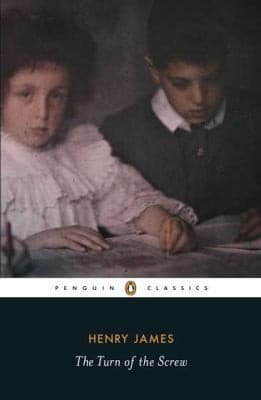
| Penguin Classics | The standard edition; good notes and introduction. |
| Norton Critical Edition | Includes the text, James's preface, critical essays including Wilson's psychoanalytic reading, and the historical context. The most complete reading edition. |
| Oxford World's Classics | Clean text with a good scholarly introduction. |
§ 05 · FIT
Who it's for / not for
Read this if you are…
- Readers interested in unreliable narration: this is the genre's foundational text for the question of what happens when you cannot trust the narrator.
- Anyone who enjoys horror that works through implication rather than statement.
- Readers of James who haven't encountered his ghost fiction: The Turn of the Screw is the best entry point into James's Gothic work.
Skip it if you are…
- Looking for resolution. The ambiguity is structural and intentional; James will not tell you which reading is right.
- Impatient with James's prose style: the sentences are long, subordinate clauses multiply, and meaning is often deferred several times before arrival. This is not a quick read even at 100 pages.
§ 06 · TIPS
Reading tips
- The frame matters. The novella is framed by a party where a guest reads aloud from a manuscript. The distance — frame narrator, manuscript, governess's account — is James's way of marking the unreliability.
- Read both the ghost reading and the psychological reading. Neither is complete; both are necessary. The Norton Critical Edition's critical essays are useful for seeing how the argument has been conducted.
- Mrs. Grose's confirmations are ambiguous. She confirms identifications she cannot independently verify. Track every moment when she confirms something and ask whether she is confirming or complying.
- James's prose is slower than it appears. Don't skim; the meaning is in the qualifications and hesitations, not in the main clauses.
§ 07 · COMPARE
Read alongside
- Shirley Jackson — The Haunting of Hill House (1959). The American heir: another first-person narrator of uncertain reliability, another house, another question of whether the horror is external or internal. Jackson credited James.
- Robert Louis Stevenson — The Strange Case of Dr Jekyll and Mr Hyde (1886). The Victorian Gothic companion: mystery structure, ambiguous interiority, a story assembled from documents. Published twelve years before James's novella.
- Patricia Highsmith — The Talented Mr. Ripley (1955). For readers interested in unreliable first-person narration: Ripley is the modern heir to James's project of rendering consciousness that the reader cannot fully trust.
§ 08 · DISCUSSION
Discussion questions
- Are the ghosts real? Construct the strongest argument for each position. Then decide: does the question have a definitive answer, or is the ambiguity irreducible?
- The governess is in love with the uncle, who has instructed her never to contact him. How does this inform her behavior at Bly? Is she reliable?
- Mrs. Grose confirms the governess's identifications without independently seeing the ghosts. Is she evidence that the ghosts are real, or is she complying with the governess's pressure?
- The children may be corrupted by Quint, or they may be innocent children being destroyed by the governess's certainty. Which reading does the ending support?
- James called it a "trap for the unwary." What is the trap? Who falls into it?
- The ending is ambiguous: Miles dies, but the cause is unclear. Is his death evidence that the governess was right (the ghost destroyed him) or that she was wrong (she frightened him to death)?
- Unreliable narration asks the reader to do interpretive work that reliable narration doesn't require. Is this a more honest form of fiction, or a game?
One line to remember
“I had an absolute certainty that I should see again what I had already seen.”— The Governess — Chapter IV
Appears in collections
Reading lists featuring this book
You might also like
Read next
Henry James · 1881
The Portrait of a Lady
The most precise novel ever written about a free woman choosing, and what it costs her to discover that freedom and error are the same thing.
Read · 7 min
William Faulkner · 1936
Absalom, Absalom!
Four narrators reconstruct a man who destroyed his family. The story keeps changing. That is the point.
Read · 7 min
Toni Morrison · 1987
Beloved
Toni Morrison said she wrote this novel to give voice to the sixty million. It won the Pulitzer, the Nobel, and is the greatest American novel of the second half of the twentieth century.
Read · 6 min