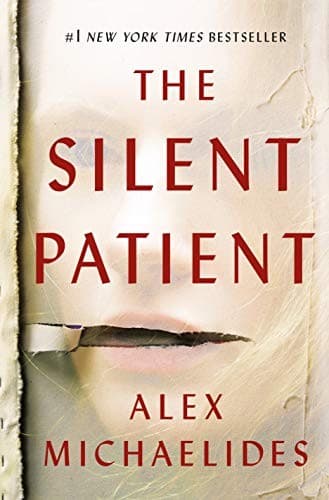
Editor-reviewed
The Silent Patient
Alex Michaelides·2019·Celadon·thriller
Reading level: Ages 14+ (YA) · 7-hour read · Beginner difficulty.
- Reading time
- 7h
- Difficulty
- Beginner
- Recommended age
- Ages 14+ (YA)
- Guide read
- 6min
- Editor's rating
- 4.0 / 5
- psychological-thriller
- twist-fiction
- silence
- greek-myth
- debut-novel
- michaelides
— In one sentence —
A locked-room mystery built around a woman who refuses to speak — and a twist whose audacity is the whole reason the book exists.
§ 01 · WHY READ
Why read
Alex Michaelides's debut sold more than seven million copies, sat on the New York Times hardcover fiction list for over a year, and turned a former screenwriter into one of the most-read thriller authors of the late 2010s. The book exists for one reason: the twist at the end. Whether that reason is enough depends entirely on the reader.
The premise is clean. Alicia Berenson, a successful painter, shoots her husband Gabriel five times in the face. She is found at the scene, refuses to speak, and is committed to a secure psychiatric unit. Six years later she still hasn't spoken a word. Theo Faber, a forensic psychotherapist with what he describes as a personal investment in difficult cases, takes a job at the unit specifically to treat her. The novel alternates between Theo's first-person account of the treatment and the diary Alicia kept in the weeks before the killing.
What Michaelides is doing — and what the reader needs to know going in to read the book on its own terms — is building toward a single structural reveal that depends on you having made a specific assumption from page one. The assumption is one the form of the novel has been designed to make you make. When the reveal lands, you will either feel that the book has earned it through fair play, or you will feel cheated. Both readings are widely held and both have merit. We will not tell you which one we think is right.
The novel is also unusually short for the genre (under 350 pages), unusually propulsive (most readers finish in two sittings), and unusually narrow in its ambitions — it is not trying to be Gone Girl's essay on marriage or The Secret History's essay on class. It is trying to be a magic trick. As magic tricks go, it is well executed.
§ 02 · CHARACTERS
Characters
The cast is small by design — the more characters, the more places to hide the trick.
Theo Faber — forensic psychotherapist and the novel's first-person narrator. Theo presents himself as a wounded healer: bad childhood, a marriage that's saved him, a professional commitment to taking on the patients no one else wants. He is almost ostentatiously self-aware about his own psychology, which is a thing thrillers sometimes do for a reason. The texture of his voice — solicitous, slightly grandiose, eager to be liked — is something you should be paying attention to throughout.
Alicia Berenson — the silent patient. Alicia exists in the novel in two forms: as the present-tense object of Theo's investigation, a woman whose interiority is closed to him, and as the writer of a diary covering the weeks before her husband's death. The diary is most of what we know of her voice. Her silence is the novel's central image, and her decision to use it as a weapon is one of the more interesting choices in recent thriller writing — silence as a kind of refusal that everyone around her insists on filling with their own theories.
Gabriel Berenson — Alicia's dead husband. A successful fashion photographer. The Gabriel of Alicia's diary is the Gabriel she wanted to believe in; the Gabriel of the investigation is harder to pin down. The novel asks, throughout, whether Alicia killed someone who deserved killing — and then, in the late stretch, asks whether that question was the right one.
Diomedes — the unit's clinical director, a Greek psychiatrist of the old school, who lets Theo take Alicia's case partly because he believes in him and partly because no one else has succeeded. The novel's Greek-tragic frame runs through Diomedes; he is the character who reaches for the Alcestis parallel before Theo does.
Christian, Stephanie, Indira — the unit's other clinicians, who function partly as a thriller's necessary chorus of suspects and partly as a study in institutional psychiatry's bureaucratic hostility to the kind of treatment Theo wants to attempt.
Kathy — Theo's wife, an actress, whose role in the novel becomes more important than her early appearances suggest.
§ 03 · HIGHLIGHTS
Three highlights
No. 1 · The Alcestis frame. The novel takes its mythic structure from Euripides's Alcestis, in which a wife dies in place of her husband and then returns from the underworld unable to speak for three days. Alicia, after killing Gabriel, paints a self-portrait titled Alcestis and stops speaking. The Greek frame is the cleanest element of Michaelides's design — it gives the silence a literary weight it would otherwise struggle to carry, and it sets up the question the novel keeps asking: what is being mourned, and who is doing the dying? Read Euripides's play (it is short — about an hour) before or after; it adds depth to the novel that the novel itself only gestures toward.
No. 2 · The diary's slow tightening. Alicia's diary entries, interleaved with Theo's chapters, are the novel's most-praised element among readers who don't love the twist. The diary covers a few weeks of escalating paranoia: a man Alicia thinks is watching the house, a husband who refuses to take her concerns seriously, the slow corrosion of a marriage that we already know ends in five gunshots to the face. The diary is doing one job overtly (building suspense) and another covertly (positioning the reader to make a specific assumption). It is the part of the book where Michaelides is most fully a novelist rather than a constructor of puzzles.
No. 3 · The structural twist. This is what most readers come for and what most readers leave talking about. We will say only that the twist is not a piece of withheld information — it is a reframing of how the chapters you have just read fit together. It belongs to a small family of thriller reveals (the family that includes the device used in a famous Agatha Christie novel from 1926, which we won't name because saying its name spoils both books) that depend on the reader making one reasonable assumption and the writer carefully never confirming it. Whether you find this fair play or sleight of hand is the central question of the book's reception, and reasonable readers split on it. Decide for yourself.
§ 04 · EDITIONS
Recommended editions
| Edition | Why pick it |
|---|---|
| Celadon Books hardcover (US, 2019) | The first edition. Clean, attractive jacket; this is the book most US readers encountered. |
| Orion (UK, 2019) | The British first edition. Same text, the harder-to-find cover features the eye motif that became the book's marketing signature. |
| Celadon paperback (2020) | Includes a brief author Q&A. Useful if you've finished the book and want Michaelides's own framing; mildly spoilery, so save it. |
| Audiobook (Jack Hawkins and Louise Brealey, Macmillan Audio, 2019) | The two-narrator approach is the right call for the dual-voice structure. Brealey's reading of the diary is the standout. Recommended even if you've already read the print version — the twist hits differently when you hear it. |
A film adaptation has been in development since the book's publication; as of 2026 it remains unmade. The premise is well-suited to the screen; the twist will be harder to land on film, where the camera makes structural sleights of hand more difficult to hide.
§ 05 · FIT
Who it's for and who it's not for
Read this if you are…
- A reader who wants a fast, propulsive thriller you can finish in a weekend.
- New to the genre and looking for an entry point that explains why "psychological thriller" is its own category.
- Curious about the post-Gone Girl commercial thriller and what it inherited from the unreliable-narrator tradition.
- Willing to play along with a structural twist, and willing to either love or be annoyed by it without needing to be persuaded in advance.
Skip it if you are…
- Looking for prose-level literary thriller writing in the Tana French or Megan Abbott register. Michaelides is a competent sentence writer, not an exceptional one — the book runs on plot and design, not voice.
- Sensitive to themes of domestic violence, child abuse (referenced in backstory), and gun violence.
- Already familiar with the specific twist family this book belongs to. If you've read a great deal of golden-age detective fiction, you may see the move coming, which dampens the only thing the book really has to sell.
§ 06 · TIPS
Reading tips
- Read it fast. The book is built for one or two long sittings. The structural trick depends on your not having time to reread early chapters with a skeptical eye.
- Don't look up the twist. It is the entire reason to read the book. Goodreads reviews and most online discussion are minefields.
- Read or skim Euripides's Alcestis first if you have an hour. The play is freely available in translation; Michaelides assumes some familiarity with it and the novel reads richer when you have the frame.
- Pay attention to Theo's voice. Specifically: pay attention to what he tells you about himself, in what order, and to what he wants you to think of him. The voice is doing more work than it appears to be.
- After finishing, reread the first chapter. This is a book that rewards a single rereading of its opening. Some readers find that the trick holds up; others find that it doesn't. Both are useful data.
§ 07 · COMPARE
Read alongside
- Gillian Flynn — Gone Girl (2012). The book that made The Silent Patient possible commercially. Read both and you'll see the lineage clearly: Flynn invents the modern structural-twist thriller; Michaelides simplifies the form into a pure puzzle.
- Donna Tartt — The Secret History (1992). The mythological-frame thriller done at literary length and depth. If The Silent Patient's Greek scaffolding intrigued you, Tartt's is the more satisfying version.
- Patricia Highsmith — The Talented Mr. Ripley (1955). The prose ancestor of the unreliable-narrator thriller. Reading Highsmith makes clear what contemporary thrillers gain in pace and lose in psychological texture.
- Tana French — In the Woods (2007). A first-person detective novel with a narrator whose limitations are the book's real subject. A more literary route into the same territory.
- Agatha Christie — almost any of the named twist novels. We won't say which ones; if you've read The Silent Patient you'll recognize the family resemblance. Christie is the patient zero of the form.
§ 08 · DISCUSSION
Discussion questions
- Theo introduces himself as a wounded healer drawn to difficult cases. Reread the first chapter after finishing the book. What is Theo doing in that introduction that you didn't see the first time?
- Alicia's silence is the novel's central image. Is silence, as she uses it, a refusal, a punishment, a confession, or something else? Can it be more than one of those at once?
- The diary entries are the most-praised element of the novel among readers who don't love the twist. What makes them work as writing, independent of what they're doing structurally?
- The Alcestis frame is explicit. Read or skim the Euripides play. Does the novel earn the parallel, or is it a borrowed authority?
- Many readers feel the twist is unfair — that Michaelides has cheated by exploiting an assumption the form encouraged. Others feel it is fair play. State the case for both positions. Which is harder to defend?
- The clinical setting (a secure psychiatric unit) is mostly used as a thriller backdrop rather than examined seriously. Does this matter? Would the book be better if it had taken its setting more seriously, or would that have weakened the trick?
- Gabriel, the dead husband, is largely defined by what Alicia and Theo say about him. Build a case for who he actually was. How much can you say with confidence?
- The Silent Patient is a debut novel by a former screenwriter. What does it show about the differences between screenplay and prose construction? What does the book do well that comes from screenwriting craft, and what does it lose?
One line to remember
“Why did Alicia shoot her husband? Why did she refuse to speak about it? Why did she paint that self-portrait, with that one word as its title — *Alcestis*?”— Theo Faber, opening framing — Part One, Chapter 1
You might also like
Read next
Agatha Christie · 1939
And Then There Were None
Ten strangers, one isolated island, and the cleanest demonstration in mystery fiction that a simple setup can still produce unbearable tension.
Read · 6 min
Daphne du Maurier · 1938
Rebecca
A second marriage, a country house, and a dead woman who seems more alive than everyone around her: du Maurier turns jealousy into one of the great slow-burn suspense novels.
Read · 6 min
John le Carre · 1974
Tinker Tailor Soldier Spy
John le Carre's George Smiley mole hunt, the source novel behind the BBC series and 2011 film.
Read · 6 min