Editor-reviewed
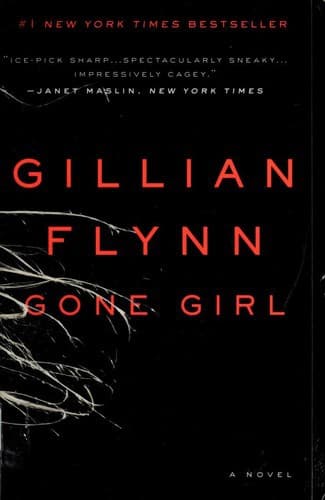
Gone Girl
Gillian Flynn·2012·Crown·thriller
Reading level: Ages 16+ (adult) · 12-hour read · Intermediate difficulty.
- Reading time
- 12h
- Difficulty
- Intermediate
- Recommended age
- Ages 16+
- Guide read
- 7min
- Editor's rating
- 4.3 / 5
- domestic-thriller
- unreliable-narrator
- marriage
- media-satire
- twist-fiction
- flynn
— In one sentence —
A marriage told by two people who are each lying to you in different directions — and the rare thriller that wants both halves of its couple to be genuinely unlikable.
§ 01 · WHY READ
Why read
Gone Girl is the book that did to the marriage plot what Psycho did to the shower scene. Before 2012, the "domestic thriller" was a sub-shelf occupied mostly by Patricia Highsmith devotees and a few stragglers. Within eighteen months of Flynn's novel, it was its own publishing category, every other Goodreads recommendation was The Girl on the Train or The Woman in the Window or The Wife Between Us, and a generation of writers had figured out that the most interesting unreliable narrator is the one who knows she's unreliable and is daring you to catch her.
The premise is mundane: on the morning of their fifth wedding anniversary, Amy Dunne disappears from her Missouri house. Her husband Nick is the obvious suspect. He has been lying — to the police, to Amy's parents, to the reader — from the first chapter. We know this because Flynn tells us so. What she does not tell us, for roughly two hundred pages, is what kind of liar he is, and what kind of liar Amy is, and which of them is the more dangerous person in the room.
The book's reputation rests on its midpoint twist, which we will not spoil. What's more interesting, and what makes it worth reading even if someone has already told you the twist, is the moral architecture underneath it. Flynn is writing about marriage as a long act of mutual performance — about the version of yourself you constructed during dating and the work of maintaining that fiction until you can no longer remember which parts were the lie. The thriller mechanics are the delivery system. The book is really a very angry essay about heterosexual coupling in the recession-era American suburb.
It sold more than twenty million copies. The 2014 David Fincher adaptation made another generation of readers go back and find it. It is the rare bestselling thriller that academic critics also take seriously, and the rare literary novel that genuinely keeps you up at night because you need to know what happens.
§ 02 · CHARACTERS
Characters
The novel alternates between two narrators, and a great deal of its power comes from how those two voices are calibrated against each other.
Nick Dunne — laid-off magazine writer, transplanted back to Missouri to nurse a dying mother and run a bar with his twin sister. Nick narrates in present tense, in the immediate aftermath of Amy's disappearance. He is defensive in a way the reader registers before he does: he lies by omission, he edits, he tells you what he wants you to know in the order that makes him look least bad. Flynn's first major trick is that you spend the early chapters trying to decide whether Nick killed his wife. The real question — what kind of man is this even if he didn't — is harder.
Amy Elliott Dunne — only child of two psychologists who turned her into a children's book series called Amazing Amy, in which a fictional version of her does everything the real Amy fell short of. Amy narrates in diary entries, dated, going back years. Her voice is the engine of the book's first half: warm, self-aware, slightly too literary, the kind of voice you trust because it flatters your intelligence to be trusted by it. You should not trust her. What Flynn does with Amy is one of the most sustained performances of unreliable narration in commercial fiction.
Margo "Go" Dunne — Nick's twin sister and his only real ally. Margo functions as the reader's surrogate: she loves Nick and is therefore willing to believe him, but she's not stupid, and her capacity to keep believing is one of the novel's quiet measurements of how bad things get.
Detective Rhonda Boney — the cop assigned to the case. Boney is the rare procedural figure who is allowed to be both competent and wrong. She reads the evidence the way the public reads the evidence, which is exactly what Amy has counted on.
Desi Collings — Amy's prep-school ex, a wealthy man with a particular set of ideas about Amy that the novel uses to make a specific point about how men's fantasies of women get weaponized against them. He appears late and matters quickly.
§ 03 · HIGHLIGHTS
Three highlights
No. 1 · The diary as performance art. Amy's diary entries are the most-discussed formal device in the novel, and rightly so. They function as a thriller engine — the slow construction of a Nick the diary-Amy claims to know, who may or may not be the Nick we're hearing from in the alternating chapters. But they also function as a piece of writing within the book that is performing for an audience. The pivotal question is not whether the diary is true. It is: who is the diary written for, and what does it want that reader to do? When you understand that, the novel reframes itself completely.
No. 2 · The Cool Girl monologue. The most-quoted passage in twenty-first-century thriller writing, and arguably the moment Flynn's novel exited the genre and became a cultural document. "Cool Girl" is the persona Amy says she performed for Nick during dating: the woman who loves football and hot wings and never complains, who is hot but eats whatever, who has no needs of her own. The monologue is a sustained piece of feminist anger that the novel then complicates by putting it in the mouth of a character whose own motives are very far from sympathetic. Flynn is not letting the reader off easy. The diagnosis is correct. The diagnostician is a monster. Both of those things are true at once, and the novel is the argument for why they have to be.
No. 3 · The structural sleight at the midpoint. We will not describe the twist. We will say this: it is not a twist of plot information ("the husband did it / didn't do it") so much as a twist of narration — the kind of reveal that makes you flip back to earlier chapters to reread them with new ears. Flynn is doing something here that Patricia Highsmith would recognize and approve of: the book has not been lying to you in the cheap way (withholding facts), it has been lying to you in the structural way (letting you assume a narrator was confessing when she was performing). Whether the twist works for you is a question of taste. That it works as a piece of construction is, we think, beyond serious dispute.
§ 04 · EDITIONS
Recommended editions
| Edition | Why pick it |
|---|---|
| Crown hardcover (US, 2012) | First edition. Clean text, no extras. |
| Weidenfeld & Nicolson (UK, 2012) | The British first edition; identical text, slightly different jacket design that some readers prefer. |
| Broadway Books paperback (2014) | The mass-market reissue tied to the Fincher film. Includes a brief Flynn interview and the screenplay's opening pages. Fine if you find it; not worth hunting. |
| Audiobook (Julia Whelan and Kirby Heyborne, Random House Audio, 2012) | The two-narrator format does exactly what the novel needs it to do. Whelan's Amy is one of the great audiobook performances of the decade. Strongly recommended — especially if you've already read the print version. |
The 2014 film (dir. David Fincher, screenplay by Flynn herself) is unusually faithful, partly because Flynn wrote it. Rosamund Pike's Amy is definitive. Ben Affleck's Nick is exactly the casting Fincher needed — a man whose face the camera has trained the audience to find slightly untrustworthy. Watch it after the book; the twist lands harder on the page first.
§ 05 · FIT
Who it's for and who it's not for
Read this if you are…
- A reader who wants a thriller that takes its prose seriously without sacrificing pace.
- Curious about the unreliable-narrator tradition and willing to be played by it.
- Interested in the post-2008 American marriage as a subject — money, status panic, the labor of self-presentation.
- A genre reader who suspects there's more going on under the hood of a "domestic thriller" and wants the book that proved it.
Skip it if you are…
- Looking for characters to root for. Flynn has gone on record that she wanted to write a book in which both halves of a marriage are unlikable and the reader has to sit with that. If you need a hero, this book will refuse you.
- Already burned out on the wave of imitators (The Girl on the Train, Behind Closed Doors, The Couple Next Door). The original still reads better than its descendants, but if the form itself has soured for you, this won't change your mind.
- Sensitive to content warnings around domestic abuse (mostly psychological), graphic violence (one scene, late), and a sustained, unblinking depiction of misogyny in both its everyday and lethal forms.
§ 06 · TIPS
Reading tips
- Read it in three sittings, not thirty. Flynn's pacing depends on the reader carrying the texture of one narrator's voice into the next chapter. Long breaks blunt the effect.
- Don't read summaries; don't watch the film first. The twist is over a decade old at this point and has saturated the culture, but if you've somehow avoided it, protect your reading.
- Pay attention to dates and locations. The diary entries are dated, the present-tense chapters are headed by their day count after the disappearance. The dates are not decorative — they are how the structural sleight is set up.
- Read the Cool Girl passage twice. Once for the diagnosis, once for who is delivering it. The relationship between those two readings is the book in miniature.
- Stay with the ending. It divides readers cleanly; readers who hate it usually want a more conventional resolution. Flynn is doing something specific by refusing one. Decide what you think the refusal means before you decide whether you like it.
§ 07 · COMPARE
Read alongside
- Patricia Highsmith — The Talented Mr. Ripley (1955). The grandparent of the morally untethered first-person thriller. Tom Ripley is the ancestor of every Amy Dunne who came after.
- Megan Abbott — Dare Me (2012) or You Will Know Me (2016). The American writer most often paired with Flynn for good reason: the same interest in female anger and the social performances that contain it, in a more compressed register.
- Tana French — In the Woods (2007). A more literary procedural with an unreliable narrator whose unreliability is psychological rather than performative. The other major reinvention of the police-investigation novel from the same era.
- Paula Hawkins — The Girl on the Train (2015). The most commercially successful of the Gone Girl descendants. Useful for understanding what Flynn pioneered, and what gets lost when the structural sleight becomes a formula.
- Margaret Atwood — Alias Grace (1996). The literary-prestige cousin: a historical novel about a woman whose narration is the central mystery, and whose performance of self is what the book is actually about.
§ 08 · DISCUSSION
Discussion questions
- Nick lies to the reader from the first chapter. At what point did you notice? Did that recognition change how you read him, or did you keep extending him benefit of the doubt?
- Amy's diary is one of the most studied formal devices in contemporary thriller writing. Reread one of the early entries after finishing the book. What was the diary trying to make you feel, and how?
- The Cool Girl monologue is delivered by a character whose motives are nakedly destructive. Does the monologue's argument survive that delivery? Should it?
- Flynn has said she wanted both Amy and Nick to be unlikable. Did she succeed? Are they unlikable in symmetrical ways, or is the book quietly weighting the scales?
- Detective Boney reads the evidence the way the public reads the evidence. What is the novel arguing about how people are perceived through media, and is that argument more or less true in 2026 than it was in 2012?
- Margo is the only sympathetic adult in the book. What does her continued loyalty to Nick measure?
- The ending divides readers more cleanly than any other element. State the case for the ending, then state the case against it. Which is harder to make?
- Is Gone Girl a feminist novel, an anti-feminist novel, or a novel that refuses the question? Defend your answer with one specific passage.
One line to remember
“I waited patiently — years — for the pendulum to swing the other way, for men to start reading Jane Austen, learn how to knit, pretend to love cosmos, organize scrapbook parties, and make out with each other while we leer. And then we'd say, Yeah, he's a Cool Guy.”— Amy Dunne — Part Two, the Cool Girl monologue
You might also like
Read next
Gillian Flynn · 2006
Sharp Objects
Gillian Flynn's small-town psychological thriller behind HBO's limited series.
Read · 6 min
Gillian Flynn · 2009
Dark Places
Gillian Flynn's bleak family-murder thriller with a film route and fresh post-Gone Girl reader demand.
Read · 6 min
Agatha Christie · 1939
And Then There Were None
Ten strangers, one isolated island, and the cleanest demonstration in mystery fiction that a simple setup can still produce unbearable tension.
Read · 6 min