Editor-reviewed
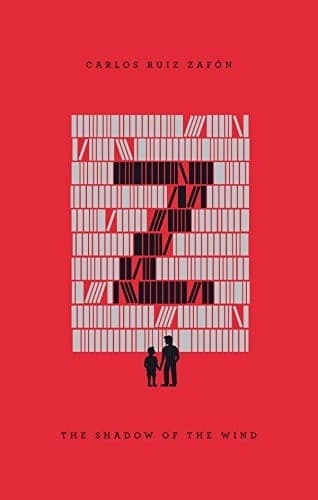
The Shadow of the Wind
Carlos Ruiz Zafón·2001·Penguin Books·literary-fiction
Reading level: Ages 14+ (YA) · 14-hour read · Intermediate difficulty.
- Reading time
- 14h
- Difficulty
- Intermediate
- Recommended age
- Ages 14+ (YA)
- Guide read
- 7min
- Editor's rating
- 4.4 / 5
- spain
- barcelona
- gothic
- metafiction
- post-civil-war
- literary-thriller
— In one sentence —
A Borges-influenced gothic literary thriller that became, on the back of one unusually good English translation, the biggest Spanish novel of the 21st century.
§ 01 · WHY READ
Why read
In 2001 a Barcelona screenwriter named Carlos Ruiz Zafón published a 500-page literary thriller called La sombra del viento. It was his first adult novel after four young-adult books and it sold modestly in Spain at first. Then Lucia Graves — the Mallorca-based translator and daughter of the poet Robert Graves — produced an English translation in 2004 that read like it had been written in English. Word of mouth carried it. By the end of the decade The Shadow of the Wind had sold somewhere north of 15 million copies in 50+ languages, and Zafón had become, by the obvious metric, the most successful Spanish novelist since Cervantes.
The premise is the book's most famous machine. In 1945 Barcelona, a ten-year-old bookseller's son named Daniel Sempere is taken by his father to a hidden library called the Cemetery of Forgotten Books and told to choose one volume — a book he will, from that point forward, protect. He picks The Shadow of the Wind by an obscure author named Julián Carax. He reads it, loves it, and slowly discovers that someone, for years, has been tracking down every copy of every book Carax ever wrote and burning them. Daniel's copy may be the last. His attempt to find out why, and to find out who Carax was, structures the rest of the novel.
What Zafón is doing here is a hybrid that shouldn't work and does. Borges-style metafiction (a book about a book whose author is a mystery) is wrapped inside a gothic-romantic thriller, set against the felt-but-rarely-named presence of postwar Barcelona under Franco. The novel borrows from Dickens (plot density, Victorian secondary characters who threaten to steal every scene), from Umberto Eco (the library as labyrinth), and from the dime-novel serial tradition Zafón loved. It is unashamedly entertaining in a way that contemporary literary fiction often refuses to be, and it is built well enough that its entertainment doesn't trivialize its subject.
The Franco context is the part that travels least well in translation, and the part most worth attending to: this is a novel about what the war and the dictatorship did to ordinary lives in Catalonia, told without ever quite making that the foreground.
§ 02 · CHARACTERS
Characters
The novel is unusually well-populated for its genre, and several supporting figures are as memorable as the leads.
Daniel Sempere — the narrator, a boy when the novel opens and a young man by the end. Daniel is the novel's moral center and its most conventional figure: thoughtful, decent, a reader. He carries the book's first-person perspective through most of its length and the novel's voice is, primarily, his.
Julián Carax — the lost author whose biography Daniel is trying to reconstruct. Carax never appears directly until very late; the novel assembles him from the testimony of people who knew him in 1920s and 1930s Barcelona and Paris. Half the book's pleasure is the slow accretion of his story.
Fermín Romero de Torres — a destitute former prisoner of the regime whom Daniel and his father rescue, and who becomes the bookshop's assistant. Fermín is the novel's comic engine — talkative, learned, sentimentally heroic, given to extravagant Catalan rhetoric — and Zafón gives him most of the best lines. He is also, structurally, the novel's witness to what the regime did. The comedy is what makes the testimony bearable.
Inspector Fumero — the antagonist. A police inspector whose presence is the novel's most direct reference to the violence of the Franco years. Fumero is closer to dime-novel villain than to fully psychological character, which is a choice: the regime, in this novel, prefers not to have its representative humanized.
Nuria Monfort — the woman who knew Julián Carax better than anyone, and whose long letter near the end of the novel re-frames almost everything the reader has assembled. Nuria's chapter is the structural pivot of the book.
§ 03 · HIGHLIGHTS
Three highlights
No. 1 · The Cemetery of Forgotten Books. The opening chapter, in which Daniel's father takes him through pre-dawn Barcelona to a hidden library where each visitor adopts one book, is the novel's most reproduced scene and one of the great inventions in 21st-century popular fiction. Zafón takes a Borgesian conceit — the library as labyrinth — and makes it tactile, child's-eye, specific. It is the moment the novel earns the right to do everything that follows.
No. 2 · Fermín's interrogation, recounted. Mid-novel, Fermín finally tells Daniel what Inspector Fumero did to him in the years after the war. The scene is restrained — Fermín's comic register breaks just enough to let the testimony through — and it is the moment the novel's political subtext becomes its actual subject. Readers who experienced Shadow of the Wind as escapist tend to underweight this scene; it is, in fact, the load-bearing one.
No. 3 · Nuria Monfort's letter. The novel's final third is dominated by a long document — Nuria's letter to Daniel, written before her death — which retells Julián Carax's story from a perspective Daniel could not have had. Zafón's structural gamble (handing the second half of the novel to a different voice) pays off because Nuria's perspective genuinely reorganizes what the reader thought they knew. It is also the section where Zafón's prose, in Graves' translation, is at its most exposed and most controlled.
§ 04 · EDITIONS
Recommended editions
| Edition | Why pick it |
|---|---|
| Penguin Books (Lucia Graves, 2005) | The canonical English translation. Graves' English version is, by reasonable agreement, why this book traveled. Read this one. |
| Weidenfeld & Nicolson (UK, 2004) | Same Graves translation; UK trim. |
| Planeta (Spanish, 2001) | The original. Worth seeking out if you read Spanish — Zafón's prose rhythms are more obvious in Castilian. |
| Audiobook (Jonathan Davis, 2005) | A strong narrator; the gothic-Barcelona register suits a voice performance, and Davis handles Fermín's monologues with the necessary brio. |
A note on series order: this novel is part of a quartet titled The Cemetery of Forgotten Books (followed by The Angel's Game, The Prisoner of Heaven, and The Labyrinth of the Spirits). The four books can be read in any order; Zafón designed them as a "fictional universe" rather than a sequence. Shadow remains the strongest and the best entry point.
§ 05 · FIT
Who it's for / not for
Read this if you are…
- A reader who wants literary fiction with a plot. Zafón gives you ornate prose and a propulsive mystery in the same book — a combination contemporary fiction rarely attempts.
- Interested in 20th-century Spain. The Civil War and Franco years are the novel's atmosphere; the book is, among other things, a long act of memorial.
- A lover of books-about-books. The Cemetery of Forgotten Books is the most evocative library in recent fiction.
- Looking for a long read for a vacation or a long flight. It is built to absorb you.
Skip it if you are…
- Allergic to gothic register. Zafón writes with deliberate excess — operatic dialogue, atmospheric weather, melodramatic encounters in alleys. If that style irritates you on page 30 it will irritate you on page 500.
- Looking for a sober historical novel about the Franco years. The history is present but stylized; for documentary realism, look elsewhere.
- Resistant to coincidence-driven plotting. Daniel's life and Julián's keep rhyming. That rhyming is by design, and you have to extend the novel some credit.
§ 06 · TIPS
Reading tips
- Trust the first hundred pages. The novel takes a while to assemble its machinery; the reward is concentrated in the second half.
- Pay attention to Fermín. He is the comic relief and he is the historical witness. Most of the novel's argument about Spain is in his lines.
- Read Nuria's letter slowly. It is the section that rewards careful reading most. The plot reorganizes around it.
- Don't worry about the series. Shadow is structurally complete. The companion novels expand the world; they do not finish a story this book leaves unfinished.
§ 07 · COMPARE
Read alongside
- Jorge Luis Borges — Ficciones (1944). The labyrinth-library tradition Zafón is working in. "The Library of Babel" is the most obvious source.
- Umberto Eco — The Name of the Rose (1980). The other great literary mystery built around a hidden library. Different century, comparable ambition.
- Charles Dickens — Great Expectations (1861). The 19th-century model for Zafón's plot density and his fondness for vivid secondary characters; the influence is direct and acknowledged.
- Wilkie Collins — The Woman in White (1859). The Victorian sensation-novel inheritance, complete with mysterious women, withheld information, and atmospheric architecture.
- Haruki Murakami — The Wind-Up Bird Chronicle (1994). A different national tradition's version of the long, atmospheric novel built around a buried wartime past.
§ 08 · DISCUSSION
Discussion questions
- The Cemetery of Forgotten Books is described as a refuge for books that would otherwise be lost. What is the novel arguing about preservation, and about the reader's responsibility to a chosen book?
- Fermín's monologues are usually comic. They are also, in places, the novel's most direct political testimony. How does the comic register affect the way the politics land?
- Daniel's life starts to mirror Julián Carax's in unsettling ways. Is this destiny, coincidence, or a writer's deliberate symmetry?
- Inspector Fumero is the novel's villain, but he is also barely psychological — closer to symbol than to character. Why did Zafón make that choice?
- Nuria Monfort's letter takes over the second half of the novel. Did it change how you read everything that came before?
- The novel is set under Franco but rarely names the regime directly. What does that strategy achieve? What does it cost?
- Zafón has been criticized for melodrama and praised for the same quality. Where, for you, does the line fall?
- Of the books-about-books on your shelf, where does Shadow of the Wind belong? What does it do that the others don't?
One line to remember
“Books are mirrors: you only see in them what you already have inside you.”— Julián Carax, quoted by Fermín — Part 2
Appears in collections
Reading lists featuring this book
You might also like
Read next
Gabriel García Márquez · 1967
One Hundred Years of Solitude
A century of one family in one village, told in prose so densely accumulating that you finish it remembering it as a single, very long afternoon.
Read · 8 min
Chinua Achebe · 1958
Things Fall Apart
The novel that ended the era in which the African could only be the colonized subject of someone else's English-language fiction.
Read · 7 min
Juan Rulfo · 1955
Pedro Páramo
A 124-page novel from 1955 that taught Latin American literature how to let the dead speak in the same paragraph as the living.
Read · 7 min