Editor-reviewed
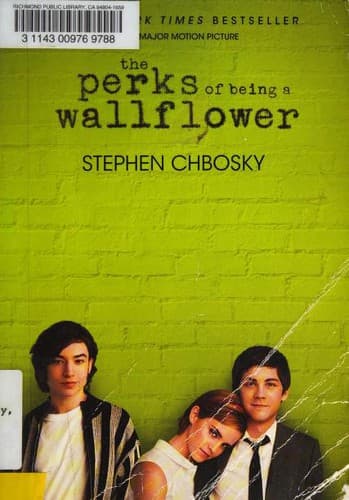
The Perks of Being a Wallflower
Stephen Chbosky·1999·MTV Books / Pocket Books·young-adult
Reading level: Ages 14+ (YA) · 5-hour read · Intermediate difficulty.
- Reading time
- 5h
- Difficulty
- Intermediate
- Recommended age
- Ages 14+ (YA)
- Guide read
- 6min
- Editor's rating
- 4.2 / 5
- young-adult
- coming-of-age
- epistolary
- depression
- abuse
- nineties
— In one sentence —
An epistolary novel that found its form by matching it exactly to its narrator's interior life — and gave a generation a phrase about love it has not stopped quoting.
§ 01 · WHY READ
Why read
The Perks of Being a Wallflower was Stephen Chbosky's first novel, published in 1999 by MTV Books — an imprint that lasted about a decade and produced very little that endured beyond it. Perks did. It has stayed continuously in print for more than twenty-five years, sold over four million copies, become a fixture of high-school reading lists, and produced a 2012 film adaptation that Chbosky directed himself (a rarity — most novelists do not direct the films of their books; almost none direct the films of their first books).
The book is short, epistolary, and structurally unconventional. Charlie, a fifteen-year-old freshman in suburban Pittsburgh, writes letters to an unnamed "Friend" — someone he has heard of but does not know, chosen specifically because the Friend is not part of Charlie's actual life. The letters span one school year. They are dated, signed "Love always, Charlie," and addressed to no one. The form is the book's central craft decision and the reason the book works: Charlie's interior life — anxious, observant, disconnected from his own affect in ways the reader gradually comes to understand — could not have been rendered the same way in third person or in conventional first person. The letters create a narrator who is trying to make himself legible to someone who is not there — which is, the novel suggests, what most adolescents are doing most of the time.
Chbosky handles abuse, depression, sexual assault, and suicide in this book with more directness than almost any YA novel before it, and that directness is part of why the book has been challenged so often (it has appeared on the American Library Association's most-banned books list almost every year since the early 2000s). The book takes its young readers seriously enough to assume they can handle the truth about what happens to some of them. That assumption was, in 1999, a literary risk. It was the right one.
§ 02 · CHARACTERS
Characters
Charlie — narrator, fifteen. Writes the letters. Recently bereaved (his best friend died by suicide the previous spring; his beloved aunt died years before in a car accident on her way to buy him a birthday present). Charlie is in therapy; on medication; gifted at noticing other people and largely incapable of seeing himself. His English teacher gives him books — To Kill a Mockingbird, The Catcher in the Rye, On the Road, Naked Lunch, Walden, The Stranger — and the books are part of the novel's argument: that what literature does for adolescents is name what they otherwise cannot.
Sam — high-school senior, three years older than Charlie. Stepsister to Patrick. The girl Charlie falls in love with on first sight, at a football game. Sam is the novel's most warmly drawn character — generous, complicated, with her own history of having been treated badly by older boys and her own clear-eyed sense of what she is and is not going to accept again. Her interest in Charlie is real, and the novel's handling of why they cannot quite be together is one of its honest accomplishments.
Patrick — Sam's stepbrother. Senior. Gay, out, and in a closeted relationship with the school's quarterback. Patrick is the friend who pulls Charlie into a social life — the wallflower thaws because Patrick decides he is going to thaw. The Patrick-Brad subplot is one of the novel's most-discussed elements, particularly for what it manages to say (without being didactic about it) about closeted relationships in 1990s suburban America.
Mr. Anderson (Bill) — English teacher. Gives Charlie the books. Believes in him in the specific way that a good teacher believes in a quiet kid. The single most cited line in the novel — "We accept the love we think we deserve" — is his, delivered in a one-on-one conversation that the novel structures as the book's emotional center.
Charlie's family — mother, father, older brother (a college football star), older sister (in an abusive relationship with her boyfriend). The family is one of the novel's quiet achievements: Chbosky refuses to make them villains or saints. They love Charlie and they do not see him.
Aunt Helen — Charlie's late aunt, who lived with the family when Charlie was a small child. The figure at the heart of the novel's final reveal. We will not spoil it.
§ 03 · HIGHLIGHTS
Three highlights
No. 1 · The tunnel scene. The most-quoted scene in the book, and the centerpiece of the film adaptation: Charlie, Sam, and Patrick driving through the Fort Pitt Tunnel at night, Sam standing up in the back of the pickup truck, a song on the radio that none of them can identify (Chbosky later confirmed: it is David Bowie's "Heroes"). Charlie's narration of this moment — "and in that moment, I swear we were infinite" — has become one of the durable cultural artifacts of the novel. The line works because the rest of the book has earned it: it arrives after sixty pages of Charlie's careful, anxious, observation-of-others prose, and it is the first moment in the book where his interiority breaks open into joy.
No. 2 · The Rocky Horror nights. Patrick and Sam are part of the local Rocky Horror Picture Show shadow-cast tradition, and the midnight screenings — and Charlie's eventual reluctant participation in them — are the novel's most generous social territory. The Rocky Horror community in the book is the kind of chosen-family teenage subculture that adolescents reading the novel recognize on contact, regardless of whether Rocky Horror itself is part of their world. Chbosky's interest in the small social organizations that adolescents invent for themselves — and that adults rarely take seriously — is one of the book's defining gentlenesses.
No. 3 · The final letters. The last several letters of the novel, written after the book's central revelation, are its most difficult and most carefully constructed pages. The reveal — concerning Aunt Helen, and what Charlie has not let himself remember — reframes everything that has come before, including the affect-flatness of Charlie's narration, his episodes of dissociation, the inexplicable crying jags. The novel's argument is that some kinds of knowing are not available to the person who needs to know them until the knowing becomes survivable. The final letters are about Charlie reaching the point where survival is possible. The pages are quiet, brief, and earned.
§ 04 · EDITIONS
Recommended editions
| Edition | Why pick it |
|---|---|
| MTV Books / Pocket Books paperback (original) | The 1999 edition; the cover with the empty highway is iconic for readers of that era. |
| Pocket Books anniversary edition (2012) | Includes a film tie-in cover; same text. |
| 20th Anniversary Edition (2019) | Includes a foreword by Chbosky reflecting on the book's life. Read after, not before. |
| Audiobook (Noah Galvin, 2018) | Galvin's reading is excellent — he catches Charlie's specific combination of observation and withholding without making either precious. |
The 2012 film, directed by Chbosky from his own screenplay, with Logan Lerman as Charlie, Emma Watson as Sam, and Ezra Miller as Patrick, is one of the few literary YA adaptations of the era that the novel's readers approve of, partly because Chbosky was protecting his own material. The tunnel scene works on film, which is harder than it looks: Chbosky understood that the line needs the rest of the movie to carry it. Read the book first; the film is best as a companion piece.
§ 05 · FIT
Who it's for / not for
Read this if you are…
- A teenager who has felt, or is currently feeling, that you are not quite inside your own life the way other people seem to be inside theirs.
- An adult who was that teenager and wants to revisit the book that gave you a vocabulary for it.
- A reader interested in epistolary form. Chbosky's use of the letter as a vehicle for a specific kind of interior voice is technically interesting beyond the YA frame.
- Anyone whose own adolescence involved abuse or grief that took years to be available to be named. The book is a careful, honest companion.
Skip it if you are…
- Sensitive to the subjects: the book contains depictions of suicide, sexual abuse, drug use, and an offstage sexual assault. The handling is careful but unflinching.
- Allergic to earnestness. Charlie is sincere. The novel is sincere. Irony is largely absent. If your default reading mode is suspicious, this book will frustrate you.
- Looking for plot. The novel's narrative is the slow disclosure of a single interior. If you need event, this is not the book.
§ 06 · TIPS
Reading tips
- Read it slowly. Charlie's letters are short and the novel is brief; the temptation is to read it in one sitting. Try not to. Let the year pass at the pace the letters establish.
- Pay attention to what Charlie does not understand about himself. The novel's craft is in the gap between Charlie's narration and what the reader can see. Read for the gap.
- Read the books Charlie reads. The English-class reading list (The Catcher in the Rye, To Kill a Mockingbird, On the Road) is part of the novel's argument. The books Charlie loves are the books that gave him language. Notice which ones.
- Reread the early letters after finishing. The first ten pages are different on the second read. The novel rewards the return.
§ 07 · COMPARE
Read alongside
- J. D. Salinger — The Catcher in the Rye (1951). The patriarch of the adolescent-voice novel. Holden Caulfield is the literary ancestor Charlie's English teacher would have him read alongside; in fact, in the novel, he does.
- John Green — Looking for Alaska (2005). The other defining literary-YA novel of the post-millennium adolescence. Useful comparison.
- Harper Lee — To Kill a Mockingbird (1960). One of the books Mr. Anderson gives Charlie. Worth reading in parallel to think about what an empathetic narrator does to the reader.
- Sylvia Plath — The Bell Jar (1963). The adult novel about depression and a girl narrator that Perks is in the family tree of. Read for an older version of the same interior weather.
- Alison Bechdel — Fun Home (2006). A different form (graphic memoir), a different family, but a similar interest in what the adolescent could not see at the time and the adult can.
§ 08 · DISCUSSION
Discussion questions
- The novel is addressed to an unnamed "Friend." Why does Charlie choose to write to a stranger he has only heard about? What does the choice tell you about him?
- The epistolary form means we receive the novel through Charlie's narration with no external perspective. Where do you find yourself reading against him — understanding things he does not yet understand?
- Mr. Anderson's line, "We accept the love we think we deserve," is the most-quoted from the book. Apply it to three characters in the novel besides Charlie. Does it hold?
- Charlie's sister is in an abusive relationship; Patrick is in a closeted one; Sam has a history of being treated badly. The novel is full of love that is going wrong in different ways. Is the novel arguing that this is what adolescent love does, or that this is what some kinds of love do, regardless of age?
- The novel waits until very late to reveal what happened with Aunt Helen. Why does Chbosky place the reveal where he does, and how does it change your reading of the earlier letters?
- Rocky Horror and the tunnel drive are the two scenes the book is most loved for. What do they have in common as scenes? What is the novel suggesting about what adolescents need from each other?
- The book has been on the most-banned list almost every year since publication. State the case for the banning and the case against it, as clearly as you can. Which case does the book itself answer?
- Chbosky directed his own film adaptation, which is unusual. If you have seen it, where does the film succeed at translating what the book does? Where does it have to compromise?
One line to remember
“We accept the love we think we deserve.”— Mr. Anderson — Part 2
You might also like
Read next
Alice Oseman · 2018
Heartstopper Volume 1
Alice Oseman's first Heartstopper graphic novel, where Nick and Charlie's friendship begins before Netflix expands the story.
Read · 6 min
Suzanne Collins · 2008
The Hunger Games
The novel that proved YA dystopia could be political, not romantic — and that a sixteen-year-old narrator could carry the weight of a real argument about what television does to war.
Read · 6 min
Leigh Bardugo · 2015
Six of Crows
Leigh Bardugo's Grishaverse heist novel, and the source of Netflix's Crow crew.
Read · 6 min