Golden set · editor-reviewed
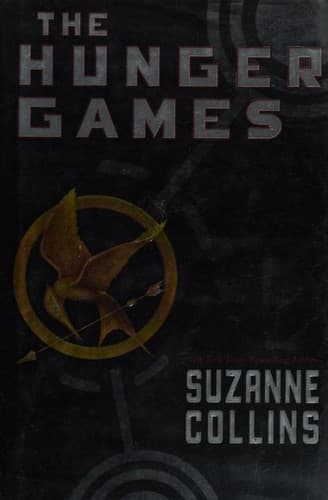
The Hunger Games
Suzanne Collins·2008·Scholastic·young-adult
Reading level: Ages 12+ (YA) · 8-hour read · Beginner difficulty.
- Reading time
- 8h
- Difficulty
- Beginner
- Recommended age
- Ages 12+ (YA)
- Guide read
- 6min
- Editor's rating
- 4.4 / 5
- young-adult
- dystopia
- political
- survival
- first-person
- modern-classic
— In one sentence —
The novel that proved YA dystopia could be political, not romantic — and that a sixteen-year-old narrator could carry the weight of a real argument about what television does to war.
§ 01 · WHY READ
Why read
Suzanne Collins has said in interviews that the seed of The Hunger Games came one night when she was channel-surfing between coverage of the Iraq War and a reality television competition, and the two streams blurred. That collision is the book's actual subject. The arena, the costumes, the manufactured rivalries, the camera angles — all of it is Collins working out what happens when the form of war and the form of entertainment become indistinguishable.
This is what separates The Hunger Games from the wave of YA dystopia that followed it. The premise — a teenage girl forced to fight to the death — could have been pulp. In other hands it would have been. What Collins does instead is build a novel whose central tension is not "will Katniss survive" but "what is required of her to survive, and what is it costing the audience that we are watching her do it." The reader is implicated. That implication is the book's craft.
It also worked as commerce in a way publishers did not expect. In 2008, the YA dystopia category did not exist as a publishing category — the publishing apparatus was still trying to find the next Twilight. The Hunger Games sold on the strength of word of mouth from teenage readers who recognized that the book took them seriously: their hunger, their political instincts, their willingness to read a protagonist who is angry and cold and not particularly easy to love. The book deserves its place on the shelf. It also reset the shelf.
§ 02 · CHARACTERS
Characters
Katniss Everdeen — narrator and tribute from District 12. Sixteen years old, the eldest daughter of a coal miner killed in a mine accident; the family's earner since she was eleven; a hunter who keeps her family alive on poached game. Katniss's voice is the book's most underrated achievement: flat, watchful, distrustful, almost without interiority in the conventional sense. She does not pause to feel her feelings; she registers them as data and moves. This is not a flaw of characterization. It is the characterization. Katniss is a person whose survival has required her to suppress most of what would make her a typical YA heroine, and Collins refuses to soften that.
Peeta Mellark — fellow District 12 tribute, the baker's son. Peeta is the novel's emotional intelligence: warm, articulate, immediately strategic about the cameras in a way Katniss is not. He understands the game as a performance long before she does, and his early television interview — the confession of his crush on Katniss — is a tactical move she only later recognizes as one. The Peeta-Katniss dynamic is not a romance in the conventional YA sense. It is a partnership under coercive surveillance, in which both parties have to keep guessing how much of the other's affection is real and how much is for the audience.
Gale Hawthorne — Katniss's hunting partner from District 12, glimpsed mostly in the first and last sections of the novel. The "love triangle" that the marketing emphasized is real but it is not what the romance novels do with the form. Gale and Peeta represent two different political futures for Katniss: Gale, the boy who will eventually choose armed resistance and is willing to accept its costs; Peeta, the boy whose moral instinct is that the games destroy you and that survival cannot come at the price of becoming what the Capitol wants. The choice between them is a political choice. Collins is admirably clear about this.
Haymitch Abernathy — District 12's only living victor, the boys' and girls' mentor. A drunk. A man kept alive in part because President Snow understands the value of having him on display as what victory looks like.
President Snow — the Capitol. Largely offstage in this volume; the later books fill him in.
§ 03 · HIGHLIGHTS
Three highlights
No. 1 · The volunteering scene. The reaping in District 12, when Prim's name is drawn and Katniss volunteers, is the novel's structural beginning. It is also Collins's first proof of method: the scene is small, specific, and refuses to be a hero moment. Katniss volunteers because Prim is twelve and would not survive an hour in the arena. There is no swelling music in the prose. Collins narrates the seconds — the silence in the square, the District 12 salute, the realization that she has just agreed to her own death — with the same flat clarity Katniss uses for everything else. The understatement is what makes the scene devastating.
No. 2 · The Cornucopia bloodbath. The opening minutes of the games, when twenty-four children are released into an arena and roughly half of them die within the first hour, is Collins's hardest scene and her most morally serious. She does not stylize the violence. She does not give the deaths meaning. The children die because adults arranged this. The arena is not a Tolkien battlefield where bravery is rewarded; it is a slaughterhouse where the producers have curated the entertainment value. This is the scene that tests whether you trust the book. If you do, the rest follows.
No. 3 · The berries. The final-act sequence in which Katniss and Peeta, the last two tributes, threaten to swallow nightlock berries simultaneously rather than fight each other is one of the most-discussed moments in modern YA. It is the moment Katniss becomes a political problem rather than an entertainment product — the moment she refuses the game's terms and the Capitol has to choose between letting both winners live and admitting that the games can be defied. Read it as a craft achievement: a teenage girl, exhausted and grieving, improvising the gesture that will make the rest of the trilogy necessary.
§ 04 · EDITIONS
Recommended editions
| Edition | Why pick it |
|---|---|
| Scholastic hardcover (US first edition, 2008) | The original. Cover art by Tim O'Brien. |
| Scholastic paperback | The standard edition; what most readers will own. |
| Scholastic 10th Anniversary Edition (2018) | Includes a foreword by Collins and reflections on the book's impact. Worth reading after, not before. |
| Audiobook (Carolyn McCormick) | Strong, flat-affect performance that matches Katniss's narration well. The audio works for this book in a way it doesn't for every first-person YA. |
The 2012 film (dir. Gary Ross, with Jennifer Lawrence) is the rare YA adaptation that understands the source material's politics rather than softening them. Lawrence's Katniss is closer to the book's emotional register than any other film performance of a YA protagonist this side of Speak. Read the book first, then watch the film — the differences are instructive.
§ 05 · FIT
Who it's for / not for
Read this if you are…
- A reader (any age) who has avoided YA because of Twilight-era assumptions about the category. This book is not that book.
- Interested in the question of how spectacle changes the experience of war for the audience that watches it. The novel and Susan Sontag's Regarding the Pain of Others are arguing the same question.
- A parent of a teenager who wants something to read in parallel — The Hunger Games rewards adult attention and gives you genuine ground for conversation.
- A reader who wants a protagonist who is not particularly easy to like and is not designed to be.
Skip it if you are…
- Looking for warmth or romance as the primary engine. The romance is real but it is subordinate to, and complicated by, the political situation.
- Sensitive to violence against children. Collins does not stylize the deaths and they are difficult.
§ 06 · TIPS
Reading tips
- Read it fast. The pacing is engineered. Collins withholds interiority for a reason; if you slow down looking for it, the book reads thinner than it is. Read the arena sections in one sitting if you can.
- Pay attention to the cameras. Every scene in the arena is mediated by surveillance. Notice when Katniss remembers and when she forgets she is being watched. The pattern is the book's argument.
- The book is not a love triangle. It is a political choice in love-triangle clothing. Read it for the choice.
- Read the sequels if you finish this one. Catching Fire and Mockingjay are not equal in quality but they are necessary; the trilogy's argument is incomplete with only the first book.
§ 07 · COMPARE
Read alongside
- William Golding — Lord of the Flies (1954). The other novel about what children do to each other when adults engineer the conditions. Golding's argument is bleaker; Collins's is more political.
- Margaret Atwood — The Handmaid's Tale (1985). Adult dystopia with a similar interest in how a regime uses spectacle and ritual to enforce compliance. Pairs well.
- George Orwell — Animal Farm (1945). The shorter version of how revolutions become the thing they overthrew, which is the question Collins is setting up for Mockingjay.
- Octavia E. Butler — Parable of the Sower (1993). Adult dystopia with a teenage protagonist whose voice is similarly flat and watchful. If you liked Katniss's narration, read Lauren Olamina's.
- Yevgeny Zamyatin — We (1924). The grandfather of dystopian fiction; useful for seeing how durable the genre's structural moves have been.
§ 08 · DISCUSSION
Discussion questions
- Katniss's narration is unusually flat for a YA first-person voice. What does Collins gain by writing her this way? What does it cost?
- The reaping scene is the only place in the novel where Katniss's emotion breaks through her surface. Why does Collins place it where she does, and why does she write it without dramatization?
- Peeta's interview confession transforms the games for Katniss. Does it transform him, in the reader's eyes? Does the question of whether his feelings are real have a clear answer in this book?
- The Capitol's tributes are children. The Capitol's audience is also children, plus adults. What is Collins arguing about the relationship between entertainment and consent?
- Katniss refuses to fight Peeta at the end. Is the gesture political, personal, or both? Does she understand what she is doing at the moment she does it?
- Compare the role of the cameras in The Hunger Games to the role of the telescreens in 1984. What is the structural difference between surveillance and broadcast, and how does that difference change what each book is arguing?
- Gale and Peeta represent different responses to the Capitol. Which response does the novel endorse, if any? Does the first book give you enough information to know?
- Collins has said the book was partly inspired by the overlap between reality television and war coverage. Now, almost two decades later, has the cultural situation she diagnosed gotten better or worse? Is the book more or less relevant in 2026 than it was in 2008?
One line to remember
“If no one watches, then they don't have a game. It's as simple as that.”— Peeta Mellark — Part II
You might also like
Read next
Suzanne Collins · 2025
Sunrise on the Reaping
Suzanne Collins's Haymitch prequel before Lionsgate's 2026 Hunger Games film.
Read · 6 min
Alice Oseman · 2018
Heartstopper Volume 1
Alice Oseman's first Heartstopper graphic novel, where Nick and Charlie's friendship begins before Netflix expands the story.
Read · 6 min
Leigh Bardugo · 2015
Six of Crows
Leigh Bardugo's Grishaverse heist novel, and the source of Netflix's Crow crew.
Read · 6 min