Editor-reviewed
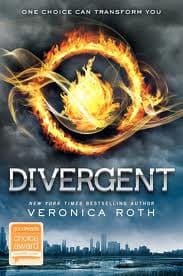
Divergent
Veronica Roth·2011·Katherine Tegen Books·young-adult
- Reading time
- 10h
- Difficulty
- Beginner
- Recommended age
- Ages 13+ (YA)
- Guide read
- 6min
- Editor's rating
- 3.8 / 5
- young-adult
- dystopia
- initiation
- identity
- first-person
- publishing-history
— In one sentence —
The most-read of the post-Katniss YA dystopias — written by a 21-year-old who delivered a propulsive initiation novel inside a world that doesn't survive close inspection.
§ 01 · WHY READ
Why read
Divergent arrived in 2011, three years after The Hunger Games, into a publishing climate that had decided YA dystopia was the next Twilight and was buying accordingly. Veronica Roth was twenty-one years old, finishing her senior year at Northwestern, when she sold the manuscript. The book hit the New York Times bestseller list within weeks, sold over ten million copies in the trilogy, and produced one of the more contentious finales in recent YA history. None of that is irrelevant to how the book reads now.
What Roth does well is the initiation novel: the long middle of Divergent, where Beatrice — now Tris — is being broken down and built back up by the Dauntless training apparatus, is genuinely propulsive. Roth understands the rhythm of pain, recovery, capability, and belonging that initiation narratives have used since boot camp memoirs and the more honest college novels. The training sequences read like she means them.
What she does less well is the worldbuilding, and most close readers eventually arrive at the same observation: the faction system that organizes the novel's society — Abnegation for the selfless, Erudite for the smart, Dauntless for the brave, Amity for the kind, Candor for the honest — does not survive being thought about. People are not one trait. A society that sorted itself by personality test would collapse in a week. But the system is narratively useful, which is what Roth needs it to be: it gives Tris a concrete choice on a specific day, a tribe to enter, an out-group to fear, and a category (Divergent) that lets her exceed the rules. As a mechanism, it works. As a coherent dystopia, it does not.
The book is worth reading, with both of those things held at once. Take it for what it is — a fast, confident initiation story with a charismatic narrator — and stop short of asking it to be Atwood.
§ 02 · CHARACTERS
Characters
Beatrice "Tris" Prior — narrator. Sixteen years old at the start, born into Abnegation, the faction of the selfless. The novel opens on the day she must choose her faction, and the first hundred pages — her dawning understanding that she is not the daughter her parents thought she was — are the novel's strongest writing. Tris is smaller than the people she trains with, more anxious than the persona she is performing, and more willing to do harm than she initially admits. Roth's instinct to make her physically slight and morally hard is the right one.
Four (Tobias Eaton) — Dauntless instructor, eighteen, the love interest. Four is the book's most carefully constructed character, in the sense that Roth visibly thought about him longer than about most of the supporting cast. His name comes from the fact that he has only four fears — a low number — and the slow reveal of who he was before he transferred into Dauntless is the kind of structural choice that makes the romance work. The Tris-Four relationship is the book's emotional center. It is also, to Roth's credit, written without the wish-fulfillment passivity that the post-Twilight YA romance subgenre had defaulted to: Tris is the protagonist of her own attraction.
Christina, Will, Al — the initiate cohort. Christina (transfer from Candor) is the strongest of the supporting friendships; Will and Al function as positions in the moral arithmetic of who survives the initiation and what survival costs.
Eric — Dauntless leader, sadistic, the institutional villain of the training section. A type, but an effective one.
Jeanine Matthews — Erudite leader, the novel's late-revealed antagonist. Functions more as a structural villain than as a character; her plot becomes central in the third act.
§ 03 · HIGHLIGHTS
Three highlights
No. 1 · The choosing ceremony. The early sequence in which sixteen-year-olds drop a drop of blood into a bowl representing their chosen faction — and in doing so commit themselves irrevocably to a way of life that may separate them from their families — is Roth's strongest piece of pure scene-building. The ceremony has the weight of religious ritual, and Roth treats it with the gravity it deserves. Tris's decision to leave Abnegation, knowing her parents will be devastated, is the moment the book earns the rest of its premise.
No. 2 · The fear landscapes. Dauntless initiates must navigate simulated fear environments — controlled hallucinations of their worst fears — and Roth uses these sequences for some of the book's best characterization. Tris's landscape contains specific, plausible terrors (drowning, intimacy, the implication that selfishness has consequences her Abnegation upbringing taught her to dread). Four's landscape, when she eventually sees it, is the book's most economical piece of backstory.
No. 3 · The Choosing Ceremony's opposite — the late-novel attack. The third-act sequence in which the simulation control is weaponized — Dauntless initiates, under control, sent to attack Abnegation — works as both political allegory (an army that does not know it is committing the atrocity) and as personal crisis (Tris must move through people she has trained with, who do not know they are her enemies). The pacing is excellent. The implications are the kind that the second and third books were going to need to grapple with.
§ 04 · EDITIONS
Recommended editions
| Edition | Why pick it |
|---|---|
| Katherine Tegen Books (HarperCollins) hardcover, 2011 | The first edition; what most libraries hold. |
| HarperCollins paperback | The standard; widely available. |
| Audiobook (Emma Galvin) | Galvin's reading is excellent — she catches Tris's specific combination of withholding and impulsiveness. One of the better YA audiobooks of the period. |
| Trilogy boxed set | The trilogy is best read together; the first book ends mid-argument and the questions it raises are answered (and complicated) in Insurgent and Allegiant. |
The 2014 film (dir. Neil Burger, with Shailene Woodley) compresses the training sequences in a way that loses their cumulative effect, which is most of what the book has going for it. The two sequels were progressively less successful adaptations. Skip the films and read the books.
A note on the ending of the trilogy: Allegiant (2013) made a structural choice that divided readers sharply at the time and still does. We will not spoil it. If you read Divergent and find yourself committed to the characters, the trilogy ending is going to be a conversation. Decide for yourself.
§ 05 · FIT
Who it's for / not for
Read this if you are…
- A reader who enjoyed The Hunger Games and wants more of the post-Katniss YA wave at its strongest.
- Interested in well-paced initiation narratives (training, ritual, peer hierarchy, the slow build of competence).
- A teenage reader, or a parent of one, looking for a strong female protagonist who is allowed to be physically capable and morally complicated.
- Curious about the publishing history of YA dystopia and want to read the second-most-important book in the category.
Skip it if you are…
- The kind of reader who needs the worldbuilding to hold up under interrogation. The factions don't.
- Looking for the political seriousness of Collins. Roth is interested in personality and identity; the political dimension is more decorative than load-bearing.
- Allergic to first-person present-tense narration. The book is committed to it.
§ 06 · TIPS
Reading tips
- Suspend the worldbuilding question for the duration. The factions don't make sense; accept them as the novel's premise the way you accept that vampires have to be invited into houses. The book works if you let it.
- Read it for the initiation, not the politics. The middle of the book — the training, the fear landscapes, the cohort dynamics — is its strongest territory. The political plot is the weakest. Adjust expectations.
- Pay attention to Four's silences. Roth gives him a specific kind of withholding that matters in the second and third books. The setup is in the first.
- Read the sequels close together if you want to engage with the trilogy's controversial ending; the gap between books costs the argument some force.
§ 07 · COMPARE
Read alongside
- Suzanne Collins — The Hunger Games (2008). The defining work of the category. Read first, or read Divergent first and then read Collins to see what the publishing-rush books were imitating.
- Lois Lowry — The Giver (1993). The earlier YA-adjacent dystopia about a society that sorts people by function. Shorter, sharper, more philosophically serious.
- William Golding — Lord of the Flies (1954). A different exploration of what initiation into a group does to the initiate's moral life.
- Aldous Huxley — Brave New World (1932). Adult dystopia about engineered personality types and social sorting. The book Divergent is in the family tree of.
- Yevgeny Zamyatin — We (1924). The ancestral dystopia about individuality versus a system that requires its suppression. Worth reading to see how durable these structural moves are.
§ 08 · DISCUSSION
Discussion questions
- The faction system asks sixteen-year-olds to commit irrevocably to a single dominant trait. Imagine the system was real: which faction would actually function, and which would fall apart? What does the answer tell you about Roth's interests?
- Tris is described as "Divergent" — someone who fits in more than one faction. The category is treated as exceptional. In a real human society, what proportion of sixteen-year-olds would be Divergent?
- Compare the choosing ceremony to a real-life initiation: religious confirmation, military enlistment, college matriculation. What does the novel's version inherit from those traditions?
- Four's name and backstory are revealed slowly. What does the structure of that reveal do to the romance, compared to a more conventional YA introduction?
- The training sequences include sustained violence between initiates. Is the violence necessary to what the book is arguing, or is it a genre expectation Roth is meeting?
- Tris kills people in this book — including people she knows. Does the novel let her feel the full weight of those killings, or does it move past them too quickly?
- Compare Tris's narration to Katniss's. Both are first-person YA protagonists in dystopian settings. What is each book gaining and losing from its narrator's specific voice?
- The Erudite are the villains. The "smart" faction is the threat. What is the novel implying about intelligence and political power, and is that implication something the trilogy ultimately complicates or endorses?
One line to remember
“Becoming fearless isn't the point. That's impossible. It's learning how to control your fear, and how to be free from it.”— Four — Chapter 21
You might also like
Read next
Suzanne Collins · 2008
The Hunger Games
The novel that proved YA dystopia could be political, not romantic — and that a sixteen-year-old narrator could carry the weight of a real argument about what television does to war.
Read · 6 min
Stephen Chbosky · 1999
The Perks of Being a Wallflower
An epistolary novel that found its form by matching it exactly to its narrator's interior life — and gave a generation a phrase about love it has not stopped quoting.
Read · 6 min
John Green · 2005
Looking for Alaska
John Green's debut: a boarding-school coming-of-age organized around a single event, written by a 28-year-old whose voice would shape the next decade of literary YA.
Read · 6 min