Editor-reviewed
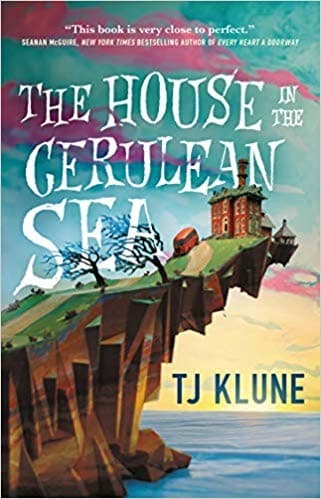
The House in the Cerulean Sea
Cerulean Chronicles · Book One
TJ Klune·2020·Tor Books·Sci-Fi & Fantasy
Reading level: Ages 14+ (adult) · 10-hour read · Beginner difficulty.
- Reading time
- 10h
- Difficulty
- Beginner
- Recommended age
- Ages 14+
- Guide read
- 6min
- Editor's rating
- 4.4 / 5
- cozy-fantasy
- found-family
- queer-romance
- bureaucracy
- orphanage
- feel-good-fantasy
- tj-klune
— In one sentence —
A bureaucrat, six magical children, and one remote island: Klune turns a state-inspection fantasy into an unusually soft, funny argument for chosen family.
§ 01 · WHY READ
Why read
The House in the Cerulean Sea is one of the books that helped define what readers now call cozy fantasy, though Klune's novel is less escapist than that label can make it sound. It begins in drab bureaucracy: Linus Baker, a lonely caseworker in the Department in Charge of Magical Youth, files reports, follows regulations, and lives inside routines designed to make him smaller than he is. Then he is sent to inspect an orphanage on Marsyas Island, where six children officially classified as dangerous live under the care of Arthur Parnassus. The plot is simple on purpose. The point is not whether Linus can solve a puzzle; the point is whether he can learn to see people without the state already having decided what they are.
Klune's big technical choice is tonal. He writes the opening bureaucracy in an Orwell-light register, then gradually warms the book without pretending that prejudice is unreal. The island sections are funny, romantic, and often very sweet, but the sweetness is always in tension with a system that sorts children by how frightening they appear on paper. That is the novel's real engine. This is a comfort read built around the question of what institutions do to the vulnerable when nobody inside them stops to ask whether the rules are humane.
The appeal is obvious. You get a found-family fantasy, a gentle queer romance, several genuinely memorable magical children, and a protagonist whose emotional arc is clear enough that nearly any reader can follow it. But the book also has limits, and an honest guide should name them. Klune prefers warmth to complexity; the villains are mostly bureaucratic or small-minded rather than deeply drawn; and the novel's politics stay fable-like. If you want fantasy that feels restorative, it works extremely well. If you want a harder, more ambivalent treatment of institutional cruelty, this is not that book.
§ 02 · CHARACTERS
Characters
Linus Baker — forty, solitary, precise, and so used to obedience that he initially mistakes compliance for morality. Linus is a good lead because he is not secretly rebellious at the start. He is ordinary in the specific bureaucratic way the novel needs: conscientious, tired, and easier to manage than he realizes. The book's success depends on whether you believe he can change, and Klune earns that change carefully enough.
Arthur Parnassus — master of the Marsyas Island orphanage, guardian, liar when necessary, and the novel's moral counterweight to Linus. Arthur understands institutions better than Linus does because he has already learned what happens when vulnerable people trust them too much. He is written as the warm center of the book, but he also carries its best note of steel.
Lucy — short for Lucifer, yes, that Lucifer. The Antichrist child is the novel's boldest joke and one of its most effective emotional devices. Lucy wants affection, safety, and permission to be a child even while the world insists on reading him as apocalypse.
Chauncey — an amorphous, tentacled child who dreams of becoming a bellhop. Chauncey is where readers usually decide whether Klune's whimsy is for them. If you find him endearing, the book opens up. If you find him precious, much of the novel will feel overdetermined.
Talia, Sal, Theodore, and Phee — the rest of the orphanage children, each built around a recognizable fear. Talia is abrasive and funny; Sal is traumatized and self-concealing; Theodore is gentle and literal; Phee is wild and territorial. Together they give the book its ensemble rhythm.
The Extremely Upper Management — less characters than institutional menace. Klune does not humanize power here, which is the point: the system appears polite, procedural, and devastating.
§ 03 · HIGHLIGHTS
Three highlights
No. 1 · The bureaucratic satire actually works. The early DICOMY chapters are not just setup. They establish the novel's governing contrast between paperwork and personhood. The slogans on orphanage walls, the manuals, the euphemisms, the managerial speech: Klune understands that a lot of cruelty arrives sounding tidy. Because the satire is light rather than savage, some readers underrate it. They shouldn't.
No. 2 · The children are written as children, not symbols in costumes. This is harder than it looks. A novel like this can easily turn magical children into a thesis about difference. Klune mostly avoids that by giving them comic timing, pettiness, repetition, odd ambitions, and the right to be annoying. Chauncey wants to be a bellhop. Theodore loves buttons. Lucy throws himself into melodrama. These details keep the book from becoming only an allegory.
No. 3 · Linus's emotional scale is deliberately modest. No epic battle, no vast lore dump, no save-the-world climax in the usual fantasy sense. Instead the book asks whether one timid, rule-following man can become the kind of person who will publicly choose other people over the machinery that trained him. That smaller scale is the whole design. The novel knows that for many readers, a life changing because someone finally says no to the wrong rule is dramatic enough.
§ 04 · EDITIONS
Recommended editions
| Edition | Why pick it |
|---|---|
| Tor Books hardcover (US, 2020) | The first US edition and the cleanest citation point for the novel as it entered the world. |
| Tor Books paperback (US, 2021) | The most common reading copy; cheaper, easy to find, same text. |
| Pan Macmillan paperback (UK, 2021) | Standard UK edition if you are buying outside the US. |
| Macmillan Audio audiobook (2020) | A good fit for the book's warmth and comic timing; useful if you want the banter to land more naturally. |
Because this is now Book One of the Cerulean Chronicles, you can continue with Somewhere Beyond the Sea if you want more time with these characters. But The House in the Cerulean Sea is structurally complete on its own; it does not end by withholding the book's main emotional payoff.
§ 05 · FIT
Who it's for / not for
Read this if you are…
- Looking for a fantasy novel with a low-stress plot and a high-empathy payoff.
- A reader of queer romance who wants the romance to remain gentle and integrated into a broader found-family story.
- Drawn to books about institutions, rule-following, and the slow realization that decency sometimes requires disobedience.
- Reading for a book club that wants something accessible but not empty.
Skip it if you are…
- Allergic to earnestness. Klune means every ounce of the book's kindness, and he does not undercut it with irony.
- Looking for intricate secondary-world fantasy, hard magic, or elaborate plot architecture. This is contemporary-fairy-tale fantasy, not systems fantasy.
- Unmoved by whimsical ensemble casts. If a yearning blob-child who wants to be a bellhop sounds intolerable, trust that reaction.
- Wanting the novel's institutional and child-removal allegory to engage real-world histories in a more rigorous, less fable-like way. The book stays soft-edged by design.
§ 06 · TIPS
Reading tips
- Let the tone shift happen. The gray, repetitive opening is intentionally narrow. The contrast with Marsyas Island is part of the book's structure, not a flaw to hurry past.
- Read Linus as the main site of change. Arthur and the children are vivid, but the real question is what Linus learns to notice and what he finally becomes unwilling to excuse.
- Do not over-literalize the worldbuilding. DICOMY, the classifications, and the magical case files work best as moral satire, not as a bureaucratic system you are meant to audit for airtight realism.
- Notice who gets described as dangerous and why. The novel is transparent about its politics, but it becomes sharper when you keep asking what the adults are actually afraid of.
§ 07 · COMPARE
Read alongside
- Seanan McGuire — Every Heart a Doorway (2016). Another contemporary fantasy about children whom institutions do not know how to hold, though McGuire is stranger and sharper.
- Ursula K. Le Guin — A Wizard of Earthsea (1968). Not especially similar in plot, but similarly interested in what power does to identity and what kind of adulthood is worth reaching.
- Becky Chambers — A Psalm for the Wild-Built (2021). The other obvious modern comfort-speculative comparison: humane, idea-led, intentionally gentle, and more philosophical than plot-heavy.
- Frances Hodgson Burnett — The Secret Garden (1911). A useful ancestor text for the emotional architecture: damaged children, an enclosed place, and healing that depends on care rather than force.
- Katherine Arden — The Very Secret Society of Irregular Witches (2022). If what you mainly want is magical found family plus an adult caretaker entering a peculiar household, this is the recent readalike most readers actually mean.
§ 08 · DISCUSSION
Discussion questions
- Linus begins the novel believing that being thorough and being good are nearly the same thing. At what point does that equation break for him?
- The children are all officially classified as dangerous. Which of them feels most misread by the adult world, and why?
- Klune writes prejudice in an intentionally legible way: suspicious villagers, bureaucratic euphemism, managerial cruelty. Does that simplicity strengthen the novel's fable structure or flatten it?
- Arthur lies, withholds, and manipulates when he thinks the children need protection. When, if ever, does the novel suggest he goes too far?
- Chauncey is comic relief, but he is also one of the book's clearest statements about aspiration and belonging. Why does his bellhop dream work so well for so many readers?
- The romance between Linus and Arthur is gentle and slow. Would the book lose anything if it removed the romance and stayed purely found-family? Would it gain anything?
- The novel is often described as comforting. What exactly produces that feeling here: plot, prose, moral clarity, humor, or something else?
- If you take the book as an argument about institutions, what is its actual claim: that systems can be reformed from within, that individuals matter more than systems, or that kindness is politically insufficient unless it risks something?
One line to remember
“Hate is a waste of time. I'm far too busy to hate anything.”— Linus Baker — early in the novel
You might also like
Read next
Ted Chiang · 2002
Stories of Your Life and Others
Ted Chiang writes 30-page stories that take longer to think about than most novels. He has won more awards per word than any writer alive.
Read · 5 min
Cixin Liu · 2008
The Dark Forest
Fan + author consensus pick for the best book in the trilogy. Two simple axioms derive the silence of the universe. After this one, you don't look at the night sky the same way.
Read · 5 min
Octavia E. Butler · 1979
Kindred
Octavia Butler sends a Black woman from 1976 Los Angeles back to antebellum Maryland. The time travel is a device. The horror is real.
Read · 5 min