Editor-reviewed
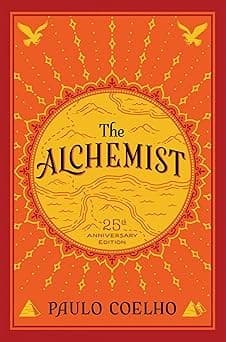
The Alchemist
Paulo Coelho·1988·HarperOne·literary-fiction
Reading level: Ages 12+ (YA) · 4-hour read · Beginner difficulty.
- Reading time
- 4h
- Difficulty
- Beginner
- Recommended age
- Ages 12+ (YA)
- Guide read
- 5min
- Editor's rating
- 3.5 / 5
- fable
- paulo-coelho
- spiritual
- journey
- inspirational
— In one sentence —
A fable that has sold sixty-five million copies and divided readers for thirty years. Worth meeting honestly rather than dismissing — even if you decide, after meeting it, that it isn't for you.
§ 01 · WHY READ
Why read
The Alchemist was published in Portuguese in 1988 as O Alquimista, sold poorly, was nearly dropped by Coelho's original publisher, and was reissued the following year by HarperCollins, after which it became one of the best-selling novels of the late twentieth century. It has been translated into more than eighty languages, has sold roughly sixty-five million copies, and holds the Guinness record for most-translated book by a living author.
The novel is a short fable in the tradition of Saint-Exupéry's The Little Prince and the Sufi teaching tales Coelho was reading at the time of its composition. The plot: Santiago, an Andalusian shepherd who has chosen the wandering life over the priesthood his parents wanted for him, dreams twice of a treasure buried near the Egyptian pyramids. Acting on the dream — first reluctantly, then with increasing commitment — he sells his sheep, crosses to Tangier, is robbed, finds work with a crystal merchant, eventually joins a desert caravan, encounters the alchemist of the title, and learns whatever the book wants you to learn about following what it calls your Personal Legend.
It is genuinely worth talking about the split reception, because the split is not random and not stupid.
The case against: the prose, in English translation, is functional rather than artful; the philosophy is generalized to the point that critical readers describe it as fortune-cookie wisdom; the women in the book exist almost entirely to wait or to be reached; the universe-conspires-to-help-you formulation, taken literally, is a recipe for confirmation bias and prosperity-gospel thinking. The novelist James Wood once described Coelho's work as "the literary equivalent of a candle scented with cinnamon." Many readers of literary fiction find the book unbearable. They are not wrong about what they are reading.
The case for: tens of millions of readers have reported a specific kind of help from this book — people in transition, people deciding whether to leave a job or a marriage or a country, people who needed permission to take their own desire seriously. The book is not pretending to be War and Peace; it is operating in the genre of the teaching tale, where simplicity is a feature and the goal is to make the reader move. By that genre's standards, The Alchemist is among the more effective examples in the modern period.
The honest position, we think, is to acknowledge both. Dismissing the book is easy and not particularly interesting. Pretending it is great literature is a different kind of evasion. Meeting it on its own terms — as a fable, with the powers and limits of fables — is the harder and more useful thing.
§ 02 · CHARACTERS
Characters
The cast is small and most members are functional, in the sense that fables use characters as positions in an argument.
Santiago — the shepherd. Eighteen years old, literate (he reads books), independent, ordinary. Coelho is careful to make him an everyman rather than a hero — the point of the fable is that the journey is available to anyone, which means Santiago must not seem exceptional. Critics of the book sometimes complain that Santiago is too thinly drawn for a novel; supporters point out that this is not a novel but a fable, and thin drawing is the form's convention.
The Old King (Melchizedek) — a king of Salem who appears to Santiago in the early pages, in Tarifa, disguised as an old man. He introduces the concept of the Personal Legend and pushes Santiago into the journey. He represents, in the fable's logic, the call to vocation.
The crystal merchant — Santiago's employer in Tangier after the robbery. The merchant has a dream of his own (a pilgrimage to Mecca) which he has chosen not to pursue, on the explicit grounds that he is afraid the achievement would leave him with nothing further to live for. The merchant is the book's portrait of the man who declines the call. He is treated with notable tenderness; Coelho does not condemn him.
The Englishman — a fellow caravan traveler who is searching for the alchemist for reasons of his own. He has read every book about alchemy; he knows the theory; he cannot do the work. He represents the limit of book-learning in the fable's epistemology.
Fatima — the woman Santiago meets at the oasis and falls in love with. The book has been widely criticized for her thinness; she essentially exists to tell Santiago that a woman of the desert knows how to wait. Readers should be honest about the limit of the book's treatment of her.
The Alchemist — appears late, serves as final teacher, demonstrates the lead-into-gold transformation that gives the book its title, accompanies Santiago for the desert crossing's final stages. He is wisdom in human form and not much more.
§ 03 · HIGHLIGHTS
Three highlights
No. 1 · The crystal merchant's refusal. The chapter in Tangier with the crystal merchant is the most interesting passage in the book, and the one that complicates the easy reading of the fable. The merchant explains that he has had his dream his entire life and that he has chosen, deliberately, not to pursue it, because the unrealized dream gives him something to live toward and the realized one would not. Coelho does not refute this position. The merchant is not a villain, not a cautionary tale, not even, exactly, mistaken. The book lets him have his choice. This nuance is often missed by readers who summarize The Alchemist as "follow your dreams or fail."
No. 2 · The "all the universe conspires" formulation. The Old King's line — when you want something, all the universe conspires in helping you to achieve it — is the book's most famous and most divisive. Taken as metaphysics, it is wrong and dangerous (the universe does not, in fact, conspire on anyone's behalf). Taken as phenomenology — as a description of how committed pursuit of a goal changes one's perception, attention, and the opportunities one notices — it is closer to true, and within shouting distance of contemporary research on attention and motivation. The book asks to be read in the second mode. Readers who read it in the first mode often have a bad time.
No. 3 · The ending. Without spoiling the specific mechanism, the ending is the book's wittiest moment and its most morally serious. The treasure turns out to have been in a place the structure of the fable could not have led Santiago to without the journey. The fable's argument about journeys — that the value is not the destination but the transformation of the person who arrives — is delivered through the plot's geography rather than its dialogue. It is well-engineered and worth holding in mind even if the rest of the book has not landed.
§ 04 · EDITIONS
Recommended editions
| Edition | Why pick it |
|---|---|
| HarperOne 25th Anniversary Edition (2014) | The standard US edition; includes a new introduction by Coelho. The Alan R. Clarke translation is the canonical English text. |
| HarperCollins UK paperback | Same Clarke translation; identical text. |
| HarperOne Illustrated Edition (2015), illustrations by Pep Montserrat | Pleasant if you want a gift edition; the illustrations do not change the reading materially. |
| Audiobook (Jeremy Irons, HarperAudio) | Irons reads the entire book; his voice is well-suited to the fable's register. Around four hours. The audiobook may be the book's best presentation in English. |
| Original Portuguese (Editora Rocco) | If you read Portuguese, the original is shorter, sharper, and less translation-flattened than the English. |
§ 05 · FIT
Who it's for / not for
Read this if you are…
- In a transition — job, relationship, country, vocation. The book's actual function is to give readers permission to take their own desires seriously, and many readers in transition report that it does this.
- Curious about the book's enormous global readership and want to evaluate it directly rather than through summary.
- A young reader (twelve and up) for whom this might be a first encounter with the fable genre and with the idea that a life can be organized around a sustained desire.
- Open to teaching tales as a form. Sufi parables, Hasidic tales, The Little Prince — if these work for you, The Alchemist probably will too.
Skip it if you are…
- Reading for prose style. The Clarke translation is competent and unmemorable. There is no sentence in this book that you will quote for its construction.
- Looking for psychological realism. The characters are positions, not people. If you need rounded interiority, this is the wrong form.
- Allergic to spiritual register or to the "follow your bliss" tradition of self-help. Coelho is operating in that tradition and is not going to apologize for it.
- Likely to take the metaphysical claims literally. The book is not a manual for changing your material circumstances by wanting them harder. Read by someone who does take this literally, it can do harm.
§ 06 · TIPS
Reading tips
- Read it in one sitting. The book is short — about two hundred pages of generously spaced text. The fable form is designed for one-sitting consumption; reading it in fragments diffuses its effect.
- Read it as a fable, not a novel. Holding it to the standards of literary realism is a category error. Hold it to the standards of The Little Prince or the Hasidic tales of Buber, and it makes more sense.
- Sit with the crystal merchant chapter. It is the chapter the book's reputation does not prepare you for, and it complicates the easy reading.
- Pay attention to the ending's geography. Where the treasure turns out to be is the book's argument compressed into a plot detail. The fable will not work if you skim the last twenty pages.
§ 07 · COMPARE
Read alongside
- Antoine de Saint-Exupéry — The Little Prince (1943). The fable Coelho is most often (and accurately) compared to. Saint-Exupéry is the better prose writer; Coelho has read him carefully.
- Hermann Hesse — Siddhartha (1922). A more serious spiritual fable; longer, denser, drawn from Hesse's encounter with Buddhism. Useful as a contrast in register.
- Richard Bach — Jonathan Livingston Seagull (1970). A direct American antecedent of the spiritual-bestseller form. Reading Bach and Coelho together reveals the genre's conventions.
- Idries Shah — Tales of the Dervishes (1967). The Sufi teaching tales Coelho was reading when he wrote The Alchemist. The originals are sharper than the derivative.
- Joseph Campbell — The Hero with a Thousand Faces (1949). Santiago's journey is a textbook hero's journey, and reading Campbell alongside Coelho clarifies what Coelho is doing structurally.
§ 08 · DISCUSSION
Discussion questions
- The crystal merchant chooses not to pursue his dream and explains his reasons. Coelho declines to condemn him. Is this consistent with the rest of the book's argument? Does it weaken or strengthen the fable?
- "When you want something, all the universe conspires in helping you achieve it." Read literally, this is false. Is there a reading of the sentence that you can defend? What is the book actually claiming?
- Fatima exists primarily to wait. The book has been widely criticized for the thinness of its women. Is this a flaw of the book, a flaw of the fable form, or both?
- The book has sold sixty-five million copies. What is it doing for readers that more literary novels are not? Is "what it does for readers" a relevant criterion for evaluating it?
- The ending's geography — where the treasure turns out to be — is the book's argument compressed. State that argument in your own words. Does the plot deliver it convincingly?
- Compare The Alchemist to a fable you take seriously (The Little Prince, Siddhartha, a parable from your own tradition). What does the comparison reveal about Coelho's craft?
- Critics dismiss the book as fortune-cookie philosophy; supporters defend it as life-changing. Are these readers reading the same book? If not, what is each one reading?
- Coelho has said the book is "about every person's dream." Is it? Or is it about a specific kind of dream — vocational, individual, framed in mid-twentieth-century Western terms? What would the book look like if Santiago were not a young man with the freedom to sell his sheep and leave?
One line to remember
“When you want something, all the universe conspires in helping you to achieve it.”— The Old King, Part One
You might also like
Read next
Gabriel García Márquez · 1967
One Hundred Years of Solitude
A century of one family in one village, told in prose so densely accumulating that you finish it remembering it as a single, very long afternoon.
Read · 8 min
Chinua Achebe · 1958
Things Fall Apart
The novel that ended the era in which the African could only be the colonized subject of someone else's English-language fiction.
Read · 7 min
Juan Rulfo · 1955
Pedro Páramo
A 124-page novel from 1955 that taught Latin American literature how to let the dead speak in the same paragraph as the living.
Read · 7 min