Golden set · editor-reviewed
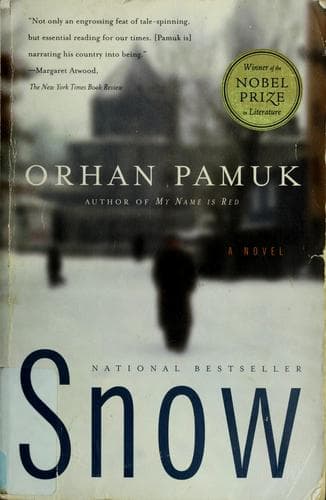
Snow
Orhan Pamuk·2002·Vintage·literary-fiction
- Reading time
- 16h
- Difficulty
- Advanced
- Recommended age
- Ages 16+
- Guide read
- 7min
- Editor's rating
- 4.2 / 5
- turkey
- political-fiction
- secularism
- islam
- nobel
- metafiction
— In one sentence —
A political novel by Turkey's only Nobel laureate, written from a position no Turkish writer was supposed to be allowed to occupy.
§ 01 · WHY READ
Why read
In 2002, Orhan Pamuk — already Turkey's most important contemporary novelist on the strength of The Black Book and My Name Is Red — published Kar (Snow), his first and only explicitly political novel. The book follows a poet named Ka, a secular Istanbul intellectual returning from a decade of exile in Frankfurt, who travels to the small eastern city of Kars to investigate an epidemic of suicides among young women who have been forbidden by the state to wear their headscarves at university. Over the three days of his stay, snow cuts the city off from the rest of Turkey, a small theatrical-political coup unfolds, and Ka — who has been searching for both faith and a woman named İpek — is drawn into a series of conversations that the novel refuses to resolve.
The political background is the engine. Turkey since Atatürk has organized itself around an aggressive secularism that, by the time Pamuk was writing, had produced two clearly opposed factions: a Kemalist establishment that saw headscarves on campus as a threat to the republic, and a rising political Islam that saw the headscarf ban as state oppression of religious women. The actual suicides among headscarf-wearing students that Pamuk drew on were real. The novel's most unusual move is its refusal to side: Pamuk gives serious, often eloquent voice to Islamist characters and secular characters alike, refuses to caricature either, and lets Ka — who is sympathetic to neither faction and confused about both — sit inside that refusal for 450 pages.
This refusal is what won Pamuk the Nobel Prize in 2006 and what earned him state harassment at home. In 2005, between the novel's Turkish publication and its Nobel year, Pamuk was prosecuted under Article 301 of the Turkish penal code — "denigrating Turkishness" — for telling a Swiss interviewer that "30,000 Kurds and 1 million Armenians were killed in these lands and nobody but me dares to talk about it." The charges were dropped on a technicality, but the prosecution made him, for a period, the most prominent test case for free speech in Turkey. He has lived with a personal security detail since.
Read Snow knowing both contexts — the contested secularism inside the novel, and the price its author paid outside it. The book is asking a question Pamuk had to ask his own country first.
§ 02 · CHARACTERS
Characters
The novel is densely populated for a three-day frame; these are the figures that matter most.
Ka — the protagonist. A 42-year-old poet, secular, exiled to Frankfurt for political reasons after the 1980 military coup, who has not written a poem in years. In Kars he begins, suddenly, to write again — nineteen poems in three days, arranged in the shape of a snowflake. Ka is a deliberately limited narrator: melancholic, vain, easily moved, prone to projecting his own longings onto everyone he meets. He is not the novel's hero; he is its instrument.
İpek — the woman Ka returns to Turkey, and to Kars, hoping to marry. İpek is the novel's most controlled portrait: beautiful, intelligent, divorced from a religious-political figure named Muhtar, and entirely aware of how Ka sees her and what that seeing leaves out.
Kadife — İpek's sister, the leader of the "headscarf girls" of Kars. Kadife is the novel's most morally serious character — a secular middle-class woman who has chosen to wear the headscarf as a political act, and who is articulate about exactly what that choice means and what it costs. Most of the novel's strongest dialogue runs through her.
Blue (Lacivert) — a charismatic Islamist militant in hiding in Kars. Blue is the figure Pamuk was most criticized for portraying sympathetically; he is also, in the novel's accounting, dangerous, capable, and partly correct. The novel refuses to flatten him.
The narrator "Orhan" — a novelist named Orhan, a friend of Ka's, who reconstructs the events of Kars four years after Ka's death. The metafictional frame — Pamuk inserting a version of himself into his own novel — is the device through which the book signals that its objectivity is impossible.
§ 03 · HIGHLIGHTS
Three highlights
No. 1 · The shooting at the National Theatre. Midway through the novel, a small theatrical company performs an old Kemalist play at the National Theatre, and during the performance — on live television, broadcast through the city — actual soldiers open actual fire on the audience, killing several Islamist students. This is the novel's central event and its hardest scene. The "play" becomes a coup, the audience cannot tell what is real until people are dead, and the violence is staged by a faction that believes it is saving the republic. Pamuk's handling of the scene — the slow, layered confusion, the absence of a single point of view — is the most formally controlled writing in the book.
No. 2 · The hotel-room conversation between Ka and Blue. Ka meets Blue twice during his three days in Kars. The second conversation, in which Blue asks Ka what he can be trusted with and Ka cannot honestly answer, is the moment the novel's political situation becomes personal. It is also the conversation that determines what happens to several characters by the end.
No. 3 · Kadife on stage. The novel's climax — Kadife agreeing to perform onstage in Kars, the conditions she sets, what she does in front of the audience — is staged with the same theatrical-political ambiguity as the earlier shooting. The reader is asked to decide what Kadife is doing and why; the novel deliberately withholds an answer.
§ 04 · EDITIONS
Recommended editions
| Edition | Why pick it |
|---|---|
| Vintage / Knopf (Maureen Freely, 2004) | The canonical English translation. Freely — who grew up in Istanbul and has translated most of Pamuk's mature work — is the reason Pamuk reads as well in English as he does. This is the only translation worth recommending. |
| Faber & Faber (UK, 2004) | Same Freely translation; UK trim. |
| İletişim (Turkish, 2002) | The original. If you read Turkish, read it in Turkish; Pamuk's prose has rhythms that no translation can fully carry. |
| Audiobook (John Lee, 2005) | A competent reading. The novel's density of political discussion benefits from a measured pace, which Lee provides. |
A note on translation: Erdağ Göknar translated My Name Is Red and Güneli Gün translated The Black Book; Freely's version of Snow (and her retranslation of The Black Book) set the standard for English Pamuk. If you read Pamuk in English, you are mostly reading Maureen Freely.
§ 05 · FIT
Who it's for / not for
Read this if you are…
- A reader who wants serious political fiction that refuses to take a comfortable side.
- Interested in the secular/Islamist tension that has structured Turkish politics for a century, and that has analogues in many other countries.
- Willing to read slowly. The novel is dense with political dialogue and metafictional doubling.
- Curious about Pamuk after the Nobel — Snow is the most direct route into what made him controversial at home.
Skip it if you are…
- Looking for a novel that takes a clear political position. Snow deliberately does not.
- Resistant to metafiction. The narrator's presence as "Orhan" investigating Ka's life is structurally important and not removable.
- Expecting a fast plot. The three days of Kars are dilated into 450 pages of conversation, weather, and poetic interlude.
§ 06 · TIPS
Reading tips
- Don't try to side with anyone. The novel is built to make that hard. Readers who arrive committed to a position usually finish the book frustrated; readers who let Pamuk run the inquiry usually finish it changed.
- Pay attention to Kadife. Of all the characters, she is the one whose arguments the novel most clearly respects. Her positions are not Pamuk's, but they are taken seriously.
- Hold the political context in mind. The Article 301 prosecution against Pamuk happened after this novel — but the conditions that produced the prosecution are exactly the conditions the novel anatomizes.
- The snow is doing structural work. Kars is cut off from the country by snow throughout the novel. The isolation is what permits the coup and the freedom both. The weather is not decoration.
§ 07 · COMPARE
Read alongside
- Orhan Pamuk — My Name Is Red (1998). Pamuk's other essential novel: a historical murder mystery set among Ottoman miniaturists, in a different register but with comparable ambition. Many readers prefer it to Snow; both are necessary.
- Fyodor Dostoevsky — Notes from Underground (1864). Pamuk has acknowledged Dostoevsky as a primary influence; the political-philosophical dialogue mode in Snow is directly indebted.
- J.M. Coetzee — Disgrace (1999). A different national context (post-apartheid South Africa) and a different political crisis, but a comparable refusal to comfort the reader.
- Mikhail Bulgakov — The Master and Margarita (1967). Another novel about how a writer survives a regime by writing inside it — and how the writing is changed by what it cannot say directly.
- Haruki Murakami — Kafka on the Shore (2002). Published the same year as Snow, in a different idiom, but the metafictional doubling and the protagonist's interior weather are usefully comparable.
§ 08 · DISCUSSION
Discussion questions
- Pamuk grants serious, articulate voice to Islamist characters. Did that make you uncomfortable, and if so, in what way did the discomfort serve the novel?
- Ka is the protagonist, but he is not heroic; the narrator who reconstructs his story is openly suspicious of him. What is Pamuk doing by making his protagonist limited?
- Kadife wears the headscarf as a political act. Her position is the novel's most carefully argued. Does the novel agree with her? Does it have to?
- The shooting at the National Theatre is committed by secular forces in the name of the republic. How does Pamuk handle the violence committed by the side most international readers would default to sympathizing with?
- The coup unfolds while Kars is cut off by snow. What is the snow doing structurally?
- The narrator is named "Orhan." How does the metafictional frame change what the novel is asking you to believe?
- Pamuk was prosecuted under Article 301 three years after this novel. Does the prosecution feel inevitable, in retrospect, given what Snow attempts?
- Compare Snow with another novel from your shelf that takes a divided political situation seriously. What does Pamuk do that the comparison shows?
One line to remember
“How much can we ever know about the love and pain in another heart? How much can we hope to understand those who have suffered deeper anguish, greater deprivation, and more crushing disappointments than we ourselves have known?”— Narrator — Chapter 19
You might also like
Read next
Gabriel García Márquez · 1967
One Hundred Years of Solitude
A century of one family in one village, told in prose so densely accumulating that you finish it remembering it as a single, very long afternoon.
Read · 8 min
Chinua Achebe · 1958
Things Fall Apart
The novel that ended the era in which the African could only be the colonized subject of someone else's English-language fiction.
Read · 7 min
Juan Rulfo · 1955
Pedro Páramo
A 124-page novel from 1955 that taught Latin American literature how to let the dead speak in the same paragraph as the living.
Read · 7 min