Editor-reviewed
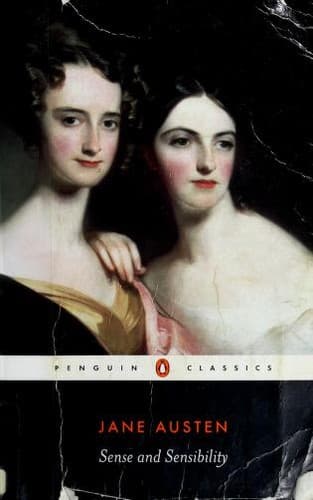
Sense and Sensibility
Jane Austen·1811·Thomas Egerton·Literature
Reading level: Ages 12+ (YA) · 11-hour read · Intermediate difficulty.
- Reading time
- 11h
- Difficulty
- Intermediate
- Recommended age
- Ages 12+ (YA)
- Guide read
- 6min
- Editor's rating
- 4.3 / 5
- classic
- romance
- austen
- english-literature
- canonical
- regency
- women
— In one sentence —
Two sisters, two ways of living in a world designed against women — and Austen refuses to let either one be simply right.
§ 01 · WHY READ
Why read
Sense and Sensibility (1811) is Austen's first published novel, and it is often read as the simplest of them: Elinor is sense, Marianne is sensibility, and the plot teaches Marianne to be more like her sister. This reading is wrong, and noticing why it is wrong is the key to the novel.
Elinor suppresses her feelings so thoroughly that the reader sometimes cannot tell whether her control is virtue or damage. Marianne's emotional expressiveness is excessive and destructive, but she is also right about most of the things she feels. The novel does not vindicate Elinor's suppression as the superior position; it asks how two women, with opposite temperaments, navigate a world where they are entirely dependent on the judgment and income of men. Both strategies have costs. The title is a description of a problem, not a verdict.
What makes the novel remarkable is the social machinery Austen dissects with complete precision: the way money (or its absence) shapes every relationship, the way women's feelings are simultaneously irrelevant and the only currency available to them, the way men can be thoughtless, cowardly, or actively predatory and still emerge from situations unmarked. Willoughby is the clearest case — charming, genuinely feeling, ultimately selfish — but the social system that makes his behavior possible is Austen's real target.
§ 02 · KEY CHARACTERS
Key characters
Elinor Dashwood — the sense: controlled, perceptive, accurate about other people and almost entirely opaque about herself. Her feelings for Edward Ferrars are genuine and suppressed for three hundred pages; when they surface, the reader realizes how much has been withheld.
Marianne Dashwood — the sensibility: passionate, eloquent, contemptuous of convention, and wrong about Willoughby in ways she could not have predicted and that the novel refuses to make simply her fault.
Colonel Brandon — misread by nearly every character in the novel as boring and old. He is the person who actually shows up, repeatedly, when it costs something. Austen's presentation of him as romantically viable challenges every assumption Marianne (and the reader) brings to what an attractive man looks like.
John Willoughby — Austen's most complicated villain. His confession scene is one of the novel's most unsettling passages: he is genuinely distressed, genuinely feeling, and also genuinely has done everything he is accused of.
§ 03 · HIGHLIGHTS
Three highlights
No. 1 · Willoughby's confession. Late in the novel, Willoughby appears at Cleveland to explain himself to Elinor. His account of his feelings for Marianne is plausible, his regret seems real, and he has still ruined a young woman's life and courted Marianne while intending nothing. Elinor's response — moving slightly toward sympathy and then pulling back — is Austen at her most precise. The scene refuses to settle.
No. 2 · Elinor's breakdown. When Elinor finally learns that Edward is free to marry her, she cries. It is one of the few moments in the novel where her control fails completely, and Austen describes it in a single sentence before moving on. The effect is more powerful than extended description would have been; we understand how much has been held.
No. 3 · Mrs. Jennings. The comedy of Mrs. Jennings — busybodying, matchmaking, cheerfully vulgar — runs beneath the main plots. She turns out, when Marianne falls genuinely ill, to be the most reliably kind person in the novel. Austen's habit of redistributing virtue without announcement is nowhere better illustrated.
§ 04 · EDITIONS
Recommended editions
| Edition | Why pick it |
|---|---|
| Penguin Classics (ed. Ros Ballaster, 1995) | Good introduction, clean text, reliable notes. The standard general-reader edition. |
| Oxford World's Classics (ed. James Kinsley, 2008) | Stronger scholarly apparatus; Kinsley's textual notes are useful for readers who want the publishing history. |
| Cambridge Edition (ed. Edward Copeland, 2006) | The definitive scholarly edition; more apparatus than most readers need, but authoritative. |
The 2008 BBC film with Emma Thompson and Kate Winslet is an excellent adaptation — use it after reading, not instead. The 1995 film is also very good.
§ 05 · FIT
Who it's for / not for
Read this if you are… Readers who want Austen but haven't found an entry point. This is not the easiest (that is Northanger Abbey) but it is the most structurally elegant. Anyone interested in gender and economic dependence in fiction will find it more analytically rich than its reputation suggests.
Skip it if you are… Coming for romance and expecting the feelings to be fully expressed. Austen's emotional register is oblique; what is not said carries as much weight as what is. If this mode frustrates rather than satisfies, try Pride and Prejudice first.
§ 06 · TIPS
How to read it
The opening chapters — establishing the Dashwoods' reduced circumstances — move slowly and reward attention. The social economy (who has money, who has none, who has expectations) matters enormously. Keep track of income figures; Austen mentions them precisely.
Pay attention to what Elinor doesn't say. The novel's information is distributed between what is stated and what is withheld, and Elinor withholds constantly.
§ 07 · COMPARE
Read alongside
- Jane Austen — Pride and Prejudice (1813). The companion piece: where Sense and Sensibility refuses to adjudicate between its two sisters, Pride and Prejudice gives Elizabeth Bennet a more unified intelligence, though the economic pressures are the same.
- George Eliot — Middlemarch (1872). The Victorian continuation of Austen's project: women of intelligence and feeling navigating institutional constraints on their lives.
- Henry James — The Portrait of a Lady (1881). The American version of the same problem: a woman with emotional intelligence and no power in a world that wants to determine her choices.
§ 08 · DISCUSSION
Discussion questions
- The title suggests Elinor (sense) will be vindicated over Marianne (sensibility). Does the novel actually take this position, or is it more complicated?
- Willoughby's confession makes him sympathetic in the moment. Does Austen intend for us to partially excuse him, or is sympathy itself the thing she's testing?
- Elinor suppresses her feelings for Edward for the entire novel. Is her restraint admirable, damaging, or both? What does the novel seem to think?
- Colonel Brandon is introduced as old and boring and turns out to be the most reliable man in the novel. What is Austen doing with this reversal?
- The women in this novel are entirely economically dependent on men. How does this dependency shape what emotional expression is possible for them?
- Mrs. Jennings is played for comedy and turns out to be genuinely kind. Is this a pattern in the novel — virtue appearing where we don't expect it?
One line to remember
“The more I know of the world, the more I am convinced that I shall never see a man whom I can really love.”— Jane Austen — Sense and Sensibility
You might also like
Read next
Jane Austen · 1813
Pride and Prejudice
It is a truth universally acknowledged — and Austen spends 400 pages examining what truths like that actually cost.
Read · 6 min
Jane Austen · 1815
Emma
Austen's greatest technical achievement: a heroine who is wrong about everything and still the most intelligent person in the room.
Read · 6 min
Jane Austen · 1817
Persuasion
Austen's last novel and her most personal: what it costs to have been right and to have listened to the wrong person anyway.
Read · 6 min