Editor-reviewed
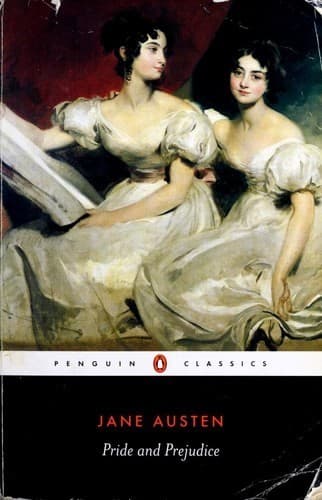
Pride and Prejudice
Jane Austen·1813·Thomas Egerton·Literature
Reading level: Ages 12+ (YA) · 12-hour read · Intermediate difficulty.
- Reading time
- 12h
- Difficulty
- Intermediate
- Recommended age
- Ages 12+ (YA)
- Guide read
- 6min
- Editor's rating
- 4.8 / 5
- classic
- romance
- austen
- english-literature
- canonical
- regency
- darcy
- elizabeth-bennet
— In one sentence —
It is a truth universally acknowledged — and Austen spends 400 pages examining what truths like that actually cost.
§ 01 · WHY READ
Why read
Pride and Prejudice is the most beloved English novel. It is also one of the most structurally precise. The famous opening sentence — read as comedy, which it is — is also a statement about economic necessity: in the world Austen is describing, the belief that wealthy men want wives is not vanity but survival strategy. The Bennet girls must marry or face poverty. The comedy works because the necessity is real.
This double register — everything light and witty and entertaining while everything also serious and constrained — is what Austen perfected in Pride and Prejudice (1813) and what makes it more than a love story. Elizabeth Bennet is the novel's intelligence, and her intelligence operates under conditions that are not funny: no money, an embarrassing mother, a father who has checked out, and a world in which her future depends on a man choosing her. The miracle of the novel is that Austen makes this situation produce wit rather than misery.
The plot's mechanism — Elizabeth's prejudice against Darcy's pride, Darcy's pride against Elizabeth's family, both of them wrong about each other in specific ways they have to correct — is one of the best-engineered narrative structures in English fiction. It works because both errors are genuine and both corrections are earned. When Darcy and Elizabeth understand each other, the reader understands why it took so long.
§ 02 · KEY CHARACTERS
Key characters
Elizabeth Bennet — possibly the most fully realized protagonist in nineteenth-century fiction. She is quick, funny, affectionate, loyal to her sister Jane, and wrong in precisely the ways the novel needs her to be wrong. Her prejudice against Darcy is not stupid; it is based on real evidence interpreted through pride.
Fitzwilliam Darcy — one of the great romantic heroes and also genuinely flawed. His first proposal to Elizabeth is an exercise in class condescension that she is right to refuse. His second self is the man who has understood the refusal.
Mr. Bennet — a man who has disengaged from his family into irony. His wit is the novel's second-best after Elizabeth's, and his affection for her is real. His failures — not entailing the estate, not managing Lydia — are the conditions that make everything else in the novel necessary.
Wickham — charm deployed as a weapon: plausible, handsome, specific in his lies, and the vehicle through which Lydia's catastrophe arrives. Austen gives him no interiority.
§ 03 · HIGHLIGHTS
Three highlights
No. 1 · Darcy's first proposal. He tells Elizabeth he loves her while also making clear that her family is beneath him and that he is fighting his inclination. She refuses him with complete lucidity, listing what he has done wrong. The scene is devastating on both sides: we see what pride actually looks like when it tries to express itself, and we see Elizabeth's intelligence at its sharpest. That Darcy is later right to love her and Elizabeth is later wrong about some of her specific charges is part of what the novel is doing.
No. 2 · The letter. Darcy's letter to Elizabeth, explaining his conduct with Wickham and Jane, is the novel's pivot. Elizabeth reads it twice: first in defensive disbelief, then with the beginning of honest self-examination. The sentence "Till this moment I never knew myself" is the novel's moral center.
No. 3 · Lydia's elopement. The comedy stops. The threat is real — Lydia's disgrace will permanently damage her sisters' prospects — and Darcy's intervention to resolve it is the novel's most revealing action. He does it in secret, at expense to himself, with no expectation of credit. This is what the revision of his character actually looks like.
§ 04 · EDITIONS
Recommended editions
| Edition | Why pick it |
|---|---|
| Penguin Classics (ed. Tony Tanner, 1972, revised 2003) | Tanner's introduction is one of the best essays on the novel; reliable text. Standard choice. |
| Oxford World's Classics (ed. James Kinsley, 2008) | Cleaner notes; useful if you want more textual and historical apparatus. |
| Norton Critical Edition (ed. Donald Gray, 4th ed. 2016) | Includes critical essays from two centuries; useful for serious study. |
The 1995 BBC television adaptation (Colin Firth, Jennifer Ehle) is the best screen version; the 2005 film is excellent. Use them after reading.
§ 05 · FIT
Who it's for / not for
Read this if you are… Anyone who has not yet read Austen: this is the right place to start. Readers who have been told it is a romance and are skeptical — it is a romance in the way a chess game is a sport: the surface activity is not the real point. Anyone interested in how comedy and social critique can operate simultaneously in the same sentence.
Skip it if you are… Looking for a slow, atmospheric novel. Pride and Prejudice moves quickly; the pleasure is in the dialogue and the observation, not the setting. Readers who need to feel sympathy for every character will find Wickham and Mrs. Bennet and Mr. Collins exhausting.
§ 06 · TIPS
How to read it
The first third establishes the Bennet household at a pace that rewards not rushing. Mr. Collins arrives in Chapter 13; his proposal to Elizabeth is where the novel's comedy becomes impossible to mistake. From Darcy's letter onward, read with attention — the second half of the novel is doing more work than the first, and the reversals accumulate quickly.
Track what each character knows and when. The novel operates almost entirely through dramatic irony.
§ 07 · COMPARE
Read alongside
- Jane Austen — Emma (1815). The companion piece: an Elizabeth Bennet with money and social power, which changes what errors she makes.
- Charlotte Brontë — Jane Eyre (1847). Romance without Austen's irony: the alternative tradition, equally canonical, interested in passion rather than intelligence.
- E.M. Forster — Howards End (1910). The Edwardian continuation of Austen's interest in class, money, and the emotional cost of social negotiation.
§ 08 · DISCUSSION
Discussion questions
- The opening sentence is both funny and serious. What truth is it mocking, and what truth is it acknowledging at the same time?
- Darcy's first proposal is condescending. Is Elizabeth's refusal of it fully justified, or is some of her anger pride rather than principle?
- Elizabeth says "Till this moment I never knew myself" after reading Darcy's letter. What did she not know about herself, and why did it take a letter to reveal it?
- Mr. Bennet retreats into irony and disengages from his family. The novel depicts him fondly. Is this a moral failure the novel overlooks, or something it handles deliberately?
- Charlotte Lucas marries Mr. Collins for security and describes it as practical. Is she right? How does the novel want us to read her choice?
- Wickham's charm works on almost everyone including Elizabeth. What does his success reveal about the limits of intelligence in a social world built on performance?
One line to remember
“It is a truth universally acknowledged, that a single man in possession of a good fortune, must be in want of a wife.”— Jane Austen — Pride and Prejudice
Appears in collections
Reading lists featuring this book
You might also like
Read next
Jane Austen · 1815
Emma
Austen's greatest technical achievement: a heroine who is wrong about everything and still the most intelligent person in the room.
Read · 6 min
Jane Austen · 1817
Persuasion
Austen's last novel and her most personal: what it costs to have been right and to have listened to the wrong person anyway.
Read · 6 min
Jane Austen · 1811
Sense and Sensibility
Two sisters, two ways of living in a world designed against women — and Austen refuses to let either one be simply right.
Read · 6 min