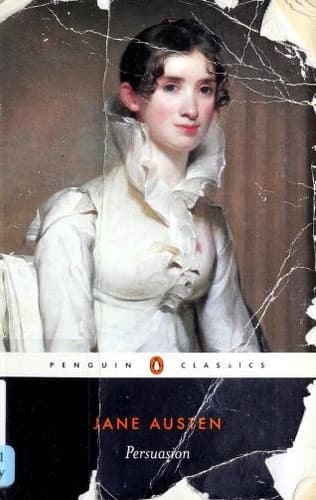
Editor-reviewed
Persuasion
Jane Austen·1817·John Murray·Literature
Reading level: Ages 12+ (YA) · 9-hour read · Intermediate difficulty.
- Reading time
- 9h
- Difficulty
- Intermediate
- Recommended age
- Ages 12+ (YA)
- Guide read
- 6min
- Editor's rating
- 4.6 / 5
- classic
- romance
- austen
- english-literature
- canonical
- regency
- late-austen
— In one sentence —
Austen's last novel and her most personal: what it costs to have been right and to have listened to the wrong person anyway.
§ 01 · WHY READ
Why read
Persuasion (1817) was published after Austen's death, and it feels like it. Not morbidly — but with a different emotional quality than the earlier novels. The comedy is quieter, the social observation more elegiac, the emotional register deeper. This is Austen writing about loss and about what remains after loss, and it is one of the most moving novels in English.
The setup is a reversal of the standard Austen plot. Anne Elliot has already met her man. Eight years before the novel begins, she was persuaded by her mentor Lady Russell to break off her engagement to Frederick Wentworth — a naval officer without fortune or prospects. The persuasion was reasonable given the information available. It was also wrong. Now Wentworth has returned from the Napoleonic Wars with money, reputation, and a pronounced indifference to Anne. The novel is about what happens when two people who loved each other are in the same room and cannot say so.
What distinguishes Persuasion from the other novels is Anne's passivity and the emotional cost the novel extracts from it. Anne cannot act; she can only be present. The reader inhabits her interiority with more access than Austen usually allows — her suffering is not masked by irony or comedy. When Wentworth's letter arrives, the release is proportionate to the restraint that preceded it.
§ 02 · KEY CHARACTERS
Key characters
Anne Elliot — twenty-seven, unmarried, considered past her best, and the novel's moral intelligence. She is quieter than Elizabeth Bennet and more fully present to the reader — we know what she feels almost entirely. Her passivity is not weakness; it is the available form of fidelity.
Captain Wentworth — charming, successful, proud, and hurt. His hurt expresses itself as determined indifference to Anne and deliberate attention to other women. He is wrong about what the persuasion cost Anne; his error is one the novel is patient about correcting.
Lady Russell — the persuader: loving, cautious, and wrong. The novel does not make her a villain. Her judgment was reasonable given what she knew. This is Austen's more nuanced treatment of the standard obstacle character.
Captain Benwick — a sailor who mourned his dead fiancée with extravagant romantic poetry and then became engaged to Louisa Musgrove with suspicious speed. Anne is the only character who notices the discrepancy; it sharpens her understanding of her own more durable feeling.
§ 03 · HIGHLIGHTS
Three highlights
No. 1 · The concert at Bath. Anne and Wentworth are in the same room for extended scenes throughout the novel but cannot speak directly. At the concert, they manage a conversation that advances nothing and contains everything. Austen renders the intensity of constrained proximity — what it costs to be near someone and not able to reach them — with complete control.
No. 2 · The letter. "I can listen no longer in silence. I must speak to you by such means as are within my reach." Wentworth's letter, written while Anne argues about constancy in the next room, is one of the most effective scenes in English fiction. It works because of everything that has not happened in the preceding pages — every restrained encounter, every suppressed feeling.
No. 3 · Anne's argument on constancy. In the conversation with Captain Harville about whether men or women love more faithfully, Anne delivers the novel's thesis: women love longest when existence or hope is gone. She is speaking about herself, to Wentworth, without speaking to Wentworth, who is writing nearby. Austen manages this three-way communication — Anne to Harville, Anne to Wentworth, reader to all of them — with extraordinary precision.
§ 04 · EDITIONS
Recommended editions
| Edition | Why pick it |
|---|---|
| Penguin Classics (ed. Gillian Beer, 1998) | Beer's introduction is excellent on the novel's autumnal quality and its relationship to Austen's biography. Clean text. Start here. |
| Oxford World's Classics (ed. James Kinsley, 2008) | Strong textual notes; useful for the variant ending Austen rewrote. |
| Norton Critical Edition (ed. Patricia Meyer Spacks, 1994) | Includes critical essays; the scholarly context is useful for this novel specifically. |
Read the novel in its published 1817 form. The original cancelled chapters (Wentworth's confession scene handled differently) are worth reading afterward as a comparison — Austen's revision is clearly the better version.
§ 05 · FIT
Who it's for / not for
Read this if you are… Readers who have read the earlier Austen novels and want the most emotionally direct one. Anyone interested in what mature feeling looks like as literary subject matter. Readers who found Pride and Prejudice slightly too brittle — Persuasion operates in a warmer register.
Skip it if you are… Starting with Austen for the first time. The novel's pleasures depend partly on knowledge of the tradition it is departing from; Pride and Prejudice or Emma will give you that foundation. Readers who want plot momentum: Persuasion is contemplative.
§ 06 · TIPS
How to read it
The first hundred pages establish the social world — the Elliot family's vanity, their reduced circumstances, the move to Bath — at a pace that can feel slow. Persist. The novel is building the conditions in which Anne's constraint makes sense. Once Wentworth appears, the emotional temperature changes and the restraint of the narration becomes purposeful.
Read the letter scene in one sitting.
§ 07 · COMPARE
Read alongside
- Jane Austen — Emma (1815). The immediately preceding novel; the contrast between Emma's active interference and Anne's passivity is a study in what different circumstances make available.
- Charlotte Brontë — Villette (1853). The Victorian successor in emotional intensity and interiority; Lucy Snowe is the continuation of where Austen leaves Anne.
- Elizabeth Bowen — The Death of the Heart (1938). A twentieth-century novel with Austen's interest in constrained feeling and the social world that produces it.
§ 08 · DISCUSSION
Discussion questions
- Anne was persuaded against her better judgment and spent eight years knowing she was right. How does the novel present this — as tragedy, as education, as something else?
- Lady Russell persuades Anne out of genuine love and reasonable judgment. Is she the villain of this novel, or something more complicated?
- Captain Wentworth is furious at Anne for eight years before he understands what her choice cost her. Is his anger reasonable or self-indulgent?
- The letter Wentworth writes is one of the most famous in English fiction. Why does it work? What has the novel done to make this scene so powerful?
- Anne argues that women love longer when hope is gone. Is this a universal observation, a feminist argument, or a statement about Anne specifically?
- Persuasion is often called Austen's most personal novel. Does biographical speculation about Austen's own failed engagement change how you read it?
One line to remember
“All the privilege I claim for my own sex (it is not a very enviable one: you need not covet it) is that of loving longest, when existence or when hope is gone.”— Jane Austen — Persuasion
Appears in collections
Reading lists featuring this book
You might also like
Read next
Jane Austen · 1813
Pride and Prejudice
It is a truth universally acknowledged — and Austen spends 400 pages examining what truths like that actually cost.
Read · 6 min
Jane Austen · 1815
Emma
Austen's greatest technical achievement: a heroine who is wrong about everything and still the most intelligent person in the room.
Read · 6 min
Jane Austen · 1811
Sense and Sensibility
Two sisters, two ways of living in a world designed against women — and Austen refuses to let either one be simply right.
Read · 6 min