Editor-reviewed
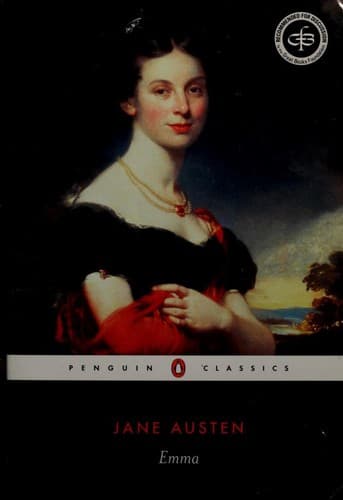
Emma
Jane Austen·1815·John Murray·Literature
Reading level: Ages 12+ (YA) · 13-hour read · Intermediate difficulty.
- Reading time
- 13h
- Difficulty
- Intermediate
- Recommended age
- Ages 12+ (YA)
- Guide read
- 6min
- Editor's rating
- 4.7 / 5
- classic
- romance
- austen
- english-literature
- canonical
- regency
- comedy
— In one sentence —
Austen's greatest technical achievement: a heroine who is wrong about everything and still the most intelligent person in the room.
§ 01 · WHY READ
Why read
Austen famously said she was writing about "a heroine whom no one but myself will much like." She was wrong about the prediction and right about the design. Emma Woodhouse is beautiful, clever, rich, and wrong about almost everything she believes she understands. Emma (1815) is built around this combination: how does a person of genuine intelligence remain systematically mistaken?
The answer is that Emma's intelligence operates without friction. She has no financial pressure, no intellectual rivals in Highbury, and a father whose dependence makes him incapable of correcting her. Her errors are the errors of unimpeded confidence. She matchmakes, misreads, condescends, and invents — and the novel's plot is the architecture of those errors resolving. The resolution is not simply romantic: it requires Emma to become capable of genuine perception, which requires the experience of being genuinely wrong.
Emma is Austen's most technically demanding novel, operating almost entirely through free indirect discourse — a narration so closely aligned with Emma's consciousness that the reader shares her errors in real time. The technique means you will misread Jane Fairfax along with Emma, dislike Miss Bates along with Emma, and miss Frank Churchill's deception along with Emma. When the corrections arrive, they correct the reader as well as the character. This is what makes it the masterpiece.
§ 02 · KEY CHARACTERS
Key characters
Emma Woodhouse — clever, well-intentioned, confident, and wrong. Her fundamental error is not malice but the assumption that her perceptions are accurate; she sees what she expects to see. Her education over the novel's length is real.
Mr. Knightley — the one person in Highbury who will disagree with Emma and explain why. He is seventeen years older than her, which Austen uses to create a mentorship that becomes something else. He is the novel's moral norm — almost all of his early judgments are correct, which can make him seem insufferable until you notice that being right carries cost too.
Harriet Smith — Emma's protégé and the instrument of most of Emma's errors. Harriet's sweetness is genuine; her tractability is the problem. She believes what Emma tells her about herself, which is a kind of damage.
Jane Fairfax — the shadow protagonist: as accomplished as Emma and without Emma's advantages, navigating a situation she cannot disclose. Emma dislikes her, which the novel uses to withhold information the reader should have.
Miss Bates — the character Emma humiliates on Box Hill, the most uncomfortable scene in Austen. Miss Bates is impoverished, talkative, and kind. Her function in the novel is to be the person whose treatment reveals what Emma has not yet become.
§ 03 · HIGHLIGHTS
Three highlights
No. 1 · The Box Hill picnic. Emma, at Frank Churchill's instigation, makes a joke at Miss Bates's expense — pointed, in public, in front of everyone. Mr. Knightley takes Emma aside and tells her what she has done: she has hurt someone who cannot hurt her back, someone who admires her, someone in reduced circumstances. Emma cries on the way home, alone. This is the novel's moral center and one of the most efficient scenes in Austen.
No. 2 · The revelation. When the truth about Frank Churchill and Jane Fairfax is revealed, the reader, like Emma, has to reread every previous scene. The retroactive correction — this is what Frank was actually doing, this is why Jane seemed cold — is a formal demonstration of Emma's perceptual limits. What the free indirect style withheld from you was there all along.
No. 3 · "It darted through her." When Emma realizes she loves Mr. Knightley, the understanding arrives as shock: she had not known it until the possibility of his marrying someone else made it impossible to deny. "It darted through her, with the speed of an arrow, that Mr. Knightley must marry no one but herself." The sentence is as efficient as a decision.
§ 04 · EDITIONS
Recommended editions
| Edition | Why pick it |
|---|---|
| Penguin Classics (ed. Fiona Stafford, 1996) | Best introduction to the novel's formal strategies; clean text. Start here. |
| Oxford World's Classics (ed. James Kinsley, 2008) | Strong textual notes; useful if you want publishing history and variants. |
| Norton Critical Edition (ed. Richard Cronin & Dorothy McMillan, 2010) | The fullest scholarly apparatus; includes essays on the novel's reception. |
The 2009 BBC television adaptation (Romola Garai, Jonny Lee Miller) is the most faithful. The 1996 Gwyneth Paltrow film is enjoyable and looser. Clueless (1995) is the best modern transposition.
§ 05 · FIT
Who it's for / not for
Read this if you are… Readers who have already read Pride and Prejudice and want Austen's more demanding work. Anyone interested in narrative technique — free indirect discourse is demonstrated here more fully than anywhere else in the tradition. Readers who want a novel in which being wrong is the subject, not just the setup.
Skip it if you are… Coming to Austen for the first time. Start with Pride and Prejudice — Emma's pleasures are more available with some experience of how Austen works. Readers who require immediate likability in protagonists will need patience.
§ 06 · TIPS
How to read it
Resist the temptation to dislike Emma early. The point is to share her errors, not to position yourself above them. When you find yourself wrong about something — and you will — notice when Austen placed the clue you missed.
Pay attention to every detail about Jane Fairfax. She is the character Emma can't read, and the information Austen withholds through Emma's dislike is exactly what matters.
Read Miss Bates's speeches in full. Austen's comedy here has a second function.
§ 07 · COMPARE
Read alongside
- Jane Austen — Pride and Prejudice (1813). Elizabeth Bennet is the version of this intelligence without money or social security; the contrast reveals what each protagonist's circumstances make possible.
- George Eliot — Daniel Deronda (1876). Gwendolen Harleth is the Victorian version of Emma: beautiful, intelligent, socially powerful, and educated by catastrophe rather than social comedy.
- Henry James — The Ambassadors (1903). The novel most formally indebted to Austen's free indirect style; Strether's slow recognition of what he has been missing is James's version of Emma's education.
§ 08 · DISCUSSION
Discussion questions
- Austen said she was writing a heroine no one would like. Do you like Emma? Does likability matter for this novel to work?
- The free indirect style means the reader shares Emma's errors in real time. What does this formal choice do that a more distant narrator couldn't achieve?
- Mr. Knightley is almost always right. Does this make him a satisfying romantic partner for Emma, or does the power imbalance concern you?
- Miss Bates is humiliated on Box Hill, and this is the novel's moral turning point. Why does Emma's cruelty to Miss Bates matter more than her other errors?
- Jane Fairfax is Emma's equal in every measurable way and has none of Emma's advantages. How does the novel use Jane to comment on what Emma takes for granted?
- Frank Churchill deceives almost everyone for most of the novel. How does Austen want us to judge him by the end?
One line to remember
“It was a sweet view — sweet to the eye and the mind. English verdure, English culture, English comfort, seen under a bright sun, without being oppressive.”— Jane Austen — Emma
You might also like
Read next
Jane Austen · 1813
Pride and Prejudice
It is a truth universally acknowledged — and Austen spends 400 pages examining what truths like that actually cost.
Read · 6 min
Jane Austen · 1817
Persuasion
Austen's last novel and her most personal: what it costs to have been right and to have listened to the wrong person anyway.
Read · 6 min
Jane Austen · 1811
Sense and Sensibility
Two sisters, two ways of living in a world designed against women — and Austen refuses to let either one be simply right.
Read · 6 min