Editor-reviewed
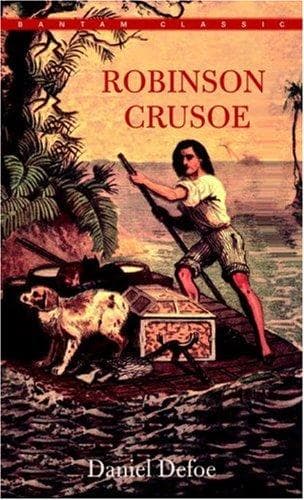
Robinson Crusoe
Daniel Defoe·1719·William Taylor·Literature
Reading level: Ages 12+ (YA) · 10-hour read · Beginner difficulty.
- Reading time
- 10h
- Difficulty
- Beginner
- Recommended age
- Ages 12+ (YA)
- Guide read
- 6min
- Editor's rating
- 4.2 / 5
- classic
- adventure
- defoe
- survival
- colonialism
- english-literature
- canonical
— In one sentence —
The original survival story: one man, one island, and the whole ideology of modern individualism.
§ 01 · WHY READ
Why read
Robinson Crusoe (1719) is the founding text of the English novel and the origin of every castaway story written since. Defoe was nearly sixty when he published it, a journalist and pamphleteer who had never written fiction. What he produced was something new: a novel that reads like fact, narrated in the flat, itemizing prose of a merchant's account book, about a man who builds civilization from scratch on an uninhabited island.
The novel works on two levels simultaneously. On the surface it is an adventure story of extraordinary vividness — the salvage of goods from the wrecked ship, the building of the enclosure, the agriculture, the pottery, the discovery of the footprint. Defoe renders the practical problem of survival in such concrete detail that readers who have never built anything feel the satisfaction of each solution. This is one of the first novels to make competence feel heroic.
Below the surface it is one of the most ideologically loaded texts in the canon. Crusoe does not simply survive — he colonizes. He names Friday, assumes authority over him, and never questions the right to do so. The novel was written at the height of British colonial expansion and encodes that expansion's values so naturally that the author apparently doesn't notice. Reading it now means reading both the adventure and the ideology, which turns out to be more interesting than either alone.
§ 02 · KEY CHARACTERS
Key characters
Robinson Crusoe — methodical, practical, Protestant, unromantic. He keeps a journal and an account ledger even on a deserted island; his religion is less rapture than accounting. His lack of introspection is both the novel's limitation and its peculiar authenticity — he is exactly the type of man who would survive by itemizing rather than despairing.
Friday — the native man Crusoe rescues and names. Defoe gives him intelligence, loyalty, and a readiness to learn; he is not mocked. But he is also not permitted an interior life or a name of his own. The relationship is drawn without apparent irony, which is precisely what makes it historically revealing.
The parrot Poll — a small detail that lingers: the parrot who has learned to say "Robin Crusoe" is the island's only voice that speaks his name. In a novel about isolation, this is the loneliness.
§ 03 · HIGHLIGHTS
Three highlights
No. 1 · The salvage. Crusoe's systematic rescue of goods from the wrecked ship is one of the most pleasurable sequences in early English fiction. He makes twelve trips, cataloguing everything he retrieves — tools, arms, food, clothing, rope. The pleasure is explicitly practical: Defoe discovered that readers will follow the inventory of a competent man with absorption.
No. 2 · The footprint. After years of complete solitude, Crusoe finds a single human footprint in the sand. The discovery takes one sentence; the dread it produces occupies the next several chapters. Defoe understood that what the imagination adds to a single clue exceeds what explicit description can achieve.
No. 3 · The rescue of Friday. The encounter with Friday is where the novel's ideology becomes visible. Crusoe names him after the day of the week on which they meet, teaches him English, converts him to a version of Christianity, and enlists him as a subordinate. The relationship is warm and never cruel by the novel's own lights — which is what makes it so clarifying about the assumptions colonialism carried about itself.
§ 04 · EDITIONS
Recommended editions
| Edition | Why pick it |
|---|---|
| Penguin Classics (ed. John Richetti, 2003) | Excellent introduction situating the novel historically; clean text. Best general-reader edition. |
| Oxford World's Classics (ed. Thomas Keymer, 2007) | Stronger scholarly apparatus; Keymer's notes are particularly good on the colonial dimensions. |
| Norton Critical Edition (ed. Michael Shinagel, 1994) | Includes critical essays spanning two centuries; useful for understanding the novel's reception. |
The prose is plain and accessible; no translation needed. An audiobook works well — the journal-entry rhythm reads naturally aloud.
§ 05 · FIT
Who it's for / not for
Read this if you are… Readers who want to understand where the novel came from and why it looks the way it does. Anyone fascinated by survival literature and its assumptions. Readers interested in colonialism's foundational texts — this is not a polemical work, which is exactly why it tells you more about the period's assumptions than a polemical one would.
Skip it if you are… Looking for psychological complexity or moral ambiguity. Crusoe is not an introspective narrator; the novel does not question its own values. Readers who find Friday's situation troubling will find the novel's blithe unawareness of it more disturbing than interesting.
§ 06 · TIPS
How to read it
The opening sections — Crusoe's earlier voyages and the shipwreck — move quickly. The long middle section on the island is where most readers either settle into the novel's rhythm or lose patience. Give it at least the first fifty pages of island life before deciding; the pace is the point. Defoe is not building toward dramatic peaks; he is rendering the texture of years.
The final third, after Friday's arrival, is the most ideologically loaded. Read it as a historical document as well as a story.
§ 07 · COMPARE
Read alongside
- Jonathan Swift — Gulliver's Travels (1726). Written seven years later as a partly satirical response to exactly this kind of confident English traveler's narrative; the contrast is illuminating.
- J.M. Coetzee — Foe (1986). Retells Robinson Crusoe from Friday's perspective and from a woman's — the most searching literary interrogation of the novel's silences.
- Michel Tournier — Friday (1967). A French philosophical rewriting of the Crusoe myth; inverts the novel's values entirely.
§ 08 · DISCUSSION
Discussion questions
- Crusoe keeps an account ledger even on the island, balancing "evils" against "goods" like a merchant. What does this tell us about his worldview and about the novel's relationship to capitalism?
- Defoe renders Crusoe's religious faith as practical and transactional rather than emotional. Is this a portrait of genuine faith or of self-deception?
- Crusoe names Friday and teaches him English, and the novel presents this as kindness. What assumptions does this reveal about Defoe's conception of civilization?
- The footprint episode is one of the most effective horror sequences in early English fiction. How does Defoe create dread with a single image?
- Crusoe survives largely through preparation and system. Is competence itself a kind of character, or does the novel's focus on practical problem-solving leave something out?
- The novel has been read as a founding myth of capitalism, of colonialism, and of liberal individualism. Which reading do you find most compelling, and why?
One line to remember
“I have been in all my Circumstances a Memento to those who are touch'd with the general Plague of Mankind, whence, for ought I know, one half of their Miseries flow; I mean, that of not being satisfy'd with the Station wherein God and Nature has plac'd them.”— Daniel Defoe — Robinson Crusoe
You might also like
Read next
William Faulkner · 1936
Absalom, Absalom!
Four narrators reconstruct a man who destroyed his family. The story keeps changing. That is the point.
Read · 7 min
Toni Morrison · 1987
Beloved
Toni Morrison said she wrote this novel to give voice to the sixty million. It won the Pulitzer, the Nobel, and is the greatest American novel of the second half of the twentieth century.
Read · 6 min
Leo Tolstoy · 1878
Anna Karenina
Not just a love story. Two parallel lives — Anna's destruction, Levin's salvation — ask the same question: how should a person live?
Read · 6 min