Editor-reviewed
People We Meet on Vacation
Emily Henry·2021·Berkley·romance
Reading level: Ages 16+ (adult) · 8-hour read · Beginner difficulty.
- Reading time
- 8h
- Difficulty
- Beginner
- Recommended age
- Ages 16+
- Guide read
- 6min
- Editor's rating
- 4.0 / 5
- romance
- contemporary
- friends-to-lovers
- dual-timeline
- emily-henry
- rom-com
— In one sentence —
The friends-to-lovers novel that proved contemporary romance could carry the dialogue weight of a Nora Ephron film.
§ 01 · WHY READ
Why read
Emily Henry is the writer most often cited when someone says contemporary romance has become craft-respectable, and People We Meet on Vacation is the novel that consolidated her readership. It is not her most experimental book — Beach Read came first, Book Lovers is the funniest — but it is the cleanest demonstration of what she does well: friends-to-lovers structure carried by dialogue that earns its laughs, a dual timeline that uses memory the way a film would, and emotional precision around the moment two people who have been pretending for a decade stop pretending.
Poppy Wright and Alex Nielsen have taken a summer vacation together every year for ten years. They are best friends. They are also, obviously to everyone except themselves, in love. Two years ago something happened on a trip to Croatia, and they have not spoken since. The novel alternates between the present — Poppy talking Alex into one more trip — and the previous nine summers, building toward what went wrong and whether it can be undone.
Read it because Henry writes the kind of romance that takes the form's pleasures seriously without being defensive about them. The book is not trying to be more than it is. It is comfortable being exactly what it is and doing that thing very well.
§ 02 · EMOTIONAL ARC
Emotional arc
The novel works because the two leads are written as actual opposites who actually love each other — not as opposites whose differences are a setup for surface-level banter.
Poppy Wright — narrator, late twenties, a travel writer at an aspirational New York magazine. Loud, externally confident, the kind of person who books a trip without knowing where she's going. The book opens with Poppy unhappy in a job she thought she wanted, and her recognition that the unhappiness has the shape of someone she's no longer talking to. Henry writes Poppy's first-person voice as actively self-deprecating in a way that earns trust — she is harder on herself than the narrative is on her.
Alex Nielsen — Linden, Ohio. High school English teacher. Quiet, controlled, the kind of friend who shows up early and brings a thermos. The book's hardest craft achievement is making Alex felt as a character primarily through Poppy's perception of him — which means Henry has to write a quiet man whose interior life the reader believes in even though we only see him through someone else's eyes. She succeeds more often than she fails.
The friendship is the book's emotional center, and Henry takes the time to make the friendship convincing on its own terms before asking the reader to want it to be more. The romance works because the friendship is already real.
§ 03 · HIGHLIGHTS
Three highlights
No. 1 · The dialogue. Henry writes dialogue the way the best romantic comedy films do: with rhythm, with shared references that the characters have built over years, with jokes that land harder because we've been told what the previous joke was. Poppy and Alex talk like people who have been each other's primary audience for a decade. This is harder to write than it looks.
No. 2 · The dual-timeline architecture. The chapters alternate between present (one final trip) and past (nine previous summers, told mostly in chronological order). The structure builds two questions in parallel: what is going to happen now, and what happened in Croatia. Henry keeps the answer to the second one withheld for most of the book, and when it finally arrives, it lands because of how carefully the previous summers have been seeded with the small wrong notes that lead to it.
No. 3 · The Sanibel chapter. A late chapter — without specifics — in which the two characters spend an evening trying very hard not to say what they came to say. It is the book's quietest section and its best one. Henry trusts the reader to feel what is happening in the spaces between their lines. This is the chapter that signaled Henry as a writer who could carry literary attention if she wanted it.
§ 04 · EDITIONS
Recommended editions
| Edition | Why pick it |
|---|---|
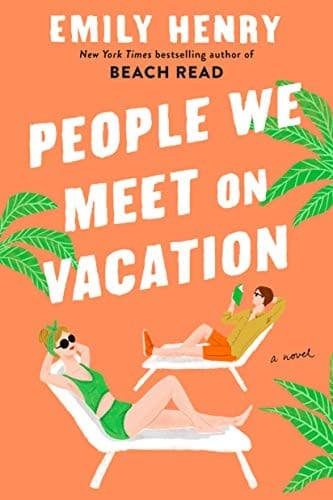
| Berkley trade paperback (2021) | The standard edition. Cover art by Sandra Chiu is iconic enough that the book is recognizable at a distance. |
| Berkley special edition (2024) | Sprayed edges, bonus epilogue. For collectors and Emily Henry completists. |
| Audiobook (Julia Whelan, 2021) | Whelan is one of the best audiobook narrators working in commercial fiction. Her handling of Poppy's voice — the over-talking, the self-correction, the warmth — is the rare case where audio adds something the page can't. |
A film adaptation has been in development since 2022. As of writing, no release date.
§ 05 · FIT
Who it's for / not for
Read this if you are…
- A reader who has tried contemporary romance and bounced off the prose; Henry writes at a level above the genre average.
- Someone who loves friends-to-lovers as a structure and wants to see it executed with patience.
- A fan of the dialogue-driven romantic comedy — Nora Ephron, Richard Curtis, early Cameron Crowe.
- Looking for a book that is happy to be what it is, without either apology or pretense to being more.
Skip it if you are…
- Allergic to first-person present-tense narration; Henry's voice is the book's pleasure, but it's a specific register.
- Looking for plot stakes outside the central relationship. Nothing else really happens. That is the point.
- Expecting heat-forward romance. Henry writes warm and witty, not steamy.
- Looking for a contemporary romance with genuine moral or formal risk. People We Meet on Vacation is a comfort object that happens to be very well made — it is not trying to ambush you.
§ 06 · TIPS
Reading tips
- Read the past and present chapters in order. Some readers try to read only the past chapters and then only the present chapters; Henry has structured the parallels deliberately, and the book is built to be read as written.
- Trust the slow build. The first hundred pages are establishing the friendship. The book gets richer in the second half.
- Read it on a vacation, or pretending to be on one. This is the rare book that benefits from being read with a drink and no other obligations.
- If you like it, Book Lovers (2022) is the funnier book and Beach Read (2020) the more emotionally ambitious one.
§ 07 · COMPARE
Read alongside
- Jane Austen — Persuasion (1817). The original second-chance romance. Austen's Anne Elliot and Henry's Poppy Wright are doing different versions of the same emotional work: returning to the person they should not have left.
- Jane Austen — Emma (1815). The other Austen novel about two people who have known each other so long they cannot see what is in front of them.
- Charlotte Brontë — Jane Eyre (1847). A different mode of romance entirely, but worth reading alongside any contemporary romance to see what the genre's serious ancestors look like.
- Haruki Murakami — Norwegian Wood (1987). A novel about young love that ended badly and what is left of the people afterward; tonally different but emotionally adjacent.
- Colleen Hoover — It Ends with Us (2016). The other defining contemporary romance of the era. Read both to see the range of the category — the warm, controlled Henry voice against the higher-stakes, less polished Hoover one.
§ 08 · DISCUSSION
Discussion questions
- The novel is structured as alternating timelines — present and past, in roughly equal weight. What does the structure accomplish that a straight chronological telling could not?
- Poppy narrates the entire novel, which means we only see Alex through her perception. Does Henry succeed in making him feel like an independent character, or does he remain a function of Poppy's longing?
- The "what happened in Croatia" question is held back for most of the book. When the reveal lands, does it justify the buildup? Was there a version that would have been more interesting?
- Poppy's job at an aspirational travel magazine is the novel's secondary plotline. How does her professional dissatisfaction relate to her romantic one? Are they the same problem in two forms?
- The book is set across many vacation destinations, most of which Poppy and Alex barely engage with. Is the travel a setting or a metaphor? What does Henry get out of it?
- Henry's prose is often praised for being above the genre average. What specifically makes it work? What would a less careful version of the same book look like?
- The novel ends on a note of optimism that the book has earned. Does it feel honest, or does it feel like genre obligation? What would have been the consequence of a different ending?
- Friends-to-lovers is one of romance's oldest structures. What does Henry add to the form? What does she take from it that is older than she is?
One line to remember
“Sometimes the best thing you can do for someone you love is let them be the version of themselves they were always becoming.”— Poppy Wright — Chapter 28
You might also like
Read next
Kennedy Ryan · 2022
Before I Let Go
Kennedy Ryan's second-chance romance behind Peacock's ordered series.
Read · 6 min
Rachel Reid · 2019
Heated Rivalry
Rachel Reid's hockey romance behind the Crave and HBO Max series.
Read · 6 min
Diana Gabaldon · 1991
Outlander
A nine-hundred-page time-travel romance written by a quantitative ecologist who decided, at thirty-five, to try writing a novel.
Read · 7 min