Editor-reviewed
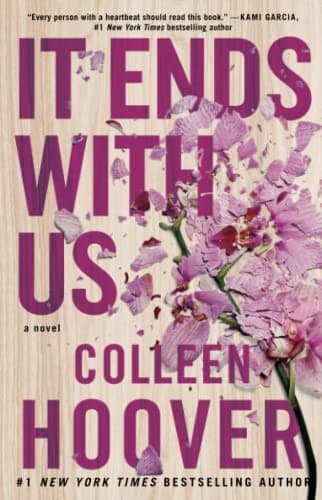
It Ends with Us
Colleen Hoover·2016·Atria·romance
Reading level: Ages 18+ (mature) · 9-hour read · Beginner difficulty.
- Reading time
- 9h
- Difficulty
- Beginner
- Recommended age
- Ages 18+ (mature)
- Guide read
- 6min
- Editor's rating
- 3.6 / 5
- romance
- contemporary
- booktok
- domestic-violence
- colleen-hoover
- phenomenon
— In one sentence —
The novel that built BookTok — a romance that turns, mid-book, into something its readers did not buy a ticket for.
§ 01 · WHY READ
Why read
It Ends with Us is the novel that, six years after its 2016 publication, sold more than a million copies in a single year on the strength of TikTok videos. Any honest discussion of contemporary romance has to start here — not because it is the best-written romance of its decade, but because it changed how romance is sold, recommended, and read. Hoover wrote it as something more personal than her earlier books: the central relationship and its turn are based on her mother's marriage, and the book carries the unevenness of personal material handled by a writer whose prior craft was built for a different kind of story.
Lily Bloom, a young florist building a shop in Boston, meets Ryle Kincaid, a charismatic neurosurgeon, on a rooftop. The first third of the book is a fast, confident contemporary romance — meet-cute, banter, attraction, a partner who seems too good to be true. The middle of the book reveals he is. The remainder of the novel is Lily's attempt to understand what is happening to her, what her mother went through, and what it means that the man hurting her is also a man she loves.
Read it because it is the cultural artifact of its decade in romance, and because the second half — for all the book's craft limitations — does something that very few mainstream romances attempt. Read it knowing what kind of book it actually is.
§ 02 · EMOTIONAL ARC
Emotional arc
The book is built on a structural switch. The early Lily-and-Ryle chapters are written in the high-gloss register of contemporary romance: hot, witty, escapist. Then the register breaks.
Lily Bloom — narrator, late twenties, in the process of opening her own flower shop in Boston. Lily is given a backstory that explains a great deal: she grew up watching her father abuse her mother, and she promised herself her own life would be different. The novel's central tension is whether her certainty about this is enough.
Ryle Kincaid — neurosurgeon, written first as a romance hero and then as something else. The criticism of Hoover's handling of Ryle is fair to raise: the book continues to present him with the romantic gloss of the early chapters even after his behavior should have changed how he reads. Some readers find this an honest portrait of how abusers are perceived from inside the relationship. Others find it the book's central problem.
Atlas Corrigan — Lily's first love, reappearing at the moment Ryle becomes most dangerous. Atlas is the novel's structural counterweight, and he is also, by the conventions of romance, where the book's readers were trained to look for resolution. Hoover both uses and resists this expectation.
§ 03 · HIGHLIGHTS
Three highlights
No. 1 · The journals to Ellen DeGeneres. Lily's adolescence is told through letters written to Ellen DeGeneres — a device that should not work and mostly does. The journals carry the novel's most controlled writing: a teenage voice that is funny without being precocious, that understands her mother is being hurt without yet knowing what to do about it. The journal sections are the part of the book that most readers, even critical ones, concede are well made.
No. 2 · The reveal. Without specifics: there is a moment, roughly a third of the way through, when the book you have been reading stops being that book. Hoover handles the transition with more care than she is sometimes credited for. The reader's discomfort — but this is a romance, this isn't supposed to happen here — is the discomfort the book is trying to produce.
No. 3 · The final conversation. The book ends on a scene that resists the genre's expected resolution. Without spoiling the specifics: Lily makes a choice that is, on the conventions of the romance plot, surprising. Many readers cite this scene as the reason the book stayed with them. Many others argue the preceding 300 pages did not earn it.
§ 04 · EDITIONS
Recommended editions
| Edition | Why pick it |
|---|---|
| Atria mass-market (2016) | The standard reading copy. |
| Atria special edition (2022) | Includes a letter from Hoover and additional content. Worth it if you want her own framing of the personal material. |
| Audiobook (Olivia Song, 2016) | Competent but unremarkable. Read in print if you can — the journal sections benefit from the visual break. |
Skip the sequel for first read. It Starts with Us (2022) was written after a half-decade of reader demand, and most readers — even Hoover's defenders — agree it does not match the original.
The 2024 film with Blake Lively and Justin Baldoni is a separate cultural object with its own controversies; whatever you think of it, the book made different choices and is worth reading on its own terms first.
§ 05 · FIT
Who it's for / not for
Read this if you are…
- Curious about why BookTok happened and want to understand its defining text.
- A reader who can tolerate a book that switches registers midway and does not apologize for it.
- Interested in fiction about domestic abuse from the perspective of someone who loves the person hurting her.
- Looking for a fast-paced contemporary read that is doing more than it looks like it's doing.
Skip it if you are…
- Looking for prose-level craft on the order of literary fiction. Hoover writes for momentum, not sentences.
- Sensitive to depictions of intimate-partner violence. The book is frank, and there is no off-page version of the scenes that matter.
- Looking for a clean romance arc. The genre conventions are deliberately interrupted; if that will frustrate you, choose something else.
- Suspicious of books carried by TikTok virality. The skepticism is fair; the book itself is worth reading past it.
§ 06 · TIPS
Reading tips
- Read the trigger warnings first. Hoover added them in later editions for good reason. The book is more readable when you know what's coming.
- Don't read it as a straight romance. Read it as a book about why women stay, written by someone whose mother stayed. The romance conventions are the bait.
- The middle is the book. The first third reads quickly; do not skip the second.
- Read it before joining any conversation about it. The discourse — both the celebration and the backlash — has obscured what's actually on the page.
§ 07 · COMPARE
Read alongside
- Jojo Moyes — Me Before You (2012). Another contemporary novel that uses romance structure to ask a question the genre usually avoids.
- Charlotte Brontë — Jane Eyre (1847). A different century's version of a romance in which the heroine has to decide whether love justifies what she is being asked to accept.
- Emily Brontë — Wuthering Heights (1847). The canonical English-language novel of love that is also damage. Useful counterweight to anyone who claims contemporary romance invented the topic.
- Gillian Flynn — Gone Girl (2012). A different mode entirely, but adjacent: a book that uses the conventions of one genre to ambush the reader with another.
- Emily Henry — People We Meet on Vacation (2021). If It Ends with Us shows what contemporary romance does at its most fraught, Henry shows what it does at its most controlled. Read both to see the range of the category.
§ 08 · DISCUSSION
Discussion questions
- The book is written in the register of conventional romance through its first third, and then changes. Does that structural switch feel honest, or does it feel like manipulation? Does the distinction matter?
- Ryle is given a backstory that explains his behavior without excusing it. Where do you think Hoover draws that line? Where would you have drawn it?
- Lily's journals to Ellen DeGeneres are some of the book's most controlled writing. Why does the device work? Would it have worked from any other narrator?
- The book has been criticized for romanticizing an abusive relationship and defended for portraying one honestly. Which reading does the text support? Can it support both at once?
- Atlas functions as the romantic alternative. Does the book give him enough interiority to be a character, or is he primarily a structural counterweight?
- The ending makes a choice that is unusual for the genre. Does the book earn it? What in the preceding pages prepares you, and what doesn't?
- It Ends with Us became a phenomenon on TikTok six years after publication. What about the book do you think made it travel that way? What did the BookTok framing add to it, and what did it take away?
- If the book had been marketed honestly as a novel about domestic violence rather than as a romance, would it have reached the readers it reached? Would it have done them the good it sometimes claims to do?
One line to remember
“There is no such thing as bad people. We're all just people who sometimes do bad things.”— Lily Bloom — Part Two
You might also like
Read next
Colleen Hoover · 2019
Regretting You
Colleen Hoover's mother-daughter grief novel behind Paramount's film adaptation.
Read · 6 min
Colleen Hoover · 2022
Reminders of Him
Colleen Hoover's grief-and-second-chance novel behind Universal and Peacock's screen adaptation.
Read · 6 min
Colleen Hoover · 2018
Verity
The dark Colleen Hoover thriller behind Amazon MGM's film adaptation, made for readers who want romance tension with a nasty psychological edge.
Read · 6 min