Editor-reviewed
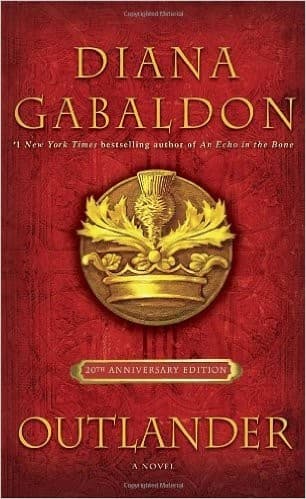
Outlander
Diana Gabaldon·1991·Delacorte Press·romance
Reading level: Ages 18+ (mature) · 32-hour read · Intermediate difficulty.
- Reading time
- 32h
- Difficulty
- Intermediate
- Recommended age
- Ages 18+ (mature)
- Guide read
- 7min
- Editor's rating
- 4.2 / 5
- romance
- historical-fiction
- scotland
- time-travel
- series
- jacobite
— In one sentence —
A nine-hundred-page time-travel romance written by a quantitative ecologist who decided, at thirty-five, to try writing a novel.
§ 01 · WHY READ
Why read
Outlander is the first novel Diana Gabaldon wrote, and she wrote it as a private exercise. She was a research professor with a PhD in quantitative ecology — she has been clear about this in interviews — and she wanted to know whether she could write a book. She picked the eighteenth-century Scottish Highlands because she had seen Doctor Who and the Scotsman in the kilt seemed interesting. The book sold, and the private exercise became a nine-book series — ten, counting Bees — that has run for over three decades and produced a successful Starz adaptation in 2014.
Claire Randall, an English former combat nurse on her second honeymoon in 1945 Scotland, walks through a circle of standing stones at Craigh na Dun and finds herself in 1743, in the middle of a clan-MacKenzie raid against an English officer who happens to be the ancestor of her twentieth-century husband. To survive the politics — Highland clans, Jacobite intrigue, English military presence — she ends up married to Jamie Fraser, a young Highland outlaw. The marriage is the book.
Read it because the research is real, because the romance is taken seriously at adult scale, and because Gabaldon writes both the historical setting and the central relationship with a specificity that has kept readers reading nine books over thirty-four years. Read it knowing it is long, that the violence — sexual and otherwise — is graphic, and that the genre conventions of 1991 romance are visible in places where contemporary readers will notice them.
§ 02 · EMOTIONAL ARC
Emotional arc
The book is the slow conversion of a marriage of necessity into a marriage of choice, narrated by a woman who never stops being from another century.
Claire Randall (Beauchamp Fraser) — twenty-seven, English, recently demobilized from a combat-nursing career in the European theater. Claire's medical knowledge is the book's clearest device for keeping her useful in 1743, but her wartime experience does more important work: she is a woman who has already seen suffering at scale, which is the reason she survives a century that does not believe she should. Gabaldon writes her in first person, and the voice is the book's primary asset — dry, observant, profane when warranted, never sentimental.
Jamie Fraser — twenty-three, Highland Scot, outlawed by the English for a crime he didn't quite commit. Jamie is the book's romance hero, and Gabaldon writes him as more than the type: literate (Latin and Greek), competent (multilingual, a swordsman, a strategist), and — unusually for a romance written in 1991 — verbally explicit about consent, his own emotional life, and the inequalities of their marriage. He is also the survivor of significant trauma, and the book takes that seriously in ways readers who came up on the 2014 series sometimes don't expect.
The Highland setting — Castle Leoch, the MacKenzies, the Frasers, Colum and Dougal, the gathering, the rent-collecting tour — is rendered with the density of research that became Gabaldon's signature. The book is genuinely a historical novel about Jacobite Scotland that happens also to be a romance.
§ 03 · HIGHLIGHTS
Three highlights
No. 1 · The wedding. The set-piece scene in which Claire is married to Jamie to keep her out of English custody. Gabaldon takes her time: the dress, the ceremony, the dinner, the bedding. The scene is a long, careful negotiation between two strangers who are about to be obligated to each other for the rest of their lives, and it is one of the best examples in commercial romance of what extended craft attention to a single scene can produce. Many readers cite the wedding as the chapter that made them commit to the series.
No. 2 · The trial at Cranesmuir. A late-middle sequence — without specifics — in which the politics of the eighteenth century turn on Claire with full force, and the book becomes briefly and terrifyingly something other than a romance. Gabaldon writes the public mechanics of accusation, gathering, and verdict with the specificity of someone who has done the reading. The scene is also the book's clearest demonstration that the historical setting is not decoration.
No. 3 · The abbey. The final movement of the book takes both characters to a place they did not expect to go, physically and morally. Without specifics: this section contains the most graphic material in the novel, and Gabaldon does not look away from any of it, including the long aftermath. Some readers have argued that the sequence is gratuitous; others have argued that it is one of the few romance novels of its era to take its hero's trauma seriously and refuse to handwave the recovery. Both responses are honest.
§ 04 · EDITIONS
Recommended editions
| Edition | Why pick it |
|---|---|
| Delacorte / Dell mass-market (1991) | The original US edition. The first British edition, retitled Cross Stitch (1991), is the same text. |
| Delacorte 20th-anniversary edition (2011) | Includes a Gabaldon-written introduction explaining the writing process and the research. Useful context, especially on the scientist-to-novelist pivot. |
| Audiobook (Davina Porter, 1998) | Davina Porter has narrated the entire series and is, by wide consensus, one of the best audiobook performers of long-form historical fiction. The Scots accents and the regional registers are handled with care. The audiobook is over thirty-three hours; for many readers it is the better format. |
The Starz series (2014–) is faithful in spirit and significantly different in particulars. Read at least the first book first; the show begins to diverge in its second season.
The series proceeds as: Outlander (1991), Dragonfly in Amber (1992), Voyager (1993), Drums of Autumn (1996), The Fiery Cross (2001), A Breath of Snow and Ashes (2005), An Echo in the Bone (2009), Written in My Own Heart's Blood (2014), Go Tell the Bees That I Am Gone (2021). Most readers either commit to the first three or to all of them.
§ 05 · FIT
Who it's for / not for
Read this if you are…
- A reader of historical fiction who is curious about Jacobite Scotland and wants research-dense fiction.
- A romance reader looking for a relationship written at length, in detail, by an author who takes both characters as fully realized adults.
- Someone with appetite for very long books and series — Outlander is the entry point to thousands of pages of related fiction.
- A reader willing to engage with graphic sexual and physical violence as part of the book's project, not as marketing.
Skip it if you are…
- Looking for short. This book is roughly nine hundred pages, depending on edition. The series compounds.
- Avoiding fiction with explicit depictions of rape and torture. Both are present, in detail, and the book does not soften them. Survivors of sexual violence should read informed warnings before deciding.
- Hoping for a fast-paced plot. Gabaldon is a slow, accumulative writer; long sections are dedicated to a single dinner, a single horseback ride, a single argument.
- A reader who needs unambiguously contemporary politics from the page. The novel was written in 1991, the central marriage begins under coercion (acknowledged by the text, and worked on by it), and readers' tolerance for those starting conditions varies legitimately.
§ 06 · TIPS
Reading tips
- Treat the first hundred pages as foundation. The 1945 framing and the early adjustment to 1743 are slower than what follows. Stay.
- Look up nothing about the plot. The book contains real surprises — historical, narrative, and structural — and the series has been spoiled in a thousand listicles. Read blind.
- Consider the audiobook. Davina Porter's performance is the consensus choice and arguably improves the book.
- Pace yourself. The book is most readers' longest read of the year. Treat it as a season, not a week.
- Decide about the series after book three. The first three books form a natural unit; Voyager (1993) is where most committed series readers say they were committed. If you bounce off, bouncing is fine.
§ 07 · COMPARE
Read alongside
- Charlotte Brontë — Jane Eyre (1847). The English-language novel of the working woman, the dangerous house, and the marriage that has to be made on terms the heroine helps to set.
- Emily Brontë — Wuthering Heights (1847). The other great English novel of love that is also violence, set in a landscape that is also a character.
- Leo Tolstoy — Anna Karenina (1877). A book at comparable scale and serious about a marriage; useful for readers who want to see what literary fiction does with the same material.
- Jane Austen — Persuasion (1817). A counterweight: the short, precise English novel of romance, against Gabaldon's long, dense Highland one.
- Jojo Moyes — Me Before You (2012). A more recent contemporary romance that, like Outlander, takes the relationship as its central subject and is unafraid of moral difficulty.
§ 08 · DISCUSSION
Discussion questions
- Gabaldon has said she chose the eighteenth-century Scottish setting almost by accident. After reading the book, does the setting feel essential to the romance, or could the same relationship work in a different historical period?
- Claire is a 1945 woman in a 1743 marriage. How does Gabaldon use that anachronism — what does Claire's twentieth-century perspective let the book do that an eighteenth-century narrator could not?
- The wedding chapter is unusually long for a romance. Why does Gabaldon devote that much page space to a single set-piece? What is she building?
- The book includes graphic sexual and physical violence, including against the hero. Some readers consider the late-novel material gratuitous; others consider it one of the rare cases in commercial romance where male trauma is taken seriously. Which reading does the text support, and where?
- Jamie is, by the conventions of 1991 romance, an unusually well-realized character — literate, multilingual, verbally explicit about consent and feeling. How much of that is on the page, and how much of it is the work the series did later? Reread an early scene to test.
- The political backdrop — Jacobite intrigue, English-Scottish relations, the run-up to Culloden — runs underneath the romance and surfaces fully only at moments. Is the politics decoration or spine?
- The book was written by a quantitative ecologist with no fiction-writing training. What does the scientific background show — what is unusually well-researched, and what is unusually well-structured for a debut novel?
- The series now spans nine books and three decades. What is it about the central relationship that has sustained that scale? What is it that the first book sets up that the later books spend thousands of pages working out?
One line to remember
“I am your master, and you're mine. Seems I canna possess your soul without losing my own.”— Jamie Fraser — Chapter 23
You might also like
Read next
Diana Gabaldon · 2005
A Breath of Snow and Ashes
The sixth Outlander novel, where revolution moves from distant warning to danger at Fraser's Ridge.
Read · 7 min
Diana Gabaldon · 1992
Dragonfly in Amber
The second Outlander novel, where romance becomes political strategy before Culloden.
Read · 7 min
Diana Gabaldon · 1996
Drums of Autumn
The fourth Outlander novel, where Claire and Jamie try to build a life in colonial America while Brianna faces the past from the future.
Read · 7 min