Editor-reviewed
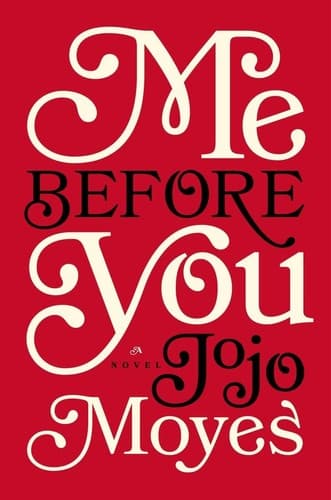
Me Before You
Jojo Moyes·2012·Pamela Dorman Books·romance
Reading level: Ages 16+ (adult) · 9-hour read · Beginner difficulty.
- Reading time
- 9h
- Difficulty
- Beginner
- Recommended age
- Ages 16+
- Guide read
- 6min
- Editor's rating
- 4.1 / 5
- romance
- british
- class
- disability
- assisted-dying
- jojo-moyes
— In one sentence —
A romance about class, caretaking, and an ending that the disability community has been correctly arguing with for over a decade.
§ 01 · WHY READ
Why read
Jojo Moyes had been a working novelist for over a decade when Me Before You became a phenomenon. The book sold across markets that contemporary romance does not usually reach, was translated into more than forty languages, and was filmed in 2016 with Emilia Clarke and Sam Claflin. It also became, almost immediately, the center of a serious public argument with disability advocates who objected — and continue to object — to the book's central plot decision. Both facts have to be carried into any honest reading of it.
Louisa Clark, twenty-six, has lost her job at the café in her small English town and takes a position as caretaker for Will Traynor, the son of the local big family, who two years earlier was hit by a motorcycle and has been quadriplegic since. Will is angry, sharp, and has made it clear to his family that he intends to end his life through an assisted-dying program in Switzerland. Lou is told she has six months to change his mind.
Read it because Moyes writes class with unusual specificity for a contemporary romance — the small-town English provincial setting, the economic precariousness, the way Lou's family lives and worries — and because the book asks a question that the genre has very rarely asked, and that the disability community has spent the years since the book's publication answering back to.
§ 02 · EMOTIONAL ARC
Emotional arc
The book moves Louisa from caretaker-as-employment to caretaker-as-something-else, and traces what that change costs both characters. The work the book does on Lou is the work the book does best.
Louisa Clark — narrator (mostly), twenty-six, the older of two daughters in a household where her sister is the one expected to do well. Lou is the book's central craft achievement: a woman whose self-conception has been narrow for so long that her capacity to feel her way past it is genuine news. Moyes writes her clothes, her job history, her relationship with her marathon-running boyfriend, and her family dynamic with the kind of specificity that builds a class portrait, not just a character.
Will Traynor — quadriplegic, formerly a high-flying London corporate type. The book gives Will most of what is sharpest in its dialogue: he is funny, demanding, contemptuous of the diminishments his life has been reduced to. He is also, the book wants us to feel, fully himself — and that fullness is what makes the plot's central question land. The disability community's argument with the book is that Moyes presents Will's decision as the rational response of a sharp man to a diminished life, rather than as one possible response shaped by inadequate support, ableist social expectation, and the particular weight of his class background. The argument is fair and the book does not really answer it.
The supporting cast — Lou's parents, her sister, Will's parents, the household nurse Nathan — is unusually well-drawn for a commercial romance. Moyes can write a family dinner. The class material is not decoration.
§ 03 · HIGHLIGHTS
Three highlights
No. 1 · The first weeks. The early chapters — Lou learning the job, Will making her quit-or-stay, the slow accumulation of routines — are some of the book's best writing. Moyes resists rushing them. The relationship that develops later is plausible because the work that precedes it is rendered.
No. 2 · The bee sting and the wheelchair. Two early scenes — without specifics — in which the book teaches the reader what daily life with quadriplegia actually involves at the granular level: the things that go wrong, the dependence, the public-space failures. Moyes does this without sentimentality and without flinching. It is the part of the book that disability writers who are otherwise critical of the novel have sometimes praised.
No. 3 · The Switzerland chapter. The book's final movement is its hardest. Moyes does not look away from any of what happens; she does not provide a last-minute genre-conventional rescue. The choices the characters make are the choices the book has spent four hundred pages preparing. Whether you finish the book agreeing with those choices is the question the disability community continues, justifiably, to press.
§ 04 · EDITIONS
Recommended editions
| Edition | Why pick it |
|---|---|
| Pamela Dorman / Viking US (2012) | The standard US hardcover. |
| Penguin UK (2012) | The original UK edition; same text. |
| Audiobook (Susan Lyons, Anna Bentinck, Steven Crossley, full cast, 2012) | The full-cast production handles the multi-perspective chapters better than a single narrator could; recommended. |
There are two sequels: After You (2015) follows Lou in the aftermath; Still Me (2018) takes her to New York. Both are competent commercial fiction; neither has the emotional pressure of the first book.
The 2016 film is faithful and well-acted; the disability community's objections to the book intensified at the moment of the film's release, and the film made some of the original's politics more visible. Read the book and the responses together.
§ 05 · FIT
Who it's for / not for
Read this if you are…
- A reader of contemporary romance who wants something that takes class seriously.
- Interested in fiction about caretaking — the labor, the intimacy, the asymmetry.
- Willing to read a book that is at its center about assisted dying, with all the moral weight that implies.
- Someone who wants to engage the disability community's response to the book as part of reading it.
Skip it if you are…
- Looking for a contemporary romance with a conventional happy ending. This is not that book.
- Currently grieving someone who chose, or considered choosing, an assisted death. The book is unsparing.
- Disinclined to read a novel whose central premise treats quadriplegia as a life-or-death question rather than a life. The disability community's objection is not a fringe view, and reading the book without engaging it is a partial reading.
§ 06 · TIPS
Reading tips
- Read the early chapters slowly. The book earns its later weight through the unhurried establishment of the relationship.
- Read the disability-community responses afterward. The pieces by writers like Penny Pepper, Emily Ladau, and others are not optional context — they are the conversation the book started and refused to finish.
- The class material is the spine. Pay attention to Lou's clothes, her family's money worries, her sister's resentment. The romance plot makes more sense when you read it as a class story too.
- Have the second book ready if you want it. Some readers need After You immediately. Most don't.
§ 07 · COMPARE
Read alongside
- Charlotte Brontë — Jane Eyre (1847). The other great English novel about a working-woman caretaker and a damaged man of higher class — and a book that, like Me Before You, makes the class asymmetry part of the romance.
- Jane Austen — Persuasion (1817). A reminder of how seriously English romance has always taken money, class, and the small economies of provincial life.
- Colleen Hoover — It Ends with Us (2016). Another contemporary romance whose central premise is morally fraught and which became a phenomenon partly for that reason.
- Emily Henry — People We Meet on Vacation (2021). A counterweight: the warm contemporary romance that does not ask its readers to sit with a moral problem.
- Kazuo Ishiguro — Never Let Me Go (2005). A different mode entirely, but adjacent: a novel about caretaking, about lives being valued differently, about characters making peace with circumstances the reader cannot.
§ 08 · DISCUSSION
Discussion questions
- The book has been seriously criticized by disability advocates for the ending it chooses. After reading the book, do you find the criticism fair? What specifically in the text supports each side?
- Lou's class background is rendered with much more specificity than is typical for contemporary romance. How does the class portrait affect the way you read the romance? Would the book work if Lou and Will were socially closer?
- Will is given some of the book's sharpest dialogue and most of its dignity. Does the book give him the same depth it gives Lou? Where does it succeed and where does it fall back on type?
- Moyes shifts perspective occasionally — into Lou's mother, into Will's father, into Nathan. Why those characters and not others? What does the shift accomplish?
- The opening scene is a London flashback to Will's accident. Reread it after finishing the book. What does the framing do that a chronological opening would not?
- The disability community's argument is, in part, that the book treats Will's decision as inevitable rather than as one response among many that better support could have changed. Where in the text could the book have made room for that other reading? Why do you think Moyes did not?
- Lou's marathon-running boyfriend Patrick is presented as plainly the wrong man. Is the dismissal fair, or is he a structural convenience?
- The book is widely read and widely loved, and also widely argued with. Is it possible for both responses to be correct? What does that say about the book — and about the genre?
One line to remember
“You only get one life. It's actually your duty to live it as fully as possible.”— Will Traynor — Chapter 17
You might also like
Read next
Jojo Moyes · 2010
The Last Letter from Your Lover
The dual-timeline Jojo Moyes romance behind Netflix's film about letters, memory, and unfinished love.
Read · 6 min
Kennedy Ryan · 2022
Before I Let Go
Kennedy Ryan's second-chance romance behind Peacock's ordered series.
Read · 6 min
Rachel Reid · 2019
Heated Rivalry
Rachel Reid's hockey romance behind the Crave and HBO Max series.
Read · 6 min