Editor-reviewed
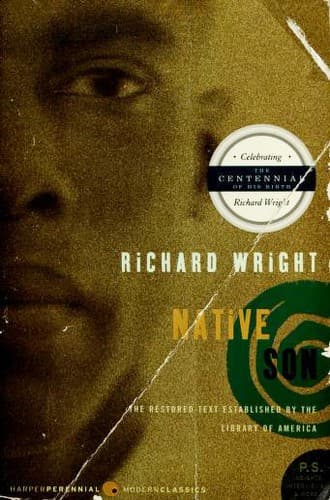
Native Son
Richard Wright·1940·Harper Perennial Modern Classics·Literature
Reading level: Ages 16+ (adult) · 11-hour read · Advanced difficulty.
- Reading time
- 11h
- Difficulty
- Advanced
- Recommended age
- Ages 16+
- Guide read
- 6min
- Editor's rating
- 4.3 / 5
- richard-wright
- hbo-adaptation
- chicago
- american-literature
- race
— In one sentence —
Richard Wright's Chicago novel behind HBO's film adaptation.
§ 01 · WHY READ
Why read
Native Son is Richard Wright's 1940 novel about Bigger Thomas, a young Black man in 1930s Chicago whose life closes around him after one panicked act. HBO's film materials identify the adaptation as based on Wright's novel, and current English edition records list the Harper Perennial Modern Classics paperback with ISBN 9780060837563.
The book is hard to read because it does not give the reader an easy moral distance. Wright writes Bigger through fear, anger, shame, violence, surveillance, and the pressure of a city built to keep him cornered. The novel is also an argument about what racism and poverty can make visible too late.
Read it if HBO's film sent you back to the source, or if you want an American novel that treats crime as social pressure rather than only individual mystery. Do not read it as a simple courtroom thriller. The book is more severe than that.
§ 02 · CHARACTERS
Characters
Bigger Thomas is the central figure. Wright keeps him frightening, vulnerable, defensive, and trapped without asking the reader to excuse him.
Mary Dalton is the white woman whose death turns Bigger's private fear into public pursuit.
Bessie Mears is Bigger's girlfriend, drawn into his panic and punished by the same world that gives her few protections.
Boris Max is the lawyer who tries to make the court see Bigger as a product of social conditions as well as a defendant.
§ 03 · HIGHLIGHTS
Three highlights
No. 1 - Direct HBO source route. The film gives current viewers a clear path back to Wright's novel without making the guide a movie recap.
No. 2 - Serious literary fit. The book belongs on the site's American literature shelf as well as its screen-adaptation shelf.
No. 3 - Discussion pressure. Native Son gives book clubs difficult questions about fear, responsibility, race, and how fiction should portray violence.
§ 04 · EDITIONS
Recommended editions
| Edition | Why pick it |
|---|---|
| Harper Perennial Modern Classics edition | Current English route with ISBN 9780060837563. |
| Library of America restored text | Useful if you want Wright's text in a broader early-work frame. |
| Ebook | Practical for notes on trial language and recurring images. |
| Audiobook | Best for readers who can stay closely attentive to tone. |
§ 05 · FIT
Who it's for / not for
Read this if you are...
- Coming from HBO's Native Son and want the original novel.
- Interested in American fiction about race, fear, and urban poverty.
- Looking for a difficult classroom or book-club discussion.
- Ready for a novel that refuses comfort.
Skip it if you are...
- Avoiding murder, sexual threat, racism, police pursuit, or execution.
- Looking for a balanced procedural.
- Wanting a sympathetic hero in the usual sense.
- Reading only for adaptation plot comparison.
§ 06 · TIPS
Reading tips
- Stay with the discomfort. Wright does not make Bigger easier so the argument can feel cleaner.
- Watch the city. Rooms, streets, jobs, and newspapers all tighten the trap.
- Separate explanation from excuse. The novel explains conditions without pretending violence has no victims.
- Read the trial as an argument. The courtroom section states ideas that the earlier scenes have already forced into the body.
§ 07 · COMPARE
Read alongside
- Octavia E. Butler - Kindred. For another screen-linked novel about race, terror, and American history.
- Toni Morrison - Beloved. For a different confrontation with violence, memory, and inherited harm.
- James Baldwin - Go Tell It on the Mountain. External follow-up for another mid-century Black literary voice.
- Truman Capote - In Cold Blood. External read-alike for readers thinking about crime, narrative, and responsibility.
- Harper Lee - To Kill a Mockingbird. For a classroom contrast in law, race, and moral framing.
§ 08 · DISCUSSION
Discussion questions
- How does Wright make fear part of the plot?
- Where does the book ask for understanding without asking for forgiveness?
- How do newspapers and public language change Bigger's story?
- What does the novel gain by staying so close to Bigger's mind?
- Does the courtroom section deepen the book or narrow it?
- What should HBO's adaptation preserve from the novel's pressure?
- How does Chicago function as more than setting?
- Why does the book remain difficult to teach and discuss?
One line to remember
“Bigger Thomas is trapped by fear, poverty, racism, and choices that turn panic into catastrophe.”— bibliotecas editorial summary, not a textual quotation
You might also like
Read next
William Faulkner · 1936
Absalom, Absalom!
Four narrators reconstruct a man who destroyed his family. The story keeps changing. That is the point.
Read · 7 min
Toni Morrison · 1987
Beloved
Toni Morrison said she wrote this novel to give voice to the sixty million. It won the Pulitzer, the Nobel, and is the greatest American novel of the second half of the twentieth century.
Read · 6 min
Leo Tolstoy · 1878
Anna Karenina
Not just a love story. Two parallel lives — Anna's destruction, Levin's salvation — ask the same question: how should a person live?
Read · 6 min