Editor-reviewed
Middlemarch
George Eliot·1871·William Blackwood and Sons (serial)·Literature
Reading level: Ages 14+ (adult) · 30-hour read · Advanced difficulty.
- Reading time
- 30h
- Difficulty
- Advanced
- Recommended age
- Ages 14+
- Guide read
- 6min
- Editor's rating
- 4.9 / 5
- george-eliot
- victorian
- british-literature
- realism
- epic
- provincial-life
- women
- marriage
— In one sentence —
Virginia Woolf called it the only English novel written for grown-up people. It is 900 pages about a provincial Midlands town. It contains everything.
§ 01 · WHY READ
Why read
George Eliot — Mary Ann Evans — published Middlemarch serially between 1871 and 1872. She was fifty-one years old and at the height of her intellectual life, the most respected novelist in England, living openly with the philosopher George Henry Lewes in an arrangement that polite society found scandalous but couldn't ignore. She had already published The Mill on the Floss, Silas Marner, and Romola; Middlemarch was the novel in which all her powers arrived simultaneously.
Virginia Woolf wrote in 1919 that Middlemarch was "one of the few English novels written for grown-up people." The remark is precise: the novel does not offer the consolations of simplified feeling or guaranteed justice. It offers instead a picture of how people actually live — their mixed motives, their self-deceptions, their small acts of courage and accommodation, their ordinary suffering — rendered with a sympathy so complete and so unsentimental that reading it feels like being understood.
The setting is the fictional Midlands town of Middlemarch between 1829 and 1832 — a period of social reform, cholera epidemics, and the first stirrings of the industrial age. The novel follows four interweaving narratives: Dorothea Brooke, an idealistic young woman who marries the wrong man; Tertius Lydgate, a reforming doctor who marries the wrong woman; Fred Vincy, who needs to become a grown-up; and Nicholas Bulstrode, a banker whose past catches up with him. Around them, the town of Middlemarch: its gossip, its institutions, its resistance to change, its occasional grace.
What the novel does technically: Eliot's narrator is omniscient and morally engaged — she comments, she generalizes, she moves from one consciousness to another with complete authority. She can render Dorothea's inner life and Casaubon's simultaneously and make both legible without making either a caricature. This requires a kind of moral intelligence that is not common and that Eliot possessed to a degree unmatched in the English novel.
§ 02 · CHARACTERS
Characters
Dorothea Brooke — the novel's moral center. She is idealistic, ardent, practically ignorant of how the world actually works, and married at the novel's opening to Edward Casaubon, a dry scholar three times her age who she believes is doing great intellectual work. He is not. Dorothea's trajectory — from idealism through disillusionment, grief, and eventually a quieter, more grounded form of goodness — is the novel's central story. Eliot's rendering of her is both deeply sympathetic and entirely honest about her faults: she is sometimes arrogant in her idealism, sometimes blind to things she doesn't want to see.
Edward Casaubon — Dorothea's husband. He is pedantic, cold, insecure, and vain. He is also pitiful in the full sense: a man who has spent his life on intellectual work that he suspects has no value, who has married a young woman he cannot understand, who is dying. Eliot is entirely fair to him. The chapter rendered from inside Casaubon's consciousness — not from outside it — is one of the most extraordinary acts of literary sympathy in the English novel.
Tertius Lydgate — a young doctor with genuine reforming ambitions who marries Rosamond Vincy, a beautiful woman whose practical intelligence is entirely devoted to social advancement. Lydgate's marriage destroys his career not through any dramatic event but through the slow, daily pressure of financial need and incompatible desires. Eliot's portrait of how a marriage can ruin a person without either party being a villain is the novel's most devastating.
Rosamond Vincy — Lydgate's wife. She is one of literature's most precisely observed antagonists: not a villain, not stupid, not even particularly selfish by her own understanding — but a woman whose entire development has been shaped toward one goal (social position) by a society that offered women no other goal, and who pursues that goal with complete consistency. Eliot is clear-eyed about what Rosamond does to Lydgate and merciless about why.
Will Ladislaw — Dorothea's eventual love interest. He is the novel's only real weakness: Eliot seems to find him more attractive than the reader does. His function is to be everything Casaubon isn't; his characterization is thinner.
Caleb Garth — the land agent, a man of complete integrity who loves honest work. He and his family are the novel's most reliable moral fixed point: not idealistic, not intellectual, just entirely trustworthy in their commitments.
Fred Vincy — Rosamond's brother, who needs to grow up and eventually does. His story is the lightest in the novel, and Eliot handles his comedy with more warmth than she sometimes allows herself.
§ 03 · HIGHLIGHTS
Three highlights
No. 1 · Casaubon from the inside. The novel spends several chapters establishing how Dorothea has misread Casaubon — how his pedantry has been dressed in language she interpreted as depth. Then Eliot gives us a chapter from inside Casaubon's consciousness. We find a man terrified that his life's work is worthless, who has never been loved and doesn't know how to accept it from Dorothea, who sees his young wife's idealism as a reproach. Eliot does not soften him; he remains difficult and ultimately unkind. But the shift in perspective is the novel's finest formal move: it requires the reader to hold a full, complex consciousness where they had been expecting a caricature.
No. 2 · "The roar on the other side of silence." Chapter 20: "If we had a keen vision and feeling of all ordinary human life, it would be like hearing the grass grow and the squirrel's heart beat, and we should die of that roar which lies on the other side of silence. As it is, the quickest of us walk about well wadded with stupidity." This is Eliot's statement of the novel's project: to give the reader, temporarily, exactly the kind of attention to ordinary life that we are usually protected from by the thickness of our inattention. The sentence is also the best description of what reading Middlemarch actually feels like.
No. 3 · The ending. The novel's final paragraph is one of the most discussed passages in English fiction: "The growing good of the world is partly dependent on unhistoric acts; and that things are not so ill with you and me as they might have been, is half owing to the number who lived faithfully a hidden life, and rest in unvisited tombs." Dorothea does not get the great reforming life she imagined; she gets a quieter life whose influence is felt rather than recorded. Eliot is not consoling her with this ending — she is making a genuine argument about how the world actually changes, and at what cost to the people who change it.
§ 04 · EDITIONS
Recommended editions
| Edition | Why pick it |
|---|---|
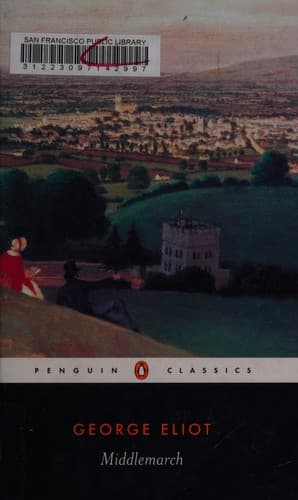
| Penguin Classics (Rosemary Ashton intro) | The standard reading edition; Ashton's introduction is excellent. Read it after the novel. |
| Oxford World's Classics (David Carroll ed.) | Scholarly edition with the most comprehensive notes; useful for readers who want historical context. |
| Norton Critical Edition | Includes the text, selections from Eliot's essays, and critical commentary. The most complete edition. |
| Audiobook (Juliet Stevenson) | Stevenson's reading is one of the great audiobook performances; 36 hours. The audio format is particularly well suited to the narrator's voice. |
§ 05 · FIT
Who it's for / not for
Read this if you are…
- A reader who has never read a Victorian novel and wants to read the best one. Start here rather than with Dickens if you want to see what the form can do at its most ambitious.
- Anyone interested in the interior lives of characters who are not heroic but who are trying — how Eliot renders the daily experience of aspiration, compromise, and ordinary disappointment.
- Readers interested in marriage as a literary subject: three marriages in the novel illuminate each other, and none of them is simple.
- Anyone who has been told the novel is too long and daunting. It is long; it is not daunting. The prose is demanding in its density but not in its difficulty.
Skip it if you are…
- Looking for plot momentum. Middlemarch accumulates rather than propels; the pleasures are of attention rather than suspense.
- Not prepared for 30 hours of reading. A novel this long requires commitment; reading it in fragments over months will lose the accumulative effect Eliot builds.
§ 06 · TIPS
Reading tips
- Read it in large chunks. The novel works by accumulation; the cross-cutting between narratives creates meaning only if you hold multiple threads simultaneously. An hour a day is better than ten minutes.
- Pay attention to the narrator's voice. Eliot's narrator is not neutral; she generalizes, judges, sympathizes, and occasionally argues with the reader. The narrator's relationship to the characters is part of the novel.
- The Casaubon chapter from inside is the formal peak. When you reach it, read it twice. It will change how you've been reading and how you'll read everything after.
- Will Ladislaw is the novel's weak link. When you feel Dorothea's attachment to him is incomprehensible, you're not missing something — Eliot's Ladislaw is genuinely underwritten. Trust your perception.
- The final paragraph is worth reading before you begin. Not as a spoiler — nothing is spoiled — but as a lens: "unhistoric acts" and "hidden lives" are the novel's subject. Reading it at the start and at the end changes both experiences.
§ 07 · COMPARE
Read alongside
- George Eliot — The Mill on the Floss (1860). Eliot's earlier novel; more personal and more tragic. The comparison shows how her thinking about women's ambition and society's limits developed.
- Virginia Woolf — Mrs Dalloway (1925). Woolf's response to the Victorian novel: a single day in a single consciousness, compressed. The contrast with Eliot's expansiveness is the contrast between two approaches to rendering interiority.
- Jane Austen — Emma (1815). The comparison clarifies what Eliot added to the English novel: Austen's narrator maintains ironic distance; Eliot's narrator moves inside her characters and generalizes outward. Both are the finest versions of their own approach.
- Henry James — The Portrait of a Lady (1881). James was reading Eliot carefully; his Isabel Archer is in dialogue with Dorothea Brooke. The comparison shows how the novel of consciousness developed between them.
- Hilary Mantel — Wolf Hall (2009). The contemporary novel most often compared to Eliot in its density, its moral intelligence, and its willingness to inhabit complex consciousnesses. A useful pairing for readers who want to see what the tradition looks like now.
§ 08 · DISCUSSION
Discussion questions
- Eliot gives us an extended chapter from inside Casaubon's consciousness at a point when the reader has been led to see him as an obstacle to Dorothea's happiness. How does this change your reading of him? Does it make you sympathize? Does sympathy require liking?
- Rosamond Vincy is one of literature's most precisely observed antagonists. Is she a villain? How does Eliot make her comprehensible without making her sympathetic?
- The narrator says "the quickest of us walk about well wadded with stupidity" — that we are protected from full attention to ordinary life because full attention would be unbearable. Is this what Middlemarch is doing — giving us temporary access to that attention? What does that feel like?
- Lydgate's career is destroyed by his marriage, not through any dramatic event but through slow, daily incompatibility. Is either party to blame? Does the novel distribute blame, or does it refuse to?
- Dorothea's final life is quieter and less reforming than she imagined. Eliot calls this "unhistoric." Is the ending consoling, tragic, or genuinely ambiguous?
- The novel is set during the Reform Act era, when English political life was changing. How does the historical setting interact with the private lives of the characters? Is Eliot making an argument about the relationship between political change and personal life?
- Eliot uses an omniscient narrator who explicitly moralizes and generalizes from individual experience to universal condition. Does this technique work for you? Does the narrator's presence feel authoritative or intrusive?
- "The growing good of the world is partly dependent on unhistoric acts." Do you believe this? Does Middlemarch convince you of it?
One line to remember
“If we had a keen vision and feeling of all ordinary human life, it would be like hearing the grass grow and the squirrel's heart beat, and we should die of that roar which lies on the other side of silence.”— Chapter 20
Appears in collections
Reading lists featuring this book
7 books
The Best Book Gifts for Mother's Day
Seven novels that take mothers seriously as people, not just as mothers.
Open list →
6 books
Best Books for Ambitious Women
Six novels that take women's serious ambition seriously, without flattering it or apologizing for it.
Open list →
7 books
Feminist Literature Worth Reading
Seven books across 150 years — each making a different argument through a different form.
Open list →
10 books
Books That Earn Every Hour: Ten Essential Long Reads
Not long because they couldn't be shorter. Long because the size is the point.
Open list →
7 books
Overlooked Masterpieces
Seven novels that belong in the first tier but rarely get there — and why.
Open list →
You might also like
Read next
George Eliot · 1861
Silas Marner
Eliot wrote a fable about how community is made — and what it costs when it breaks.
Read · 5 min
William Faulkner · 1936
Absalom, Absalom!
Four narrators reconstruct a man who destroyed his family. The story keeps changing. That is the point.
Read · 7 min
Toni Morrison · 1987
Beloved
Toni Morrison said she wrote this novel to give voice to the sixty million. It won the Pulitzer, the Nobel, and is the greatest American novel of the second half of the twentieth century.
Read · 6 min