Editor-reviewed
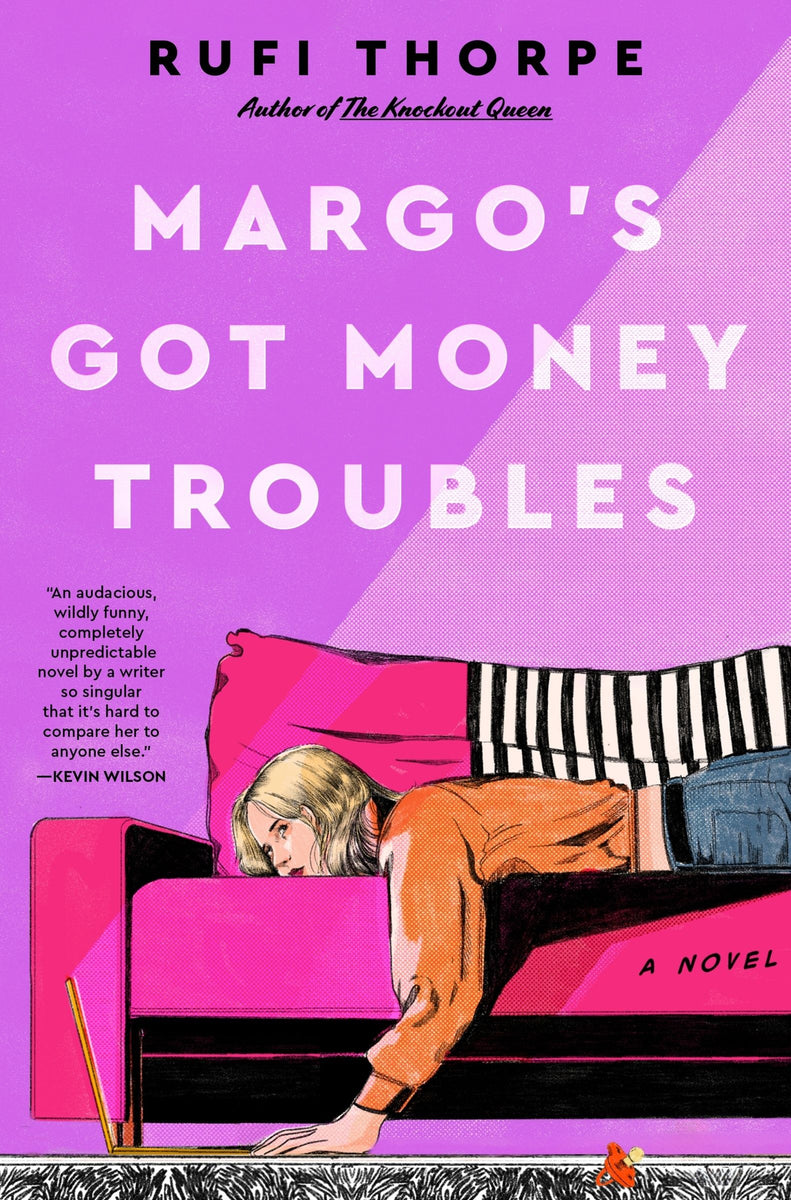
Margo's Got Money Troubles
Rufi Thorpe·2024·William Morrow·literary-fiction
Reading level: Ages 17+ (adult) · 7-hour read · Intermediate difficulty.
- Reading time
- 7h
- Difficulty
- Intermediate
- Recommended age
- Ages 17+
- Guide read
- 6min
- Editor's rating
- 4.1 / 5
- contemporary-fiction
- single-motherhood
- money
- sex-work
- comic-fiction
- apple-tv-adaptation
— In one sentence —
A broke young mother turns survival into performance, and Rufi Thorpe makes the premise funny, uncomfortable, and sharper than its hook.
§ 01 · WHY READ
Why read
Margo's Got Money Troubles sounds, in summary, like a provocation: a young woman becomes a single mother, loses the respectable path she thought she was on, and starts using online sex work and performance strategy to keep herself and her child afloat. The surprise is that Rufi Thorpe does not write it as a gimmick. She writes it as a money novel, a motherhood novel, a class novel, and a comic novel about what happens when a person with limited options refuses to be ashamed on command.
Margo Millet is young, broke, and newly responsible for a baby. The father is her college professor. Her mother is not the reliable safety net a softer novel would provide. Her former pro-wrestler father is not a conventional model of stability, but he understands performance, attention, and the difference between humiliation and control. The book's best idea is that Margo's online reinvention is not simply empowerment fantasy. It is labor, risk, branding, self-protection, and compromise.
The Apple TV adaptation, from A24 and David E. Kelley, made the book newly visible in 2026. Apple describes the series as based on Thorpe's bestselling novel, and JustWatch showed current US chart activity during this run. The book is worth reading because the source version has more room for Margo's interior math: what each choice costs, what each choice buys, and who gets to call the result dignity.
§ 02 · CHARACTERS
Characters
Margo Millet is the center and the test. She is not written to be a tidy inspirational heroine. She is funny, scared, improvisational, vain sometimes, practical often, and more intelligent than the people around her are prepared to notice.
Margo's father brings the wrestling logic that gives the novel part of its shape. He understands that performance can be fake and emotionally true at the same time, which becomes central to how Margo thinks about online work.
Margo's mother and surrounding adults show the limits of polite support. The book is sharp about how quickly people who say they care can disappear when care requires money, childcare, or reputational discomfort.
The baby is not a prop for sentiment. The child changes the stakes of every decision, which is why the book's comedy never floats free of consequence.
§ 03 · HIGHLIGHTS
Three highlights
No. 1 · It treats money as plot, not background. Many novels say a character is broke and then let the story continue as if rent, childcare, transport, and debt are atmospheric details. Thorpe keeps the pressure visible.
No. 2 · The performance theme is smarter than the premise. Wrestling, social media, sex work, motherhood, and respectability all involve roles people perform for an audience. The book keeps asking who benefits when one performance is called honest and another shameful.
No. 3 · The adaptation hook has a real reader job. Show-first readers are not just asking what happens next. They are asking whether the novel is funnier, harsher, more interior, or less glossy than Apple TV's version. That is exactly the kind of decision a book guide can answer.
§ 04 · EDITIONS
Recommended editions
| Edition | Why pick it |
|---|---|
| William Morrow hardcover (2024) | The original US edition and the clearest bibliographic source. |
| William Morrow paperback / TV tie-in | The practical edition for adaptation-first readers. |
| Ebook edition | Works well because the novel is voice-led and easy to return to in short sessions. |
| Digital audiobook | A strong option if you want Margo's comic timing and discomfort to come through as voice. |
§ 05 · FIT
Who it's for / not for
Read this if you are...
- Interested in contemporary fiction about money, motherhood, and social performance.
- Coming from the Apple TV series and wanting the more interior version of Margo.
- Looking for a book that is funny without being lightweight.
- Drawn to messy women protagonists who make arguable choices under real pressure.
Skip it if you are...
- Looking for a tidy empowerment story.
- Uncomfortable with explicit discussion of sex work, online performance, and predatory power dynamics.
- Hoping for a purely cozy single-motherhood novel.
- Easily frustrated by characters who solve problems through improvisation rather than good judgment.
§ 06 · TIPS
Reading tips
- Read it as a class novel first. The sex-work premise gets attention, but money is the deeper subject.
- Watch how Thorpe uses comedy. The jokes often arrive where a more sentimental novel would ask for pity.
- Do not flatten Margo into a role model or a cautionary tale. The book is better than either reading.
- If you watched the series first, give the novel time. The page version is less about plot surprise and more about Margo's reasoning.
§ 07 · COMPARE
Read alongside
- Sally Rooney — Normal People. For contemporary fiction about sex, class, and the stories people tell about power.
- Emily Henry — People We Meet on Vacation. A warmer mainstream comparison point for contemporary voice and emotional timing.
- Liane Moriarty — Big Little Lies. Another accessible novel that hides social critique inside page-turning scenes.
- Gillian Flynn — Gone Girl. If the performance-of-self theme is what catches you.
- Betty Smith — A Tree Grows in Brooklyn. A much older poverty-and-resilience novel, useful as a contrast in tone and era.
§ 08 · DISCUSSION
Discussion questions
- Is Margo's online work framed as empowerment, exploitation, labor, performance, or some mixture of all four?
- How does the novel change when you read it primarily as a book about money?
- What does Margo's father understand about performance that more respectable characters miss?
- Where is the book funniest, and what is the comedy protecting the reader from?
- Does the novel judge Margo? Does it ask you to judge her?
- How does motherhood change the moral stakes of Margo's choices?
- What would be lost if the story were told from outside Margo's point of view?
- After watching the Apple TV version, what does the novel give you that the screen version cannot?
One line to remember
“A young single mother tries to turn the only tools available to her into a way to survive.”— bibliotecas editorial summary, not a textual quotation
You might also like
Read next
Gabriel García Márquez · 1967
One Hundred Years of Solitude
A century of one family in one village, told in prose so densely accumulating that you finish it remembering it as a single, very long afternoon.
Read · 8 min
Chinua Achebe · 1958
Things Fall Apart
The novel that ended the era in which the African could only be the colonized subject of someone else's English-language fiction.
Read · 7 min
Juan Rulfo · 1955
Pedro Páramo
A 124-page novel from 1955 that taught Latin American literature how to let the dead speak in the same paragraph as the living.
Read · 7 min